

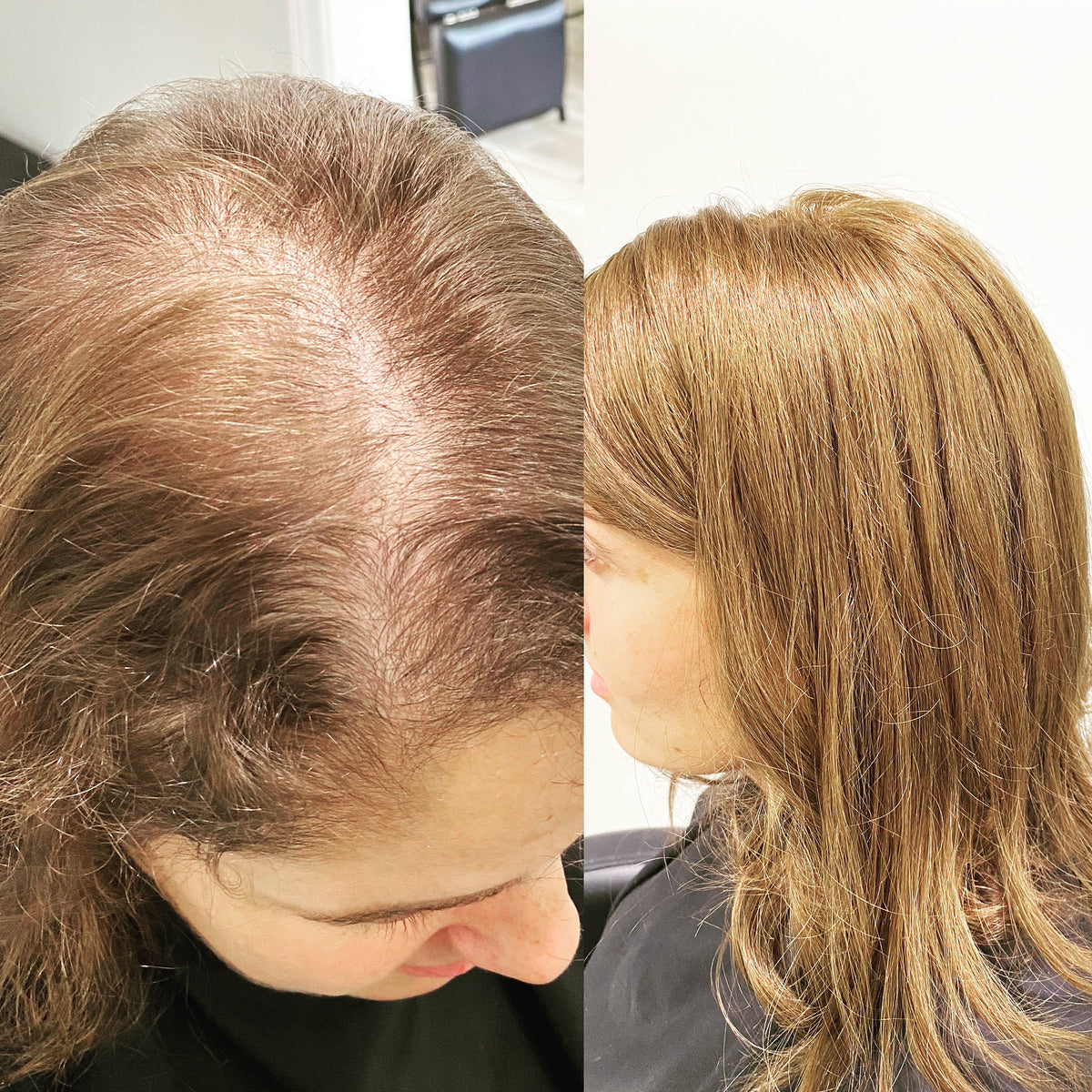


Scalp Micropigmentation vs. Hair Toppers: Which Is Right for Thinning Hair in Boston?
If you're researching options for a widening part, crown thinning, or overall volume loss, two treatments come up again and again: scalp micropigmentation (SMP) and hair toppers. They solve the same problem in very different ways — one is a semi-permanent cosmetic tattoo, the other is a removable hairpiece — and the right choice depends heavily on your hair length, your goals, and how much permanence you're comfortable with.
For a broader look at your options, start with our Hair Loss Boston collection. This guide focuses specifically on how SMP and hair toppers compare, and why we typically steer clients toward one over the other.
What Is Scalp Micropigmentation?
Scalp micropigmentation is a cosmetic tattooing technique. A technician deposits tiny dots of pigment into the scalp to mimic the look of hair follicles — either replicating a closely buzzed hairline or, for some clients, creating the illusion of density underneath existing hair. It doesn't add real hair or stimulate growth; it's a visual effect created entirely with pigment.
Who Scalp Micropigmentation Tends to Work Best For
SMP is most effective and most predictable on men with short or fully shaved hair. The technique is built around replicating stubble or a buzzed look, so when a client already wears their hair very short, the pigmented dots blend in almost seamlessly with minimal risk of looking artificial.
It's a different, more demanding job on women. Most women aren't trying to replicate a shaved head — they want the appearance of more density underneath hair they're still wearing at a normal length, or subtle camouflage along a widening center part. That requires far more precise, individualized placement to blend with existing hair rather than replace it, and the color match has to account for hair that isn't uniformly short. Done well by an experienced SMP artist, it can work for the right woman with the right goal (typically a widening part rather than broad thinning) — but it's a narrower use case than the men's-shaved-head scenario, and results vary a lot more by technician skill.
Noelle Salon does not perform scalp micropigmentation. It's a specialized cosmetic tattooing service, typically offered by dedicated SMP studios or tattoo-adjacent clinics rather than hair salons. We're covering it here because it's a real option worth understanding — but our recommendation below reflects what we actually see and hear from clients.


The Trade-Off Many Women Report: Pigment That Changes Color Over Time
SMP is marketed as long-lasting, and it is — but "long-lasting" cuts both ways once the pigment starts to shift. This is one of the most consistently reported regrets in the SMP industry itself, not just anecdotal: black pigment can develop a blue-grey tint after months or years, especially where lower-quality pigment is used or where the scalp gets regular UV exposure. Because it's a tattoo, this isn't something you can wash out or undo overnight — fixing an off-tone result usually means a touch-up session, a color correction, or in some cases laser removal.
In our experience talking with clients who've looked into SMP or tried it elsewhere, this is exactly the concern that comes up most: they got the coverage they wanted at first, but months later the tone had shifted into something that didn't look like a natural shadow anymore. It's a real risk of the treatment, not a rare complication, and it's worth weighing seriously before committing to something semi-permanent.
What Are Hair Toppers?
A hair topper is a partial hairpiece, made from synthetic fiber or human hair, designed to cover thinning at the crown or part line while blending with your existing hair. Unlike SMP, nothing is applied to the scalp permanently — it's fitted, styled, and can be removed, replaced, or adjusted as your needs change.
We've covered hair toppers in more depth elsewhere — see our Hair Topper vs. Hair Extensions guide for how toppers compare to extensions specifically, and our Hair Topper Cost Guide for a full pricing breakdown by hair type and base construction.

Scalp Micropigmentation vs. Hair Toppers: Side by Side
|
Feature |
Scalp Micropigmentation |
Hair Toppers |
|---|---|---|
|
What it is |
Semi-permanent cosmetic tattoo |
Removable hairpiece |
|
Best suited for |
Men with short or shaved hair; select women with a widening part |
Any hair length; broader range of thinning patterns |
|
Appearance over time |
Can shift tone — black pigment often develops a blue-grey cast after months or years |
Stays consistent; can be re-styled, re-colored, or replaced as needed |
|
Reversibility |
Difficult — usually requires touch-ups, color correction, or laser removal to change |
Fully reversible — simply remove or stop wearing it |
|
Typical cost (industry-wide) |
Roughly $1,500–$5,000+ for 2–3 sessions, depending on coverage area and location |
Roughly $80–$300 for synthetic, $250–$2,500+ for human hair (see our full cost guide) |
|
Maintenance |
Occasional touch-up sessions to maintain density and tone |
Regular cleaning, occasional professional blending or tightening |
Which Is Right for You?
If you wear your hair very short or shaved, SMP is a well-established option worth researching with a specialized SMP studio — it's simply not something Noelle Salon offers. If you're a woman dealing with thinning at the crown or a widening part and still wearing your hair at a normal length, a hair topper generally gives you the coverage you're looking for without the permanence risk — you can adjust, restyle, or stop wearing it any time, and there's no chance of the color shifting on you months down the line.
The safest way to figure out which route actually fits your hair and your goals is a real consultation rather than guessing from a guide like this one.
👉 Book a free hair loss consultation and we'll talk through what will actually work for your hair.
Frequently Asked Questions
Is scalp micropigmentation permanent?
It's considered semi-permanent — the pigment doesn't wash out, but it does fade and can shift in tone over time, sometimes developing a blue-grey cast. Reversing or correcting it typically requires touch-up sessions or, in some cases, laser removal.
Does scalp micropigmentation work for women?
It can, but it's technically harder than the men's-shaved-head version. Women are usually trying to create the illusion of density under hair they're still wearing at length, or camouflage a widening part, rather than replicating a fully shaved look — which demands more precise, individualized work from the technician.
Why does SMP pigment change color over time?
Black pigment can shift toward a blue-grey tone as it breaks down under the skin, particularly with UV exposure or lower-quality pigment. It's one of the most commonly reported regrets among SMP clients.
Does Noelle Salon offer scalp micropigmentation?
No — SMP is a specialized cosmetic tattooing service typically performed at dedicated SMP studios. Noelle Salon focuses on hair toppers, custom-fitted and styled to blend with your natural hair.
Are hair toppers a safer choice than scalp micropigmentation?
They carry less long-term risk in the sense that they're fully reversible — there's no pigment to fade or shift, and you can change your approach at any time. SMP is a bigger commitment since it's a tattoo, not a hairpiece.


