

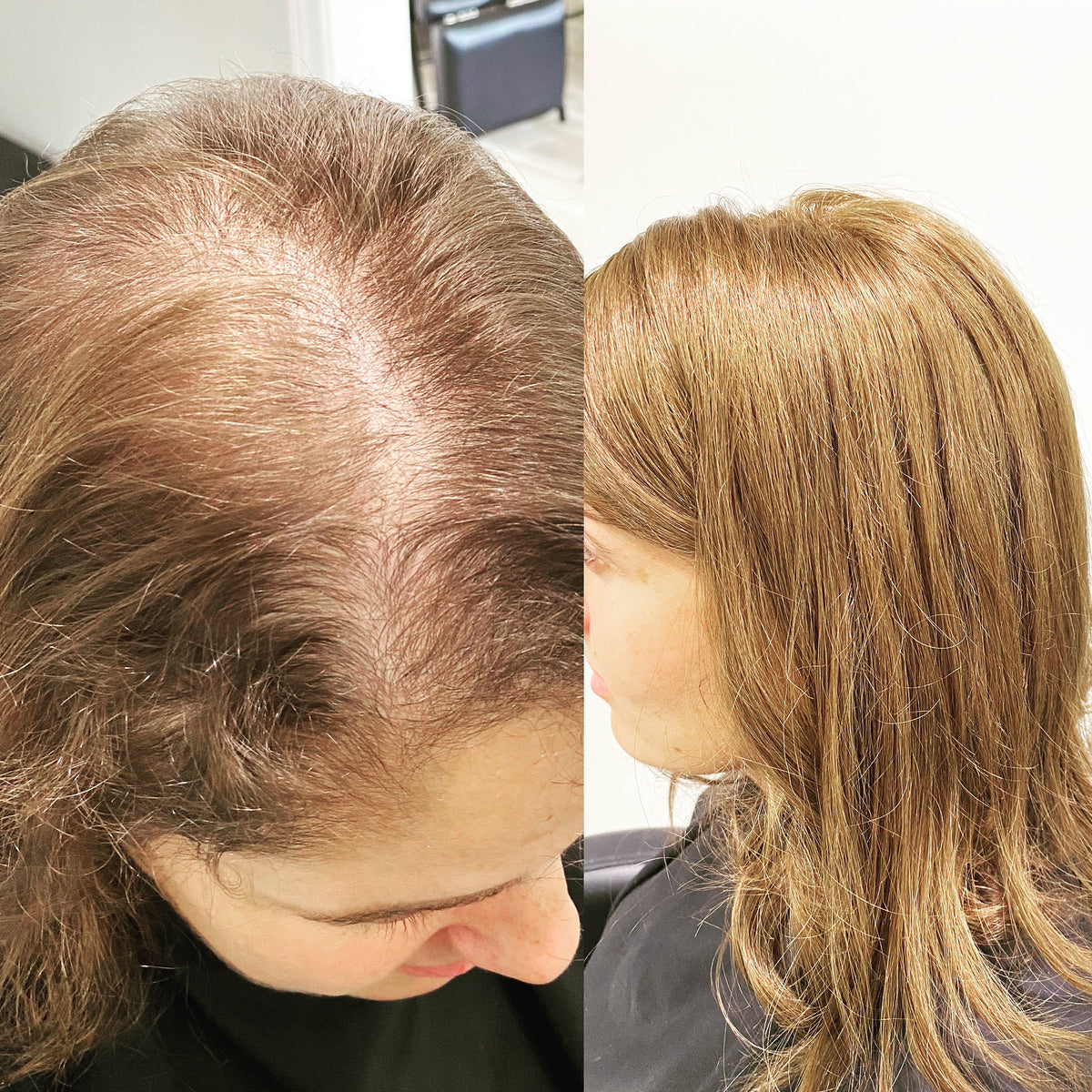


I get some version of this question in the chair more often than you'd think: "Is this trich, or is something else going on with my hair?" It's one of the questions I hear most from clients searching for Trichotillomania Boston answers, and it's a fair one to ask.
Two very different things can look almost identical from the outside — thin patches, hair that snaps off short, a texture that just feels "off" no matter what you put on it. One of them is trichotillomania, a hair-pulling condition. The other is a hair shaft condition called pili torti. Most people have never heard of the second one until they start googling why their hair won't grow past a certain length no matter what they do, or why a stylist keeps finding the same breakage in the same spot appointment after appointment.
I've worked with clients on both sides of this question, and the two conditions genuinely need different approaches — which is exactly why sorting out which one you're dealing with matters before you spend money on treatments aimed at the wrong problem.
What pili torti actually is
Pili torti means "twisted hair" — literally. Instead of growing straight out of the follicle the way hair normally does, the shaft twists on itself at irregular intervals along its length. Run your fingers down a strand and you can sometimes feel it: little flat, ribbon-like twists instead of a smooth round shaft. Under stronger light or a loupe, you can often see the twist itself — the hair catches the light unevenly, almost like a tiny ribbon candy pattern.
That twisting is a structural weak point. Every twist is a spot where the hair is more likely to snap under completely normal, everyday stress — brushing, wind, even just sleeping on it. So instead of hair that breaks because something is pulling on it, you get hair that breaks because it's built that way from the root out. That's the core distinction I come back to with clients: pili torti is a manufacturing problem in the hair itself, not a behavior.
Why it happens
Pili torti shows up in a few different ways, and knowing which category you're in matters for what happens next:
- Genetic and inherited. Some people are born with it, and it can run in families. It's also associated with certain inherited conditions — Menkes disease and Björnstad syndrome are two that come up in dermatology literature — though most people with pili torti do not have an underlying syndrome, and it can appear entirely on its own.
- Acquired later in life. Pili torti can also develop after the fact, sometimes linked to certain skin or scalp conditions, nutritional deficiencies, or as a side effect of specific medications.
- Localized versus widespread. For some people it shows up in just one or two patches; for others, it affects hair more broadly across the scalp.
I'm not a physician, and none of this replaces an actual diagnosis — a dermatologist can confirm pili torti with a simple hair shaft examination, sometimes under a microscope, and rule out other causes. If you haven't had that confirmed and you're seeing this kind of breakage, that's genuinely the right first stop before doing anything else.


Why it gets confused with trichotillomania
Here's where it gets tricky for the person living with it: both conditions can leave you with the exact same visible result — patchy areas, hair that seems to just stop growing, ends that look frayed or broken rather than tapered. If you don't know to look for the twist itself, it's genuinely hard to tell them apart just by looking in the mirror.
The difference matters, though, because trichotillomania is a body-focused repetitive behavior — the hair loss comes from pulling, whether or not someone is fully aware they're doing it in the moment. It's classified as an obsessive-compulsive and related disorder, and it's far more common than people assume; a lot of people dealing with it feel embarrassed and never bring it up, even to a stylist they trust. Pili torti has nothing to do with pulling at all. It's a hair shaft issue, full stop. Some of the clients I've worked with actually have both going on at once, which makes it even harder to untangle without someone who's seen it before taking a real look.
Pili torti vs. trichotillomania, side by side
| Pili torti | Trichotillomania | |
|---|---|---|
| What it is | A hair shaft defect — the hair itself grows twisted | A hair-pulling behavior (body-focused repetitive disorder) |
| Cause | Structural, from the follicle out — genetic or acquired | Pulling, whether or not the person is fully aware of it in the moment |
| Where it shows up | Can be scattered or uniform, depending on the underlying cause | Often clustered where it's easiest to reach and pull — one side, the crown, eyebrows, eyelashes |
| Hair ends | Breaks at a fairly consistent length at the weak point | Often uneven, with short regrowth stubble mixed in |
| Is there an urge? | No — nothing is being done to cause it | Usually yes — tension before pulling, relief after |
| Diagnosed by | Dermatologist, via hair shaft exam | Mental health provider or dermatologist familiar with BFRBs |
| Hereditary? | Sometimes — can run in families or link to inherited conditions | Not inherited in the same way; can run in families as a behavioral pattern |
None of this replaces an actual diagnosis. It's just the shorthand I find myself walking clients through when they sit down and aren't sure what they're looking at.
This is also where I want to mention something most people don't know: in rare, severe cases, trichotillomania can progress into trichophagia — where the pulled hair is also swallowed — and if that goes on long enough, it can lead to a genuinely serious medical complication called Rapunzel syndrome, where hair accumulates in the stomach. It's uncommon, but it's a real reminder that hair pulling isn't just a cosmetic issue. It's worth taking seriously and addressing early, gently, and without shame — and it's a medical, not cosmetic, situation if it's happening.
How mesh integration helps with both
This is the part I actually love talking to clients about, because mesh integration does two jobs at once, and most people only know about the first one.
It covers what's already thinning or breaking. A well-fitted mesh integration system gives you natural-looking density and length right away, without waiting to see if the hair underneath recovers on its own. The mesh is a fine, breathable base attached along the part and thinning areas, with hair integrated through your own for a blended, undetectable result. Whether the cause is pili torti's structural breakage or trich-related shedding, the visual result — coverage that looks and moves like your real hair — is the same, and it means you're not putting your life on hold waiting to see what happens.
It also interrupts the urge to pull. This one surprises people. When there's a secured system covering the scalp, there's simply less bare, accessible hair to grab onto in the first place. For a lot of my trichotillomania clients, that physical barrier ends up doing quiet, constant work that willpower alone struggles to do — it removes the easiest, most automatic version of the habit. It's not a cure, and I'm always clear with clients that mesh integration works alongside therapy and habit-reversal support, not instead of it. But as one piece of a bigger plan, it genuinely helps, and I've watched it make a real difference for people who'd tried almost everything else first.

Watch a real mesh integration reveal in our chair.

For clients who want coverage without a longer-term integration commitment, a hair topper is often the right starting point — same idea of covering thinning or breakage naturally, with an easier on-and-off routine day to day.
Frequently asked questions
Can pili torti be cured?
There's no cure that changes the hair shaft itself, since the twist is built into the hair as it grows. Treatment is generally about gentle hair care to minimize breakage, treating any underlying cause if one is identified, and options like mesh integration or toppers for coverage in the meantime.
Is pili torti hereditary?
It can be. Some cases are genetic and run in families, sometimes alongside other inherited conditions. Other cases develop later in life with no family history at all. A dermatologist is the right person to sort out which situation applies to you.
Does trichotillomania cause permanent hair loss?
Not usually, if the pulling stops and the follicle hasn't been repeatedly damaged over a long period. Hair can regrow once pulling stops. In more longstanding or severe cases, regrowth can be slower or less complete, which is part of why addressing it early tends to give the best outcome.
Can I get mesh integration or a topper while I'm still working through trichotillomania?
Yes, and for a lot of clients it helps rather than hinders. It's not a replacement for therapy or habit-reversal work, but many people find that having coverage in place makes the whole process easier while they're working on the underlying habit.
If you're not sure which one you're dealing with
You don't have to figure this out on your own before you come in. Bring me your questions, your worries, whatever you've already tried — I've sat with a lot of clients working through exactly this, and half the battle is just having someone actually look closely and tell you what they see, instead of guessing from a mirror at home.
If you're in Melrose, Boston, or anywhere on the North Shore and you've been wondering whether what you're seeing is pili torti, trichotillomania, or something else entirely, we'll take a real look, talk through it honestly, and figure out the right path forward together.
Schedule a free trichotillomania consultation


