

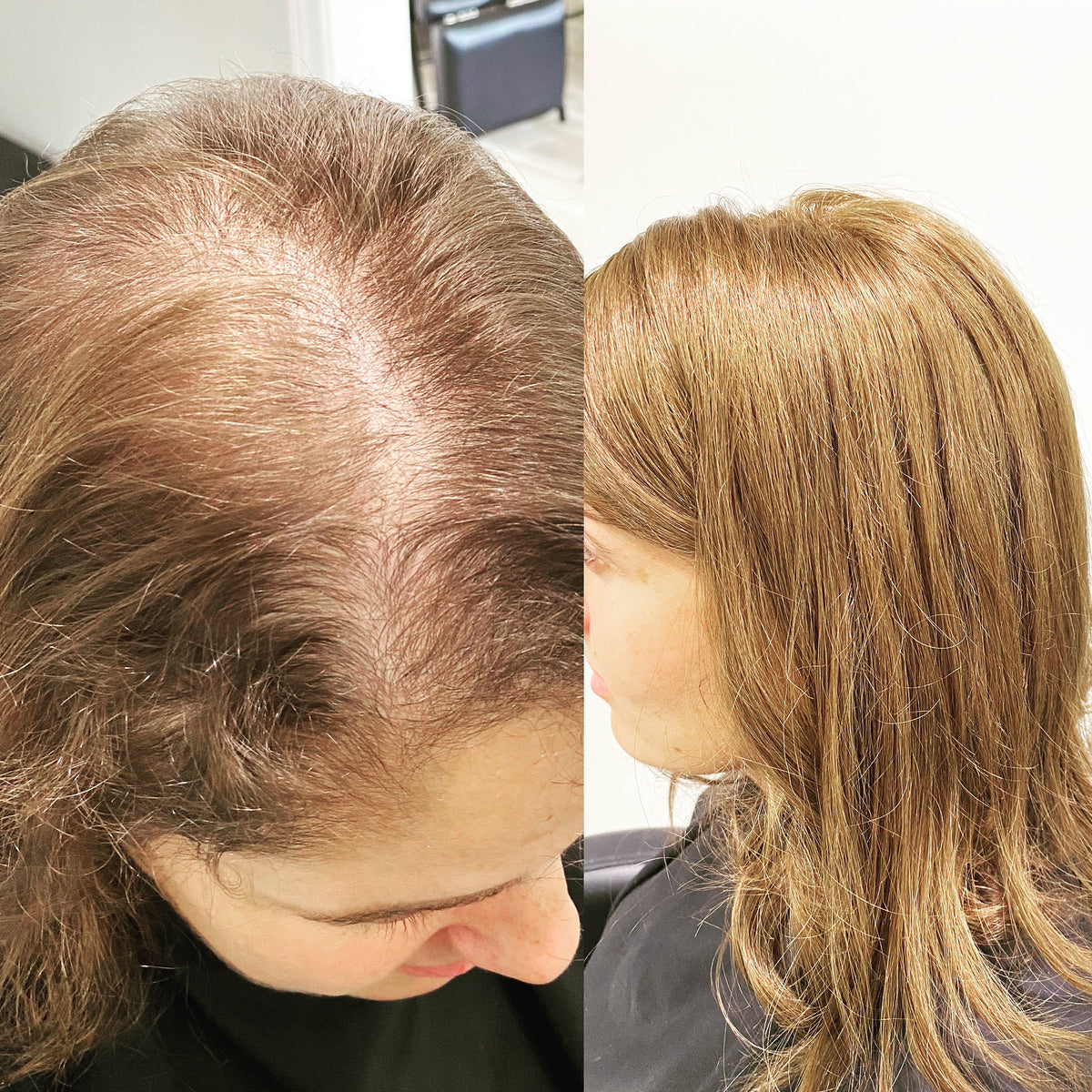


Women experiencing hair loss are often told that their only options are wigs or hair toppers.
In reality, hair extensions can sometimes be an effective solution when enough natural hair remains to support them safely. Depending on the type of hair loss, strategically placed extensions may help create fullness, reduce scalp visibility, and restore confidence without requiring full hair replacement.
Women searching for Hair Loss Boston solutions are often surprised to learn how many non-surgical options may be available depending on the type and extent of their hair loss.
At Noelle Salon, we work with women experiencing thinning hair, alopecia, trichotillomania, menopause-related hair loss, postpartum shedding, and chemotherapy regrowth. When enough healthy hair remains to support attachment, customized hair extensions can sometimes help improve fullness, density, and confidence.
The client transformations below demonstrate how hair extensions can sometimes help restore fullness and confidence for women experiencing different forms of hair loss.
Can Hair Extensions Help Hide Hair Loss? Quick Answer
Yes, in some situations. When enough healthy hair remains to safely support attachment, strategically placed hair extensions can help create fullness, reduce scalp visibility, and improve density. However, the best solution depends on the type of hair loss, scalp condition, and amount of existing hair. Some women may achieve better results with hair toppers, mesh integration systems, or a customized combination approach.

Watch This Hair Extension Transformation for Hair Loss
Hair loss solutions are never one-size-fits-all. This transformation demonstrates how customized hair extension placement can help create natural-looking fullness while addressing thinning hair concerns.
When Hair Extensions Can Help Hide Hair Loss
Hair extensions may be an appropriate option when:
- Hair loss is mild to moderate
- Enough natural hair remains for safe attachment
- The primary concern is reduced density
- Thinning is concentrated in specific areas
- Additional fullness is desired
- The client's hair can safely support extension placement
In our experience, many women assume they need a topper when strategically placed extensions may be capable of creating a natural-looking result.
Not every hair loss situation is appropriate for extensions, which is why a professional evaluation is important before choosing a solution.
Real Hair Extension Transformations for Hair Loss

Frontal hair loss can be particularly difficult to conceal because it affects one of the most visible areas of the scalp.
For this client, a customized sew-in approach was used to create density and coverage while maintaining a natural-looking blend. Strategic placement helped improve fullness and reduce visible thinning without creating excess bulk.
At our Boston salon, we regularly work with women experiencing postpartum shedding, menopause-related thinning, alopecia, trichotillomania, and chemotherapy recovery who are looking for non-surgical ways to restore confidence and fullness.
The result was fuller-looking hair with natural movement and improved confidence.
Micro Extensions for Hair Loss

Micro extensions can be a valuable option for certain clients experiencing thinning hair who still have enough natural hair to support lightweight attachment points.
In this transformation, customized placement helped increase overall density and create a fuller appearance while maintaining a natural blend with the client's existing hair.
When properly selected and applied, lightweight extension methods can provide fullness without overwhelming fine or delicate hair.
In some cases, micro extensions can also be used for clients experiencing trichotillomania, alopecia, or localized thinning when sufficient healthy hair remains to safely support the extension placement.

Many women experiencing thinning hair feel frustrated because their hair lacks both density and length.
For this client, micro weft extensions were used to create additional fullness while preserving a natural appearance. Careful placement allowed us to increase density and length while keeping the result lightweight and wearable.
The goal was not simply longer hair. The goal was creating hair that looked healthier, fuller, and more balanced.
Hair Extensions for Different Types of Hair Loss
Hair Extensions for Menopause-Related Hair Loss
Many women notice changes in density and scalp visibility during menopause.
When enough natural hair remains, strategically placed extensions may help improve fullness and create the appearance of greater density without requiring a full hair replacement system.
Hair Extensions for Postpartum Hair Loss
Postpartum shedding can create noticeable thinning, particularly around the front and top of the scalp.
Depending on the amount of regrowth present, lightweight extension methods may help restore fullness while supporting a client's confidence during the recovery process.
Hair Extensions for Alopecia
Some forms of alopecia may still allow for extension placement when enough healthy hair remains to safely support lightweight attachments. In certain situations, customized micro extensions can help improve density and blending while creating a natural-looking result.
However, every alopecia case is different. The amount of existing hair, scalp health, and pattern of hair loss all influence whether extensions are appropriate or whether another solution may be a better fit.
Hair Extensions for Trichotillomania
For clients recovering from Trichotillomania, customized micro extensions can sometimes be used to blend areas of regrowth and improve density when enough healthy hair remains to support attachment.
The location of pulling, amount of regrowth, scalp condition, and overall hair density all influence whether extensions are appropriate. In some situations, a hair topper, mesh integration system, or a customized combination approach may create a better result.
Learn more about our Trichotillomania Hair Loss Solutions in Boston and the customized approaches we use to help clients experiencing hair loss from hair pulling.
V-Light and CombLine Extensions for Frontal Hair Loss
Traditional extension methods are not always appropriate around the hairline, crown, or bangs.
V-Light and CombLine techniques can sometimes help address thinning bangs, sparse temples, frontal hair loss, and other delicate areas where traditional extension methods are not appropriate. These specialized approaches are part of the customized solutions we offer through our Hair Extensions Boston services for fine hair, thinning hair, and hair loss clients.
Depending on the situation, they may help address:
- Frontal hair loss
- Sparse temples
- Thinning bangs
- Crown visibility
- Hairline density concerns
Because these techniques are highly customized, a professional evaluation is necessary to determine whether they are appropriate.
When Hair Extensions Are Not the Best Hair Loss Solution
One of the biggest misconceptions we see is that every hair loss concern should be treated with extensions.
In reality, some clients achieve better results with:
- Hair toppers
- Mesh integration systems
- Partial mesh integration
- Customized combination solutions
The goal is not to recommend extensions for everyone. The goal is to recommend the solution that best fits the client's amount of hair loss, scalp visibility, lifestyle, and long-term goals.
Partial Mesh Integration for Advanced Hair Loss

For clients experiencing more advanced thinning, mesh integration may provide better support than traditional extensions alone.
Partial mesh integration combines a lightweight foundation with customized hair additions to create natural-looking coverage while allowing existing hair to remain incorporated into the final result.
How We Determine Whether Hair Extensions Are Right for Hair Loss
During a consultation, we evaluate hair density, scalp visibility, existing hair strength, lifestyle, and long-term goals before recommending the most appropriate solution. Some women achieve excellent results with hair extensions, while others may be better candidates for hair toppers, mesh integration systems, or a customized combination approach.
Frequently Asked Questions About Hair Extensions for Hair Loss
Can hair extensions help with thinning hair?
Yes. In many cases, strategically placed extensions can help create fullness and reduce the appearance of thinning while maintaining a natural look.
Can hair extensions hide scalp visibility?
Depending on the location and severity of thinning, extensions may help improve coverage and create the appearance of greater density.
Are hair extensions safe for thinning hair?
Not all extension methods are appropriate for thinning hair. The safest approach depends on the amount of hair present and the overall condition of the scalp and hair.
What is the best extension method for hair loss?
There is no single best method. The right solution depends on the type of hair loss, amount of density present, and the client's goals.
Do I need hair extensions, a topper, or mesh integration?
Every situation is unique. Some clients are best suited for extensions, while others achieve better results with toppers, mesh integration, or a combination approach.
Book a Hair Loss Consultation
If you are experiencing thinning hair, alopecia, menopause-related hair loss, postpartum shedding, trichotillomania, or chemotherapy-related hair loss, our specialists can help determine which solution may be most appropriate.
Whether the answer is hair extensions, a hair topper, mesh integration, V-Light, CombLine, or a customized combination approach, our goal is to create a natural-looking result that helps you feel confident again.
Book your Hair Loss Consultation today to learn which solution is right for you.


