

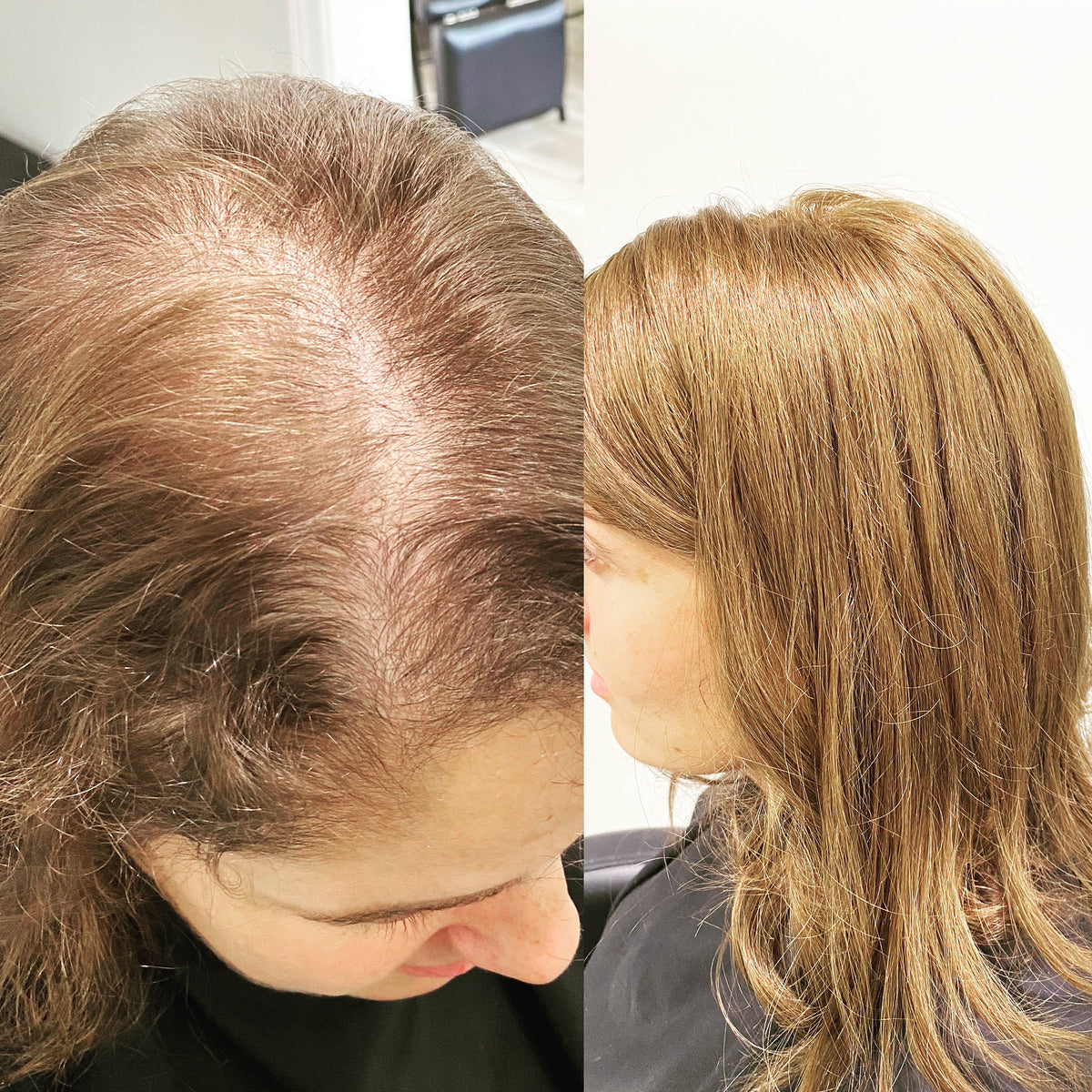


Hair Topper vs Hair Extensions for Thinning Hair: Which Solution Is Right for You?
Many women experiencing hair loss assume there is only one solution available. Some believe they automatically need a hair topper. Others assume hair extensions are only used for adding length.
The reality is that the best solution depends on the cause of the hair loss, the amount of density remaining, scalp visibility, lifestyle, and long-term goals.
At Noelle Salon, we help clients experiencing many forms of hair loss, including alopecia areata, chemotherapy-related hair loss, menopause-related thinning, postpartum shedding, genetic hair loss, trichotillomania, and severe breakage. Some clients are best candidates for hair extensions. Others benefit from a hair topper. Some require mesh integration systems. The best solution is always customized to the individual.
If you are experiencing thinning hair, visit our Hair Loss Boston specialists to explore the solution that best fits your needs.

Not every woman experiencing hair loss needs a hair topper. Some clients achieve better results with hair extensions, while others benefit from toppers, mesh integration, or a customized combination of techniques.
Understanding the Difference Between Hair Toppers and Hair Extensions
A hair topper is designed to provide coverage in areas where scalp visibility has become difficult to conceal. Toppers are commonly used for crown thinning, diffuse thinning, alopecia areata, and advanced hair loss.
Hair extensions are designed to add density, fullness, length, and strategic coverage when enough natural hair exists to support extension placement.
Neither solution is universally better. The right choice depends on your specific pattern of hair loss.
What Causes Thinning Hair?
One of the biggest misconceptions we see is that all thinning hair is the same. Different causes often require completely different solutions.
Genetic Hair Loss
Many women experience hereditary thinning that gradually causes reduced density, widening parts, and increased scalp visibility.
Menopause-Related Hair Loss
Hormonal changes during menopause can significantly affect hair density and volume, particularly around the crown and top of the scalp.
Postpartum Hair Loss
After pregnancy, many women experience temporary shedding that can dramatically reduce density and fullness.
Chemotherapy Hair Loss
Hair regrowth after chemotherapy often creates challenges with uneven length, reduced density, and styling limitations during recovery.
Trichotillomania
Hair loss caused by hair pulling behaviors often requires a highly customized strategy depending on the location and severity of the affected areas.
Why One Solution Does Not Work for Everyone
One of the most important parts of a consultation is determining which solution will work best for your specific situation.
During a consultation we evaluate:
- Hair density
- Scalp visibility
- Hair loss pattern
- Lifestyle
- Maintenance preferences
- Long-term goals
- Existing hair strength
In many cases, clients arrive convinced they need one solution only to discover another option provides a more natural result.
When Hair Extensions Are the Better Choice
Many women are surprised to learn that hair loss does not automatically mean they need a topper.
In many cases, strategically placed hair extensions can restore fullness, create density, conceal thinning areas, and provide natural movement while blending seamlessly with existing hair.
For clients seeking customized solutions, visit our Hair Extensions Boston specialists.
Hair Extensions for Fine Hair and Thinning Density
Many clients with naturally fine hair struggle with visible scalp, flat hair, and thin ends.
Strategically placed extensions can increase density while maintaining a lightweight, natural appearance.

Hair Extensions for Chemotherapy Hair Regrowth
As natural hair begins growing back after treatment, many clients struggle with uneven lengths and limited styling options.
Hair extensions can help bridge the transition period while natural hair continues to recover.

Hair Extensions for Bleach Damage and Breakage
Severe breakage often leaves hair thin, uneven, and difficult to style.
Extensions can restore fullness while clients work toward rebuilding the health of their natural hair.

Hair Extensions for Frontal Hair Loss and Thinning Bangs
Certain advanced techniques, including V-Light and strand-by-strand placement, allow us to create density in areas where traditional extension methods cannot be used.
For some clients, strategically placed extension hair can create fuller bangs and improve frontal density without requiring a topper.
When a Hair Topper Is the Better Choice
Hair toppers are often ideal when significant density loss exists on the top of the head or when scalp visibility becomes difficult to conceal using extensions alone.
Hair Topper for Alopecia Areata
Alopecia areata often creates isolated patches of hair loss that require targeted coverage.
Custom hair toppers can blend naturally with existing hair while providing immediate confidence.

Hair Topper for Diffuse Crown Thinning
For clients experiencing widespread thinning throughout the crown, toppers can provide coverage while maintaining a natural appearance.

When Mesh Integration Is the Better Solution
For advanced hair loss, traditional extensions and toppers may not provide enough support.
Mesh integration systems create a foundation that allows hair to be secured comfortably while blending with existing hair. Mesh integration is often recommended when traditional hair extensions or hair toppers cannot provide adequate support due to the extent of the hair loss. By creating a lightweight foundation, mesh integration allows clients with more advanced thinning to achieve natural-looking coverage while protecting fragile hair.
Partial Mesh Integration for Advanced Hair Loss
Partial mesh integration can provide coverage for clients experiencing larger areas of hair loss while maintaining a natural appearance.

Mesh Integration Combined With a Hair Topper
In some cases, combining a topper with mesh integration creates the most natural and secure result.

Hair Loss Solutions for Trichotillomania
Hair loss caused by trichotillomania often requires a completely different strategy.
Coverage, density, regrowth patterns, and lifestyle must all be considered during the consultation process.
Learn more about our Trichotillomania Hair Loss Solutions and the customized options available for recovery and restoration.

How We Determine the Best Solution
The biggest mistake we see is clients choosing a solution before understanding the cause of their hair loss.
What works for alopecia areata may not work for menopause-related thinning. What works for chemotherapy recovery may not be ideal for trichotillomania or genetic hair loss.
Every solution should be customized based on your hair density, scalp visibility, lifestyle, and long-term goals. Every hair loss journey is unique, which is why clients often have questions about which solution may work best for their situation.
Frequently Asked Questions
Are hair extensions safe for thinning hair?
When properly selected and applied, lightweight extension methods can be an excellent solution for many clients with thinning hair.
Is a hair topper better than hair extensions?
Not necessarily. The best solution depends on the amount and location of the hair loss.
Can hair extensions help with frontal hair loss?
In some cases, advanced techniques such as V-Light and strand-by-strand placement can help improve density in frontal areas.
What is the best solution for alopecia?
The best solution depends on the type of alopecia, the amount of existing hair, and your individual goals.
When is mesh integration recommended?
Mesh integration is often recommended for clients experiencing more advanced or widespread hair loss.
Book a Free Hair Loss Consultation
If you are experiencing thinning hair, visible scalp, alopecia, trichotillomania, chemotherapy-related hair loss, postpartum shedding, menopause-related thinning, or genetic hair loss, our specialists can help determine the most appropriate solution.
During your consultation, we evaluate the location of the hair loss, scalp visibility, existing density, lifestyle, maintenance preferences, and long-term goals. This allows us to recommend whether hair extensions, a topper, mesh integration, or a customized combination approach will provide the most natural result.
Book a Free Hair Loss Consultation to discover whether a hair topper, hair extensions, mesh integration system, or customized combination approach is right for you.


