



Mesh Integration vs Hair Topper: Which Creates Better Coverage For Hair Loss?
Quick Answer
For many women experiencing hair loss, a traditional hair topper provides excellent coverage and may be all that is needed.
However, women with diffuse thinning, patchy hair loss, trichotillomania, alopecia areata, weak support hair, or significant scalp visibility may benefit from mesh integration or meshless integration systems that provide additional support and stability.
At Noelle Salon, every consultation begins with an evaluation of hair density, scalp visibility, support capacity, hair loss pattern, and long-term hair preservation. There is no single solution that works for everyone.
In many cases, the best solution is actually the simplest one, which is why a proper evaluation is far more important than choosing a specific system before understanding your hair loss pattern.
Many women who visit our Hair Loss Boston specialists believe they need mesh integration because they have seen it on social media. In reality, approximately half of the women I evaluate can achieve excellent results using a traditional hair topper, while others benefit from customized solutions involving mesh integration, meshless integration, closures, or strategically placed hair extensions.

What Is The Difference Between A Hair Topper And Mesh Integration?
One of the biggest misconceptions I see is that mesh integration and hair toppers are competing solutions.
They are not.
A hair topper is the actual hair replacement piece.
Mesh integration is simply an attachment method.
Think of the topper as the hair and mesh integration as the support system that helps secure the topper when existing hair is too fragile, too sparse, or too unevenly distributed to support traditional attachment methods.
Many women with mild to moderate thinning can wear a topper without mesh at all. In those situations, I simply bead the topper into the client's existing hair and perform routine maintenance every four to six weeks.
For more complex hair loss patterns, mesh integration often provides better support and longer maintenance intervals.
Hair Topper vs Mesh Integration Comparison
| Traditional Hair Topper | Mesh Integration |
|---|---|
| Best for mild to moderate thinning | Best for diffuse, patchy, or advanced thinning |
| Typically maintained every 4–6 weeks | Often maintained every 6–8 weeks |
| Uses existing perimeter hair for attachment | Creates additional support structure |
| Lightweight and simple | More customized solution |
| Often sufficient for widening parts and crown thinning | Helpful for alopecia, trichotillomania, and severe thinning |
| Usually lower maintenance | Provides additional stability |
When a Hair Topper is Usually Enough
In my experience, approximately half of the women who come to us seeking hair loss help can achieve excellent results with a traditional topper application.
Women experiencing:
-
Early female pattern hair loss
-
Widening parts
-
Mild crown thinning
-
Menopausal density changes
-
General volume loss
often do not require mesh integration.
In fact, one of the most common things I tell women during consultations is that they don't necessarily need a more advanced system. If enough healthy support hair remains around the perimeter, a traditional topper can often create beautiful, natural coverage with less maintenance and less complexity.
Many of these women first notice symptoms discussed in Why Is My Part Getting Wider? 7 Common Causes Of A Widening Hair Part In Women, where scalp visibility gradually increases while enough healthy support hair remains around the perimeter.

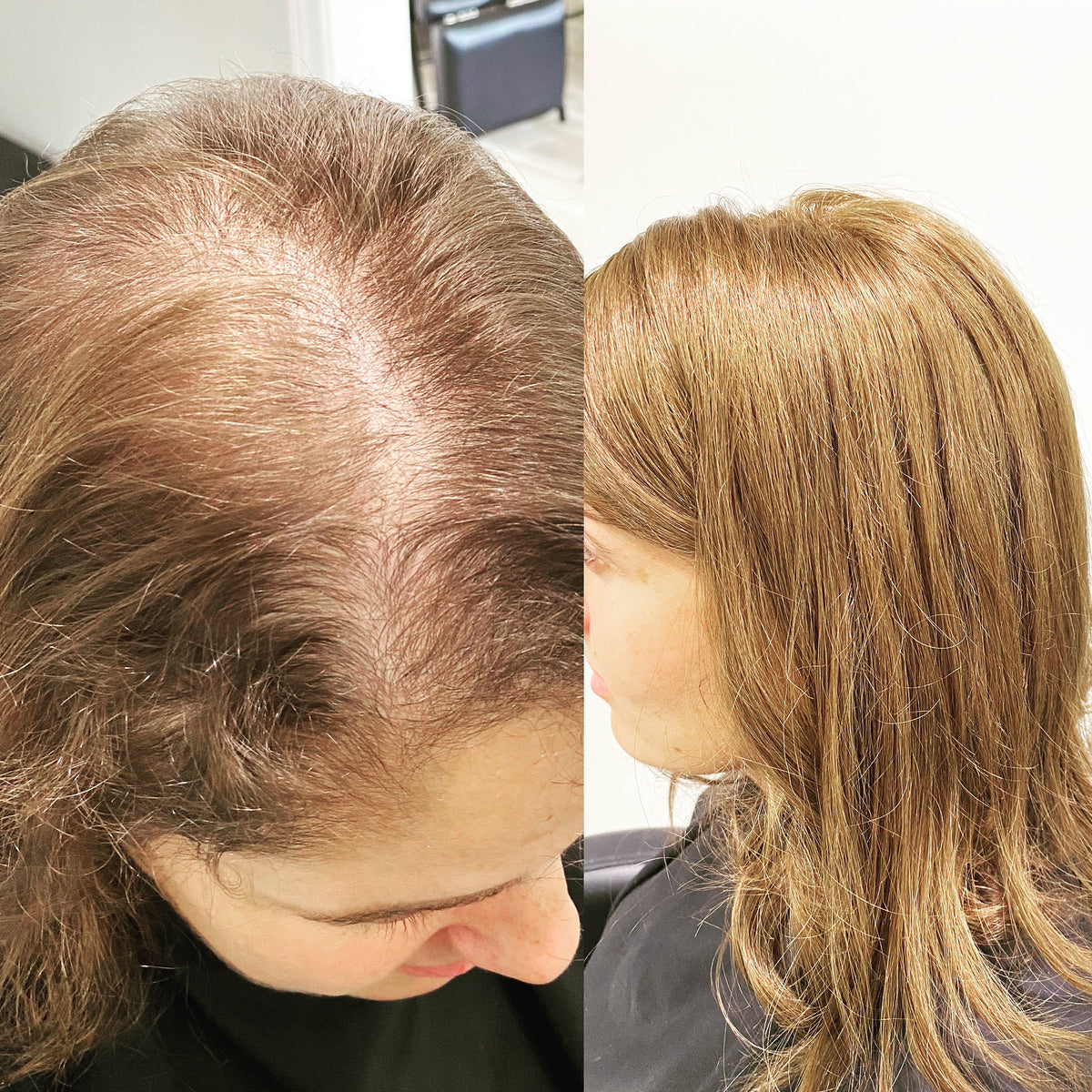
Many women experiencing early thinning can achieve excellent coverage with a traditional hair topper application.
Lightweight Topper Plus Hair Extensions Example
In some cases, a lightweight topper combined with strategically placed hair extensions creates natural coverage without requiring mesh integration.
When Mesh Integration Creates Better Coverage
Some women simply do not have enough support hair to safely secure a topper using traditional methods.
Others have hair in certain areas of the scalp but significant loss elsewhere.
This is where mesh integration becomes valuable.
The mesh acts as a support foundation that allows me to distribute weight more evenly while securing a topper, closure, or customized hair replacement system.
Mesh integration is particularly useful for:
-
Diffuse thinning
-
Trichotillomania
-
Alopecia areata
-
Advanced female pattern hair loss
-
Irregular patchy hair loss
-
Clients with weak support hair
Women experiencing advanced thinning similar to the patterns discussed in Female Pattern Hair Loss vs Telogen Effluvium: How To Tell The Difference often require additional support beyond traditional topper placement.

Mesh Integration For Patchy Hair Loss
Patchy hair loss creates unique challenges.
A woman may have dense hair in one area and very little hair in another.
This is common with trichotillomania and alopecia areata.
The mesh helps secure existing hair while creating support where hair is missing.
Many of the trichotillomania clients featured in Trichotillomania Recovery: What Happens After Hair Pulling Stops? benefit from customized partial mesh integration systems because traditional topper placement often cannot adequately stabilize the affected area.

Patchy hair loss caused by trichotillomania or alopecia often requires customized support systems beyond traditional topper placement.
Mesh Integration Transformation
Mesh Integration vs Meshless Integration
Not every client tolerates traditional mesh.
Some women have highly sensitive scalps or simply prefer a lighter feeling system.
For these clients, I often create meshless integration patterns that allow me to sew toppers, closures, and even hair extensions into place without traditional mesh.
The goal is always comfort, security, and hair preservation.

Some women benefit from traditional mesh integration while others with sensitive scalps may prefer meshless integration techniques.
Can Mesh Integration Create More Length Than A Hair Topper?
Yes.
This is one of the biggest advantages of mesh integration.
I often see women who want both:
-
Top-of-head coverage
-
Additional length
Instead of using an excessively long topper, I frequently use a shorter topper or closure for scalp coverage and strategically place hair extensions underneath.
This creates a lighter, more natural result while protecting the client's existing hair.
Many of the extension strategies discussed during our Hair Extensions Boston consultations focus on preserving support capacity rather than simply adding more hair. In some cases, a shorter topper combined with strategically placed extensions creates a lighter, more natural result than a longer, heavier topper alone.

When additional length is desired, mesh integration may provide more support for combining toppers, closures, and extensions.
Founder Insight
"One of the biggest misconceptions I encounter is women arriving convinced they need mesh integration because they saw it online. In reality, about half of the women I evaluate can achieve excellent results with a traditional topper. My job is not to sell the most complicated solution. My job is to determine the lightest, safest, and most natural solution for their specific hair loss pattern."
— Noelle Spinosa, Founder, Noelle Salon
Conclusion
Hair toppers and mesh integration are not competing solutions.
A topper is the hair.
Mesh integration is simply one method of securing that hair when additional support is needed.
Many women achieve beautiful results with a traditional topper application. Others require mesh integration, meshless integration, closures, or customized combinations involving hair extensions.
The right solution depends on your density, scalp visibility, support capacity, hair loss pattern, and long-term hair goals.
This is why every hair loss consultation begins with a thorough evaluation rather than a one-size-fits-all recommendation.
Frequently Asked Questions
Is mesh integration better than a hair topper?
Not necessarily. Many women achieve excellent results with a traditional topper. Mesh integration is typically reserved for more advanced or complex hair loss patterns.
Does mesh integration damage hair?
When properly designed and maintained, mesh integration should not damage healthy hair. Proper weight distribution and support capacity are critical.
How often does mesh integration require maintenance?
Most mesh integration systems require maintenance every six to eight weeks.
Can mesh integration be used for trichotillomania?
Yes. Mesh integration is often one of the most effective solutions for patchy hair loss caused by trichotillomania.
Can I wear hair extensions with a hair topper?
Absolutely. Many of our customized solutions combine lightweight toppers with strategically placed extensions to create natural-looking density and length.
Do I need mesh integration if I have a widening part?
No. Many women with widening parts, early female pattern hair loss, or mild crown thinning achieve excellent results with a traditional hair topper. Mesh integration is often reserved for more advanced thinning, patchy hair loss, or situations where additional support is needed.
Schedule A Hair Loss Consultation
If you're unsure whether you need a hair topper, mesh integration, meshless integration, or a customized combination solution, the first step is a professional evaluation.
At Noelle Salon, we assess density, scalp visibility, support capacity, hair loss pattern, and lifestyle considerations before recommending any hair loss solution. Many women are surprised to learn that a traditional topper may be enough, while others benefit from mesh integration, meshless integration, closures, or customized extension-supported systems.
Whether you're experiencing female pattern hair loss, alopecia, trichotillomania, menopausal hair loss, or diffuse thinning, our goal is to create the safest and most natural-looking solution while protecting your existing hair.
Schedule your free hair loss consultation to discover which solution is right for you.


