

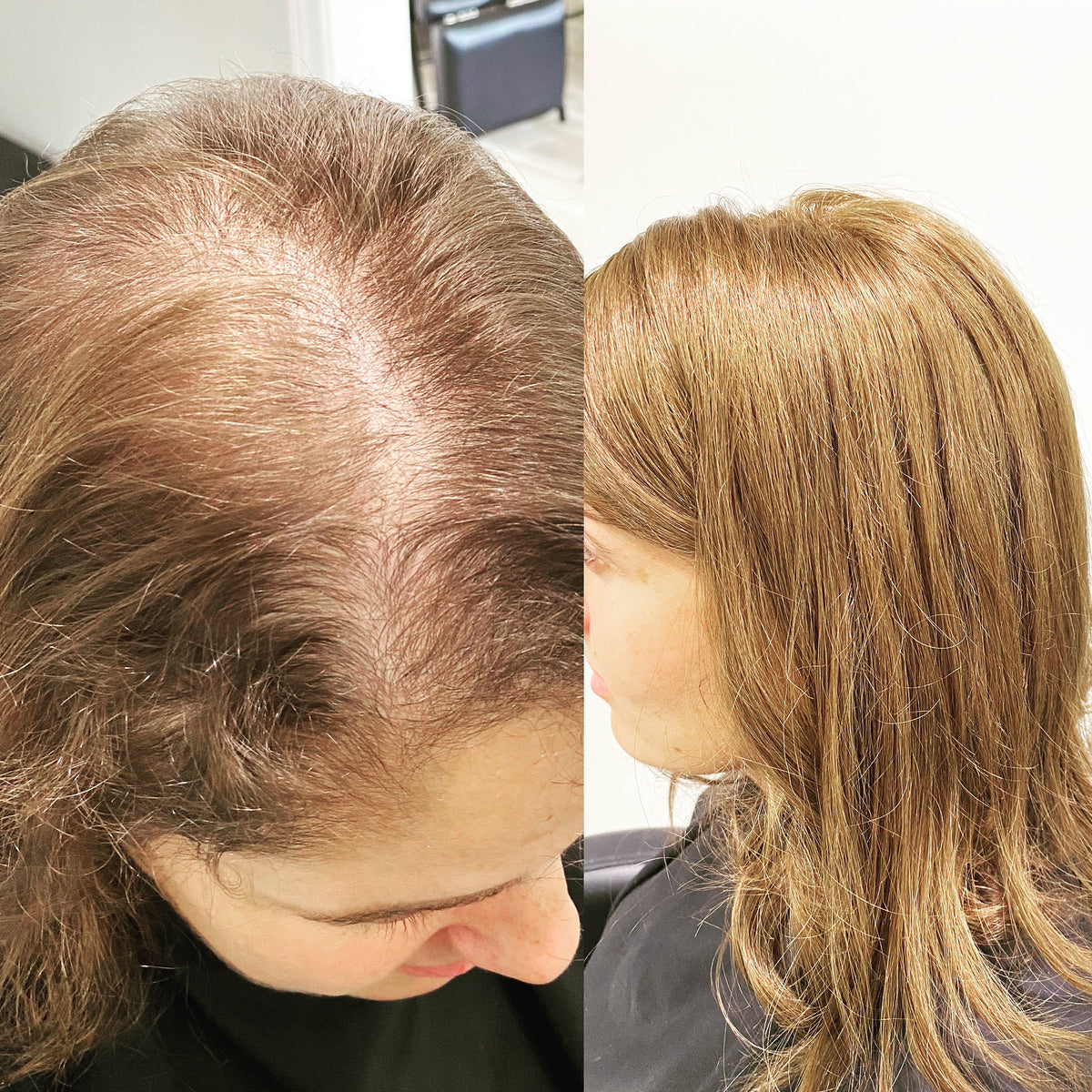


Why Is My Part Getting Wider? 7 Common Causes Of A Widening Hair Part In Women
Quick Answer: Why Is My Part Getting Wider?
A widening part can happen when hair density decreases along the top of the scalp, crown, hairline, or part line. For some women, the change is gradual and related to Female Pattern Hair Loss, menopause-related thinning, genetics, aging, or reduced follicle density. For others, it may appear more suddenly after shedding from stress, illness, weight loss, thyroid changes, hormonal changes, or Telogen Effluvium.
A widening part does not always mean permanent hair loss, but it is a sign worth paying attention to. If you are noticing more scalp, a wider part, increased shedding, or thinner hair around the crown, a professional evaluation can help identify the visible pattern and determine whether a dermatologist should be involved before considering cosmetic hair solutions.
Many women searching for Hair Loss Boston solutions come to us because they feel like their part became wider almost overnight. In reality, the change may have been developing slowly, but one day the lighting, a photo, a mirror, or a hairstyle suddenly makes it impossible to ignore.
Why A Widening Part Feels So Alarming

One of the most common things women tell me during a hair loss consultation is:
"I swear this happened overnight."
They may say:
"My part was never this wide before."
"I can suddenly see my scalp."
"My bloodwork is normal, so I don't understand why this is happening."
"My mother had hair loss, and I'm afraid the same thing is happening to me."
"I'm too young for this."
That last one is something I hear more often now than I did years ago.
After more than 35 years working with women experiencing thinning hair, hair loss, fine hair challenges, hair toppers, mesh integration systems, and extensions for thinning hair, I have noticed that women are seeking help for widening parts and scalp visibility at younger ages than many people expect.
Some are in their 50s and 60s. Others are in their 20s and 30s. Some are even teenagers who are terrified because their hair is shedding, their part looks wider, and they do not know whether the hair loss is temporary or permanent.
That fear is real.
A widening part affects more than how hair looks. It affects how a woman feels when she looks in the mirror, takes a photo, styles her hair, or goes out in public.
For a broader explanation of common causes of thinning hair, you may also want to read Why Is My Hair Thinning? The 12 Most Common Causes of Hair Loss for Women In Boston.

What A Widening Part Often Means
A widening part usually means that the hair along the part line is no longer as dense as it once was.
This can happen for several reasons.
Sometimes the hair follicles are producing thinner strands over time. Sometimes the scalp is more visible because overall density has decreased. Sometimes shedding has made the hair temporarily look thinner. Sometimes the part line looks wider because hair around the crown and top has become weaker, finer, or more sparse.
The important thing is this:
A widening part is a visible sign. It is not a diagnosis.
As a hair loss specialist, I do not diagnose medical hair loss conditions. What I do during a consultation is evaluate what I can see, ask detailed questions, look at the pattern, listen to the client's history, and help determine whether cosmetic solutions are appropriate or whether a dermatologist should be part of the next step.
| What You Notice | Possible Next Step |
|---|---|
| Wider Part + Increased Shedding | Explore shedding-related causes |
| Wider Part + Family History | Consider dermatology evaluation |
| Wider Part + Menopause | Discuss hormonal factors |
| Wider Part + Crown Thinning | Hair loss consultation |
| Wider Part + Extension Damage | Extension correction evaluation |
A widening part is a symptom rather than a diagnosis. Looking at the bigger picture often helps determine the most appropriate next step.
1. Female Pattern Hair Loss
One of the most common reasons women notice a widening part is Female Pattern Hair Loss.
This type of hair loss often develops gradually. Many women do not notice heavy shedding at first. Instead, they begin to see more scalp along the part, reduced density at the crown, flatter hair on top, or a part line that seems to spread wider over time.
Clients often say:
"My part keeps getting wider."
"I can see more scalp in photos."
"My hair still grows, but it looks thinner on top."
"My mom or aunt had the same thing."
Family history can be an important clue. Many women tell me their mother, grandmother, sister, or aunt experienced similar thinning. That does not mean every widening part is genetic hair loss, but it is one of the questions I ask during a consultation.
When Female Pattern Hair Loss is suspected, I often encourage clients to speak with a dermatologist, especially if the thinning is progressing, they have not been evaluated, or they are unsure what is causing the change.

2. Telogen Effluvium Or Sudden Shedding
Sometimes a widening part occurs because overall density has decreased after a period of excessive shedding. When women tell me their shower drain is full of hair, their brush is packed with strands, and their ponytail suddenly feels smaller, I start asking questions about shedding patterns and timing. For a deeper discussion of shedding-related hair loss, see Female Pattern Hair Loss vs Telogen Effluvium: How To Tell The Difference.
3. Menopause-Related Hair Changes
Menopause and perimenopause can also play a role in widening parts, crown thinning, texture changes, and reduced density.
Many women tell me their hair changed dramatically during perimenopause or menopause. The hair may feel more fragile, brittle, dry, fine, or difficult to style. Some notice more shedding. Others notice gradual thinning around the crown and part line.
This is personal for me as well. I have experienced changes in my own hair during perimenopause, so I understand how frustrating it can feel when the hair you have always known suddenly behaves differently.
Menopause-related hair loss does not look the same for every woman. Some women maintain good density around the sides and back but lose volume on top. Others experience diffuse thinning. Some notice that their part widens while their ponytail becomes smaller.
For more on this topic, read Menopausal Hair Loss Before and After: Real Solutions for Thinning Hair Over 50.

4. Stress, Depression, And Emotional Trauma
Stress can affect the body in many ways, and many women connect a period of intense stress with increased shedding or changes in density.
I often hear stories from women who say their bloodwork looks normal, their diet is good, and they cannot identify a medical explanation, but they have been under extreme emotional pressure.
Some describe anxiety, depression, caregiving stress, grief, divorce, work stress, or major life transitions.
Again, I do not diagnose the cause of hair loss. But from a consultation standpoint, the timeline matters. If a woman experienced intense stress several months before noticing shedding or a widening part, that is important information to discuss with a dermatologist or medical provider.
A widening part can feel especially frightening when someone is young and being told that her bloodwork is "normal." Normal bloodwork does not always explain what a woman is seeing in the mirror, which is why the pattern, timeline, family history, shedding level, and visible density all matter.
5. Thyroid Changes, Hormonal Changes, And Medical Factors
Sometimes a widening part may be associated with medical or hormonal factors.
Many women tell me they have already had bloodwork performed and were told everything looks normal, yet they continue to notice changes in density, scalp visibility, or the width of their part line.
Bloodwork can provide valuable information, but it does not always explain every visible change in hair density. This is why I often recommend dermatology evaluation when hair loss is progressing, shedding is significant, or the cause remains unclear.
For a broader discussion of potential medical and hormonal contributors to hair thinning, read Why Is My Hair Thinning? The 12 Most Common Causes Of Hair Loss For Women In Boston.
6. Low Density, Fine Hair, And Natural Changes Over Time
Some women have always had fine hair, but they do not notice how little support their hair has until density starts to change.
Fine hair and low-density hair are different from thick hair. They do not always conceal scalp visibility well, especially under bright lighting, in photos, or when the hair is oily, flat, or parted in the same place every day.
A woman with fine hair may notice her part widening earlier than someone with coarse, dense hair because there is less natural coverage.
During a consultation, I look at:
-
Hair density
-
Follicle density
-
Texture
-
Support capacity
-
Scalp visibility
-
Existing thinning
-
Styling habits
-
Hair color contrast against the scalp
These details matter because not every solution is safe for every head of hair. Adding too much weight to fine or thinning hair can make the problem worse.
7. Traction, Styling Stress, And Hair Extension Damage
Sometimes a widening part or thinning around the top is not only related to genetics or hormones.
Styling habits can also play a role.
Tight ponytails, repeated tension, heavy extensions, oversized attachments, aggressive brushing, chemical damage, and years of stress on fragile hair may contribute to breakage or thinning in certain areas.
This is especially important for women who already have fine hair or reduced density.
If your hair extensions feel heavy, painful, difficult to hide, or you notice more breakage around attachment points, read Are My Hair Extensions Too Heavy? 7 Warning Signs Your Extensions May Be Damaging Your Hair.
The safest hair solution is always the one your natural hair can actually support.
What I Look For During A Widening Part Consultation
When a woman comes in concerned about a widening part, I am not only looking at the part itself.
I look at the whole picture.
I evaluate:
-
Is the part widening evenly?
-
Is the crown also thinning?
-
Is the hairline affected?
-
Is there diffuse thinning throughout the scalp?
-
Is the client actively shedding?
-
Is there breakage?
-
Is the scalp irritated?
-
Is the density strong enough to support extensions?
-
Would a topper, mesh integration, fill-in piece, or another solution be safer?
-
Should the client see a dermatologist first?
The story matters just as much as the visual pattern.
A woman who says, "My hair started falling out three months after a stressful event," may need a different discussion than someone who says, "My part has been slowly widening for five years, and my mother had the same issue."
Family history does not guarantee that you will experience the same pattern of hair loss, but it is one of the factors I discuss during a consultation because it can provide helpful context when evaluating what may be happening.
If you are unsure what happens during a professional evaluation, read What To Expect During A Hair Loss Consultation.

Can A Widening Part Be Concealed?
In many cases, yes.
The right solution depends on the amount of hair loss, the density of the existing hair, the size of the part, the client's lifestyle, and whether the hair can safely support added hair.
One of the biggest misconceptions I see is that every widening part requires a full wig or large hair system. In reality, many women only need coverage in a very specific area. In some cases, we create custom hair additions designed specifically for the part line or crown, allowing the solution to blend naturally with the client's existing hair while addressing the area that concerns them most.
This is where customization matters.
A widening part does not always require a full wig. In fact, many women still have healthy hair around the sides and back of the head. Their main concern is coverage along the top, part, or crown.
That is why localized solutions can be so effective.
In this video, we created a custom hair addition specifically for a client with an extremely widened part. The goal was to restore coverage exactly where density was missing while still allowing the result to blend naturally with her existing hair.
Custom hair solution for a widening part showing a personalized hair addition designed to restore coverage and reduce scalp visibility.

Not Every Widening Part Needs The Same Solution
One of the biggest mistakes women make is assuming there is one correct answer.
There is not.
A woman with a mildly widened part may need a completely different solution than a woman with advanced crown thinning. A woman with active shedding may need medical evaluation before any cosmetic solution. A woman with low-density hair may not be a good candidate for heavy extensions.
Depending on the situation, we may discuss:
-
Scalp-conscious styling options
-
Hair toppers
-
Fill-in hair pieces
-
Mesh integration systems
-
Meshless integration
-
Lightweight extensions
-
Custom combination solutions
-
Medical evaluation before cosmetic work
For women comparing cosmetic options, Hair Topper vs Hair Extensions For Thinning Hair: Which Solution Is Right For You? can help explain why one solution may be better than another depending on the pattern of hair loss.

When A Widening Part Becomes Part Of A Larger Hair Loss Pattern
Sometimes the part is only one part of the concern.
A woman may first notice her part widening, but during a consultation we may also see crown thinning, reduced density around the temples, or diffuse thinning throughout the top of the scalp.
This does not mean the situation is hopeless.
It means the solution may need to be more customized.
In more advanced cases, partial mesh integration or a customized hair replacement system may be considered when a topper or extensions alone will not provide enough coverage.


When I Recommend Seeing A Dermatologist
A widening part should not be ignored, especially if it is changing quickly.
I often recommend seeing a dermatologist when a client has:
-
Sudden shedding
-
Rapid density loss
-
Scalp irritation
-
Redness, scaling, or inflammation
-
Pain or tenderness
-
Patchy hair loss
-
A strong family history and progressive thinning
-
Unexplained hair loss despite normal bloodwork
A hair loss specialist can help evaluate visible patterns and cosmetic options, but diagnosing medical hair loss conditions belongs with a medical professional.
The best outcomes often happen when the right professionals are involved at the right time.
Why A Widening Part Feels Personal
Hair loss is never just about hair.
A widening part can make a woman feel exposed. It can affect how she styles her hair, whether she wears it down, how she feels in photos, and whether she avoids certain lighting or social situations.
Many clients tell me they stopped wearing their hair the way they wanted because they were trying to hide the top of their head.
That emotional impact matters.
The goal is not simply to cover the scalp. The goal is to help a woman feel like herself again while protecting the health of the hair she still has.
Conclusion
A widening part can be caused by many different factors, including Female Pattern Hair Loss, Telogen Effluvium, menopause-related changes, thyroid or hormonal concerns, stress, genetics, low-density hair, styling damage, or a combination of issues.
The most important thing is not to panic and not to assume there is only one explanation.
After more than 35 years helping women with thinning hair and hair loss, I have learned that the story behind the hair loss matters just as much as what we see on the scalp.
When did it begin?
Was it sudden or gradual?
Is there shedding?
Is there family history?
Is the crown thinning too?
Is the hair strong enough to support added hair?
Does a dermatologist need to be involved?
Those questions help guide the next step.
A widening part can feel frightening, but with the right evaluation, education, and customized approach, many women have more options than they realize.
Schedule A Hair Loss Consultation In Boston
If you are concerned about a widening part, increased scalp visibility, thinning at the crown, or changes in your hair density, you do not have to figure it out alone.
During your consultation, we will discuss your concerns, review your hair history, evaluate your density and scalp visibility, and help determine which next steps may be appropriate.
If medical evaluation is recommended, we will tell you that. If a cosmetic solution is appropriate, we will explain your options clearly and honestly.
Schedule Your Free Hair Loss Consultation
About The Author
Noelle Salon Founder & Hair Loss Specialist
For more than 35 years, Noelle has helped women navigate hair loss, thinning hair, fine hair challenges, trichotillomania, alopecia, menopause-related hair changes, and non-surgical hair replacement solutions.
Her work focuses on helping women understand their options while protecting the integrity of their existing hair. Over the course of her career, she has worked with thousands of women experiencing Female Pattern Hair Loss, Telogen Effluvium, trichotillomania, menopause-related thinning, and other forms of hair loss.
Noelle's expertise includes hair toppers, mesh integration systems, customized hair extension solutions for fine and thinning hair, and advanced hair loss consultations. She is also the founder of a luxury hair extension manufacturing company and has spent decades studying hair quality, customization, product sourcing, and natural-looking hair replacement solutions.
Her approach combines technical expertise, ongoing education, compassion, and individualized planning to help women restore confidence while maintaining the health of their natural hair.
Frequently Asked Questions
Is A Widening Part A Sign Of Hair Loss?
A widening part can be a sign of reduced density, Female Pattern Hair Loss, shedding, or other hair loss concerns. It does not always mean permanent hair loss, but it should be evaluated if it is progressing or causing concern.
Why Is My Part Getting Wider But My Bloodwork Is Normal?
Normal bloodwork does not always explain every visible change in hair density. A widening part may be related to genetics, shedding, hormonal changes, stress, hair miniaturization, or other factors. A dermatologist can help evaluate medical causes.
Can Stress Cause A Widening Part?
Stress may contribute to increased shedding in some people, which can make the hair appear thinner and the part look wider. If shedding is sudden or severe, medical evaluation is recommended.
Can Menopause Cause A Widening Part?
Menopause-related hormonal changes can contribute to thinning, reduced density, texture changes, and increased scalp visibility in some women. The pattern often appears around the crown, top, and part line.
Can A Hair Topper Help A Widening Part?
Yes, a hair topper may help conceal a widening part when the thinning is concentrated along the top or crown. The best option depends on the amount of hair loss, density, lifestyle, and desired result.
Can Hair Extensions Help A Widening Part?
Sometimes, but not always. Hair extensions can add fullness when there is enough natural hair to support them safely. If the part is very wide or the crown is thin, a topper, mesh integration, or custom solution may be more appropriate.
When Should I See A Dermatologist For A Widening Part?
You should consider seeing a dermatologist if your part is widening quickly, you are actively shedding, you have scalp irritation, patchy hair loss, pain, inflammation, or unexplained density loss.
What Happens During A Hair Loss Consultation?
During a consultation, we discuss your history, evaluate scalp visibility and density, look at the pattern of thinning, discuss your goals, and explain possible next steps. If medical evaluation is appropriate, we will recommend that before cosmetic solutions.


