

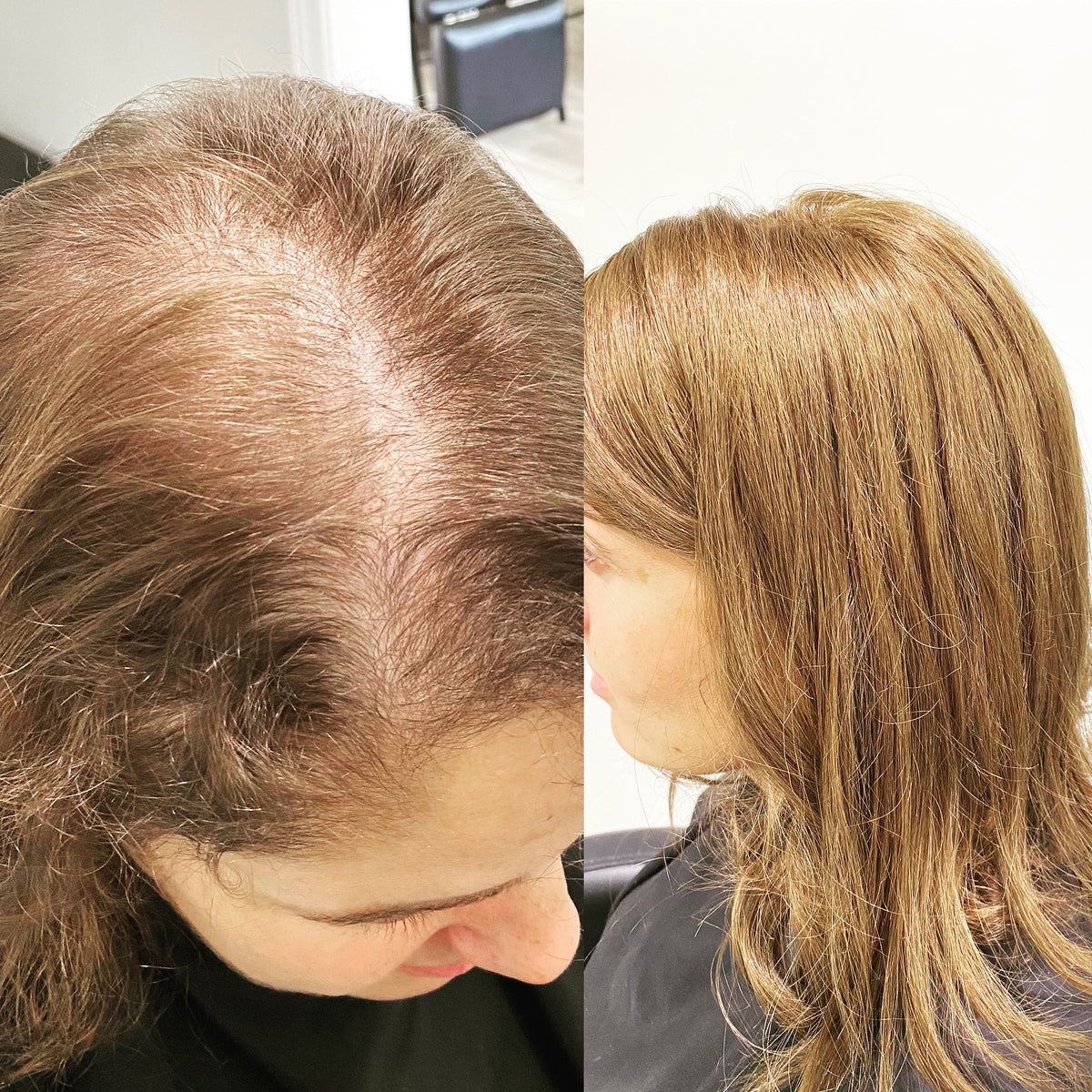


A hair topper only looks natural when it matches you: your color, your gray, your curl and the way your hair moves. Ready-made toppers rarely get all of that right out of the box. That's why almost every topper we fit is customized in our salon before it ever goes on a client's head.
Here's how we do it, and what to watch out for if you're thinking about changing the color or texture of a topper.
It Starts With the Right Hair
We carry one-donor virgin human hair toppers. Virgin means the hair has never been colored, permed or relaxed, and one-donor means all the hair comes from one person, so it behaves evenly. That matters, because virgin hair takes color and perm predictably. Processed or mixed hair can break, go brassy or refuse to hold a curl.
Even with the best hair, we always do a strand test on a small hidden section before any color or perm.

Matching Your Color
We color toppers in the salon to match your own hair: rooted color, highlights, balayage, or a soft blend of gray. The goal is for the topper to disappear into your hair at the part and the hairline, where people look first.

A hair topper custom blended with gray to match the client's own hair.
Salt-and-Pepper Toppers: Check the Gray First
In many salt-and-pepper toppers, the gray strands are synthetic. Manufacturers use synthetic fiber because it holds a gray tone well, but synthetic hair can't be colored, permed or relaxed.
To check, touch a hot flat iron to just a few gray strands. If they melt, singe or shrivel, they're synthetic. Don't put chemicals on them.
Matching Your Texture: A Real Client
A client with tightly coiled, salt-and-pepper 4C hair came to us for thinning at the front and crown. We had a topper in her color, but not her curl, and she didn't want to relax her own hair to match it. So we changed the topper instead.
First I did a strand test with perm solution, left it for the full time and rinsed. The hair stayed strong and soft, so I knew it could take a careful perm. I put the topper on a mannequin head and used a gentle Paul Mitchell perm. I checked a test curl at 20 minutes, processed 10 minutes more, then rinsed for over 5 minutes. After blotting, I applied the neutralizer for 10 minutes, took out the rods and rinsed again for 10 minutes. The result was a soft, bouncy curl that matched her texture.
She left with her own color and her own curl, just fuller. You can see her before and after at the top of this post.
Cutting and Blending
Color and texture get you close. The cut finishes the job. We cut the topper on your head, so it blends into your own layers, part and fringe. Placing the bangs right is often what makes a topper look like your own hair instead of sitting on top.
How We Attach It
We attach toppers with a beaded matrix: small beads placed in a simple grid that hold the topper to your own hair, with no glue or sewing. It's snug and comfortable, and it protects the hair you have. Most clients come back about once a month to have it removed, serviced and reattached.
Some clients, including some of our transgender clients, prefer a clip-in topper they can put on and take off whenever they choose. We customize those the same way.
Before You Color or Perm a Topper
- Know what it is: human, virgin, Remy, or mixed with synthetic.
- Test the gray with heat before using any chemicals.
- Always strand test color or perm on a hidden section first.
- Work on a mannequin head, check often and rinse thoroughly.
- If you're not sure, ask a professional. A ruined topper is an expensive mistake.
Let Us Customize Yours
Every hair loss visit starts with a free, private consultation. We'll match your color and texture and show you which topper and attachment fit your hair and your life. You can also email photos of your hair to noelle@noellesalon.com first.
Book your free hair loss consultation
Learn more: Custom hair toppers in Boston · Hair loss solutions · Bald spots in women


