



Why Fine Hair Requires a Different Extension Strategy: What 35 Years Has Taught Me
By Noelle Salon | Hair Extensions Boston & Hair Loss Boston Specialists
After 35 Years, I've Learned That Fine Hair Should Never Be Treated Like Thick Hair
One of the biggest misconceptions in the hair extension industry is that every client can wear the same extensions if the method is adjusted slightly.
After more than 35 years working with women seeking Hair Extensions Boston services, struggling with Hair Loss Boston concerns, experiencing thinning hair, menopause-related hair changes, early female pattern hair loss, and various forms of alopecia, I've learned that successful extension applications are rarely about choosing the newest method.
They are about understanding what the natural hair can safely support.
Many women arrive at our salon asking about tape-ins, keratin bonds, I-tip extensions, hand-tied extensions, invisible bead rows, or micro wefts. They have spent hours researching methods online and often assume the most important decision is choosing the right extension system.
In reality, my evaluation starts somewhere entirely different.
Before I discuss extension methods, I evaluate follicle density, scalp visibility, hair strength, active shedding, and long-term hair health.
Because successful extensions are not determined by trends.
They are determined by support.
One of the biggest mistakes I see is treating fine hair like thick hair.
Fine hair requires a different extension strategy.
After 35 years of working with fine hair, thinning hair, and hair loss, I've learned that successful extensions begin with evaluating what the natural hair can safely support.

Fine Hair, Thin Hair, Thinning Hair, and Hair Loss Are Not the Same Thing
One of the first things I explain during consultations is that these terms are often used interchangeably when they shouldn't be.
Fine Hair
Fine hair refers to the diameter of the individual strand and is usually genetic.
A woman can have extremely fine hair and still have excellent density.
Thin Hair
Thin hair refers to density.
In other words, how many hairs are actually growing from the scalp.
Thinning Hair
Thinning hair may result from aging, menopause, stress, medications, nutritional deficiencies, thyroid disorders, hormonal changes, or other medical conditions.
Hair Loss
Hair loss is an entirely different category and may include:
- female pattern hair loss
- androgenetic alopecia
- alopecia areata
- frontal fibrosing alopecia
- traction alopecia
- Trichotillomania Hair Loss
- chemotherapy-related hair loss
- autoimmune disorders
Each situation requires a different strategy.
At our Hair Loss Boston consultations, we frequently meet women who have been told they have female pattern hair loss, alopecia, or another hair loss condition but still feel uncertain about what options are available after diagnosis.
This is why I don't start with extension methods.
I start with understanding why the hair looks the way it does.
If you're unsure why your hair is becoming thinner, I recommend reading our guide on common causes of hair thinning in women before deciding which cosmetic solution may be appropriate.
Women experiencing early female pattern hair loss often require a different approach than women with naturally fine hair because scalp visibility, density loss, and support capacity can significantly change which solutions are most appropriate.
Likewise, women experiencing Trichotillomania Hair Loss often require a completely different strategy because support may be uneven, patchy, or concentrated in specific areas of the scalp. In these situations, traditional extension methods may not always be the best answer, and alternative support systems may need to be considered.
What I See During the First Five Minutes of a Consultation
After 35 years of working with fine hair, thinning hair, and hair loss, I have learned that some of the most important information is visible before I ever discuss extension methods.
When a client sits in my chair, I am already evaluating how the hair behaves.
I look at where the scalp is visible. I observe whether the thinning is concentrated at the crown, temples, hairline, or throughout the entire scalp. I pay attention to whether the density appears stable or whether the hair looks actively compromised.
Many women focus on the ends of their hair because that is what they see in the mirror.
I focus on the scalp because that is where the answers are.
I also pay attention to how clients wear their hair.
Do they constantly adjust the front to hide thinning?
Do they avoid pulling their hair back?
Do they feel uncomfortable when someone stands above them?
Do they part their hair in the exact same place every day because they are trying to conceal an area of thinning?
These observations tell me far more than simply knowing which extension method a client found online.
The goal is not finding a way to attach hair.
The goal is understanding what the natural hair can safely support.
Understanding follicle density and scalp visibility is often more important than choosing an extension method.

What I Evaluate Before Recommending Extensions
Before recommending any solution, I evaluate:
- Follicle density
- Scalp visibility
- Crown density
- Hairline density
- Temple density
- Hair strand strength
- Previous extension history
- Existing breakage
- Hair loss patterns
- Signs of active shedding
One of the most important things I evaluate is density.
Many people assume that because they have fine hair they are automatically a poor candidate for extensions.
That is not necessarily true.
I have worked with women who have extremely fine hair but excellent density. I have also worked with women whose hair strands appear stronger but whose follicle density is significantly lower.
This is why density matters more than most people realize.
I am not simply evaluating the hair.
I am evaluating how much support it can safely provide.
Women experiencing early female pattern hair loss often arrive at this stage because they are noticing widening parts, increased scalp visibility, or gradual density changes but are unsure what to do next.
Those concerns require a very different evaluation than a woman who simply has naturally fine hair.
Why I Perform a Tug Test
When appropriate, I often perform a gentle tug test during the consultation process.
The purpose is not to diagnose a medical condition.
The purpose is to determine whether the client may be experiencing active shedding.
If the hair appears to be actively shedding, that changes the conversation.
My first priority becomes protecting the natural hair.
Adding extensions to hair that is actively shedding without understanding the cause may create additional challenges and can make it more difficult to evaluate what is happening over time.
In those situations, I may encourage a client to work with a dermatologist, primary care physician, endocrinologist, or another healthcare professional while we discuss cosmetic options that may be appropriate in the meantime.
Understanding the common causes of hair thinning in women is often an important first step before deciding whether extensions, toppers, or other cosmetic solutions may be appropriate.
Density Tells Me Far More Than Texture
One of the biggest mistakes people make is focusing on the extension method before understanding the hair itself.
Over the years, I have learned that density tells me far more than texture.
Two women may both describe their hair as fine, yet one may be an excellent extension candidate while the other may require a completely different solution.
The extension method comes after the evaluation—not before.
Two clients may both have fine hair yet require completely different extension strategies based on follicle density and support capacity.

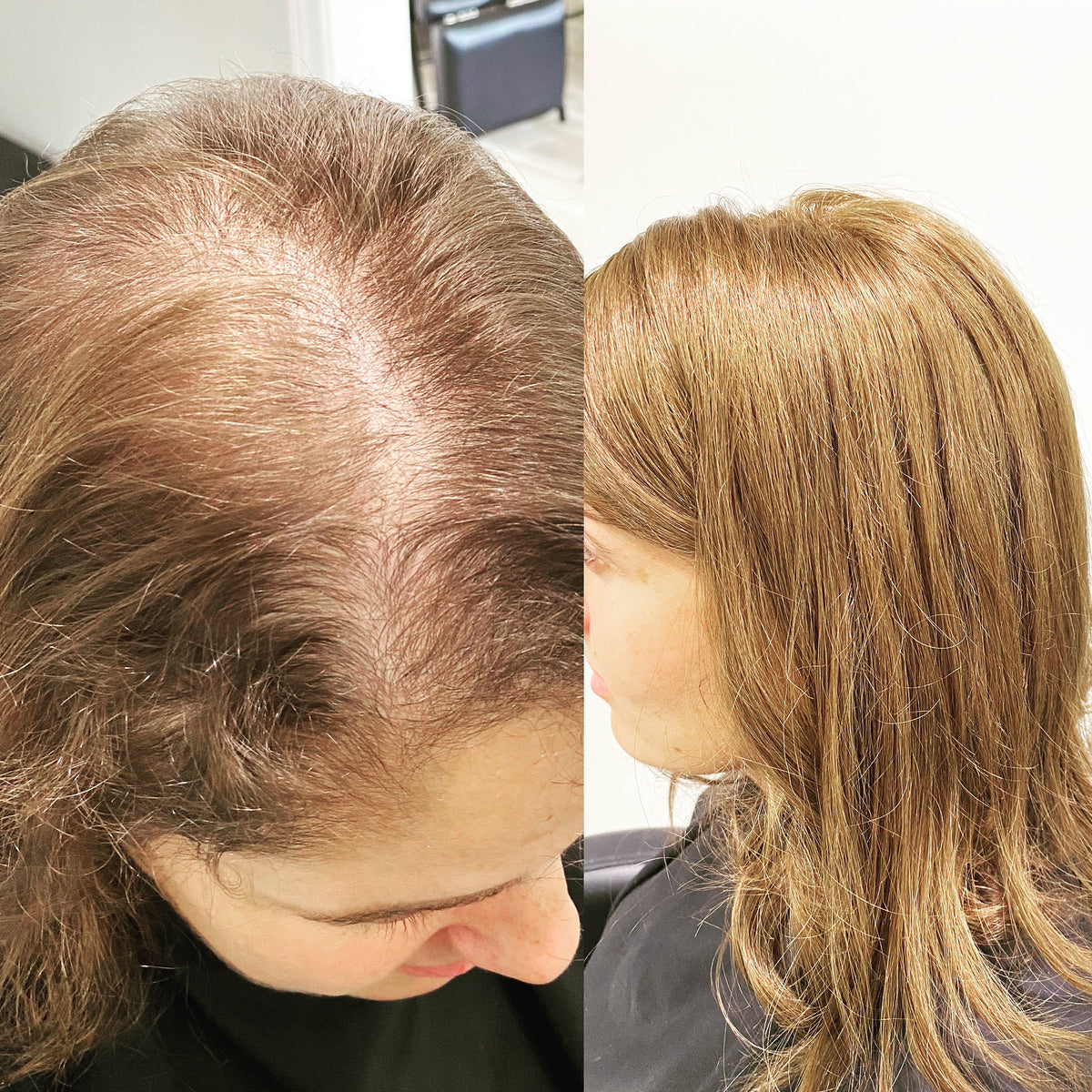
See How a Customized Fine Hair Extension Strategy Can Transform Thin Hair
Many women assume that fine hair cannot support extensions. In reality, success depends on evaluating density, support capacity, placement, and long-term hair health before extensions are ever applied.
The Biggest Mistakes I See With Fine Hair Extensions
Many women come to us after experiencing extension damage, discomfort, excessive shedding, poor blending, or disappointment with previous extension applications.
In many cases, the problem is not the extension method itself.
The problem is that fine hair was treated like average-density hair.
After more than 35 years working with fine hair, thinning hair, and hair loss, I've learned that successful extension applications are rarely determined by the newest method.
They are determined by understanding what the natural hair can safely support.
Adding Too Much Hair
One of the most common mistakes I see is simply adding too much hair.
Many women assume that if their hair feels thin, the solution is adding as much density as possible.
In reality, excessive density can create unnecessary weight, increased maintenance, and additional stress on the natural hair.
The healthiest extension applications are often the most realistic ones.
I have found that believable density almost always creates a better long-term outcome than dramatic transformations that overwhelm the natural hair.
Many of the women who visit us for Hair Extension Correction Boston consultations are dealing with problems that began when too much hair was added without considering density, support capacity, or long-term maintenance.
Adding Too Much Length
Length creates leverage.
This is one of the most overlooked concepts in fine hair extensions.
Most people focus on weight.
I also focus on leverage.
Every additional inch increases the amount of force being placed on the attachment point.
A client who can comfortably support twelve-inch extensions may struggle with twenty-two-inch extensions even if the total amount of hair seems reasonable.
This is one reason why realistic length recommendations are so important for fine-haired clients.
The goal is not creating the longest hair possible.
The goal is creating hair that remains healthy, comfortable, and believable.
Why Weight Distribution Matters More Than Weight
One of the biggest misconceptions about fine hair extensions is that weight alone determines success.
In my experience, weight distribution matters more than weight.
I evaluate the scalp almost like an architect evaluates a structure.
Every area has a different support capacity.
Some areas have excellent density.
Other areas are more fragile.
The goal is not simply reducing weight.
The goal is distributing weight appropriately across the areas capable of supporting it.
This is why two women with similar hair may receive completely different extension recommendations.
What 35 Years Has Taught Me
Most people assume fine hair cannot support extensions because extensions are "too heavy."
In reality, the question is rarely whether extensions are too heavy.
The question is whether the weight is being distributed appropriately.
Fine hair often responds beautifully when attachment sizes, placement, and density are customized to the individual.
Weight distribution matters more than weight alone.
Fine hair extensions should be customized based on density, support capacity, and weight distribution rather than using a one-size-fits-all approach.

Why Placement Matters More Than Method
Many women spend a great deal of time researching extension methods.
In reality, placement often matters more than method.
The same extension method can create dramatically different outcomes depending on where the hair is placed, how much support exists in that area, and how the weight is distributed.
This is one reason why I evaluate every area of the scalp individually rather than applying the same strategy everywhere.
Fine hair requires customization.
Not every section of the scalp can safely support the same attachment size, weight, or density.
Why Perimeter Preservation Is So Important
One of the most important things I have learned over the years is that the perimeter often needs protection.
The hairline, temples, and perimeter are frequently the most fragile areas of the scalp.
For many fine-haired clients, leaving portions of the perimeter completely free of extensions creates healthier long-term results.
This not only helps conceal the extensions more naturally, but it also helps reduce unnecessary tension in areas that may already be vulnerable.
Sometimes what I leave out is just as important as what I add.
Why I Create Custom Keratin Bonds for Fine Hair
Most pre-bonded keratin extensions are designed for the average client.
Fine hair is not average.
When working with fine hair, thinning hair, or fragile areas of the scalp, I often reduce both the size of the attachment and the amount of hair contained within the bond.
In some cases, I create my own custom keratin extensions entirely using keratin adhesive.
This allows me to control:
- The amount of hair in each bond
- The size of the attachment
- The weight being supported by the natural hair
- The placement of each extension
- The overall density being added throughout the scalp
A standard manufacturer-made bond may be perfectly appropriate in one area but too large in another.
By creating custom bonds, I can match the extension to the support available rather than forcing the hair to support a predetermined attachment size.
Custom fine hair keratin bonds compared to standard manufacturer-made keratin extensions.
Fine hair often benefits from customized bond sizes and reduced attachment weight to better match follicle density and support capacity.

When Micro Wefts Can Work Beautifully
Many people assume micro wefts are never appropriate for fine hair.
That is not true.
Some women have fine strands but excellent follicle density.
Those clients may be wonderful candidates for carefully placed lightweight micro wefts.
The key is not whether the hair is fine.
The key is whether the density and support capacity can safely support the application.
This brings us back to the same principle that has guided every section of this article:
The evaluation comes first.
The extension method comes second.
When I Tell Clients Not To Get Extensions
One of the hardest conversations I have is telling a client that extensions are not the best solution.
That may sound surprising coming from someone who specializes in hair extensions, but after 35 years working with fine hair, thinning hair, and hair loss, I have learned that forcing the wrong solution almost always creates disappointment.
My responsibility is not to sell extensions.
My responsibility is to recommend the solution that gives the client the healthiest and most natural-looking outcome.
Sometimes that solution includes extensions.
Sometimes it does not.
When scalp visibility becomes the primary concern, extensions alone may not always be the best solution.

If The Top Of The Scalp Is See-Through, Extensions May Not Solve The Problem
One of the first things I evaluate is scalp visibility.
If the top of the scalp is highly visible, simply adding more hair underneath the problem often does not solve the problem.
In fact, it can sometimes make the contrast more noticeable.
This is where many women become frustrated.
They assume they need more hair.
What they often need is a different type of support system.
At that point, I begin evaluating whether the client would be better served by a topper, a closure, mesh integration, a meshless support system, carefully placed extensions, or a combination approach.
The goal is always the same:
Create natural-looking density while protecting the hair that remains.
When I Recommend A Hair Topper
A topper can be an excellent option when the primary concern is visible scalp exposure at the top of the head.
Many women researching Hair Topper vs Hair Extensions for Thinning Hair are surprised to learn that they are trying to solve a scalp visibility problem rather than a length or fullness problem.
A topper allows us to add density exactly where it is needed most.
For some women, that creates a more natural-looking result than traditional extensions alone.
When I Recommend Mesh Integration
There are situations where traditional attachment points simply do not have enough support capacity to safely hold additional hair.
This is often where What Is Mesh Integration and Who Is It Best For? becomes an important conversation.
Mesh integration can provide a support system that helps distribute weight across a larger area rather than asking fragile hair to carry the entire load.
For women experiencing advanced thinning, patchy hair loss, diffuse hair loss, or Trichotillomania Client Transformations and Recovery Stories, mesh integration can sometimes provide options that extensions alone cannot.
When I Use Partial Mesh Or Meshless Support Systems
Not every client requires a full mesh integration system.
Sometimes only a specific area lacks the support necessary for traditional extension attachments.
In those situations, I may use partial mesh integration or a meshless support system to create stability in weaker areas while using extensions in stronger areas.
This is one reason why no two consultations are exactly alike.
The strategy is always built around the client's density, support capacity, hair loss pattern, lifestyle, and goals.
Sometimes The Best Solution Is A Combination Approach
Some of the most successful transformations I have created involve combining multiple techniques.
A client may benefit from:
- Carefully placed extensions
- A topper
- Partial mesh integration
- A closure
- A meshless support system
- Custom keratin bonds
This is why many of our Real Hair Loss Transformations: Before and After Results for Thinning Hair and Alopecia look completely different from one another.
The solution is never determined by a trend.
It is determined by what the hair can safely support.
Why Fine Hair Requires More Maintenance
One of the biggest misconceptions about fine hair extensions is that once the extensions are installed, the work is done.
In reality, maintenance becomes even more important when working with fine hair.
Fine hair often has less support capacity than medium or coarse hair. It may also be more susceptible to breakage, slippage, and changes in density over time.
Because of this, I typically monitor fine-haired clients more closely than clients with naturally dense hair.
The goal is not simply keeping the extensions looking beautiful.
The goal is protecting the natural hair underneath.
Fine Hair Changes More Quickly
One of the things I have observed over the years is that fine hair can change quickly.
Hormonal changes, stress, medications, menopause, health conditions, and normal aging can all affect density and support capacity.
A client who was an excellent candidate for a particular extension strategy two years ago may require a different approach today.
This is one reason I continually reassess the hair rather than assuming the original plan should remain unchanged forever.
More Hair Is Not Always Better
As the natural hair changes, the extension strategy may need to change as well.
Sometimes that means reducing density.
Sometimes it means shortening the length.
Sometimes it means changing attachment sizes.
Sometimes it means transitioning to a different solution entirely.
The healthiest long-term results usually come from adapting the strategy as the hair evolves.
Maintenance Is Part Of Hair Protection
Many women view maintenance appointments as a cosmetic service.
I view them as an opportunity to evaluate the health of the natural hair.
During maintenance appointments, I pay attention to:
- Changes in density
- Signs of tension
- Areas of weakness
- Hairline health
- Crown density
- Shedding patterns
- Overall support capacity
These appointments allow me to make adjustments before small problems become larger ones.
Why Maintenance Matters
One of the biggest mistakes I see is waiting too long between maintenance appointments.
Fine hair often benefits from proactive adjustments rather than reactive corrections.
The healthiest extension clients are usually the ones who view maintenance as part of protecting their natural hair, not just maintaining their extensions.
Regular maintenance appointments allow extension strategies to evolve as the natural hair changes over time.

Frequently Asked Questions About Fine Hair Extensions
Can women with fine hair safely wear hair extensions?
Yes, many women with fine hair can safely wear extensions when the application is customized to their density, support capacity, and hair health. The key is selecting the right strategy rather than assuming every extension method works for every client.
What are the best hair extensions for fine hair?
There is no single best method for every client. The best extension strategy depends on follicle density, scalp visibility, support capacity, lifestyle, and long-term goals. For some clients, micro wefts work beautifully. Others may benefit from customized keratin bonds or alternative solutions.
Can hair extensions cause damage to fine hair?
Hair extensions can contribute to damage when too much weight, density, or length is added without considering what the natural hair can safely support. Proper placement, customization, and maintenance are essential for protecting fine hair.
How do I know if my hair is too thin for extensions?
The answer depends on density, scalp visibility, and support capacity rather than strand diameter alone. Some women with very fine strands are excellent extension candidates, while others may benefit from toppers, mesh integration, or alternative support systems.
What if I have thinning hair or hair loss?
Women experiencing thinning hair, female pattern hair loss, alopecia, menopause-related hair loss, or trichotillomania often require a different evaluation process. In some cases, extensions may be appropriate. In others, solutions such as hair toppers, mesh integration, or combination approaches may create better results.
Why do fine hair extensions require more maintenance?
Fine hair often changes more quickly than dense hair and may have less support capacity. Regular maintenance appointments allow adjustments to be made before small problems become larger concerns.
Is mesh integration better than hair extensions?
Neither solution is universally better. Mesh integration and extensions solve different problems. The best choice depends on scalp visibility, support capacity, density, and the specific pattern of hair loss.
Can I wear extensions if I have menopausal hair loss?
Many women with menopausal hair loss can still wear extensions, but the strategy often needs to be adjusted to accommodate changing density and support capacity. A consultation can help determine the safest and most natural-looking approach.
Conclusion: Fine Hair Deserves A Different Approach
After 35 years of working with fine hair, thinning hair, and hair loss, one thing has become clear: successful extensions are not determined by trends or methods alone.
They are determined by understanding what the natural hair can safely support.
Every woman has different density, different support capacity, different goals, and different challenges.
That is why I do not begin with an extension method.
I begin with an evaluation.
Whether the solution involves extensions, custom keratin bonds, micro wefts, a topper, mesh integration, or another support system, the goal remains the same: create a natural-looking result while protecting the natural hair.
Fine hair deserves more than a one-size-fits-all approach.
It deserves a strategy built specifically for the hair you're working with today.
Schedule a Free Hair Extension Consultation
If there is one thing I hope you take away from this article, it is that fine hair should never be treated exactly the same as thick hair.
Successful extensions are not determined by trends, social media transformations, or choosing the newest method.
They are determined by understanding what your hair can safely support.
Whether you're struggling with fine hair, thinning hair, menopause-related density changes, female pattern hair loss, scalp visibility, or previous extension damage, the first step is a proper evaluation.
During your consultation, we will assess:
- Follicle density
- Scalp visibility
- Hair health
- Support capacity
- Active shedding concerns
- Previous extension history
- Your lifestyle and long-term goals
From there, we'll discuss the options that may be most appropriate for your hair.
Depending on your needs, that may include customized keratin bonds, micro wefts, hair extensions, mesh integration, a topper, or another solution designed specifically for your situation.
The goal is not simply adding hair.
The goal is creating a natural-looking result while protecting the hair you already have.
If you're looking for expert guidance from a salon that specializes in fine hair, thinning hair, and hair loss solutions, we invite you to schedule a free hair extension consultation.


