

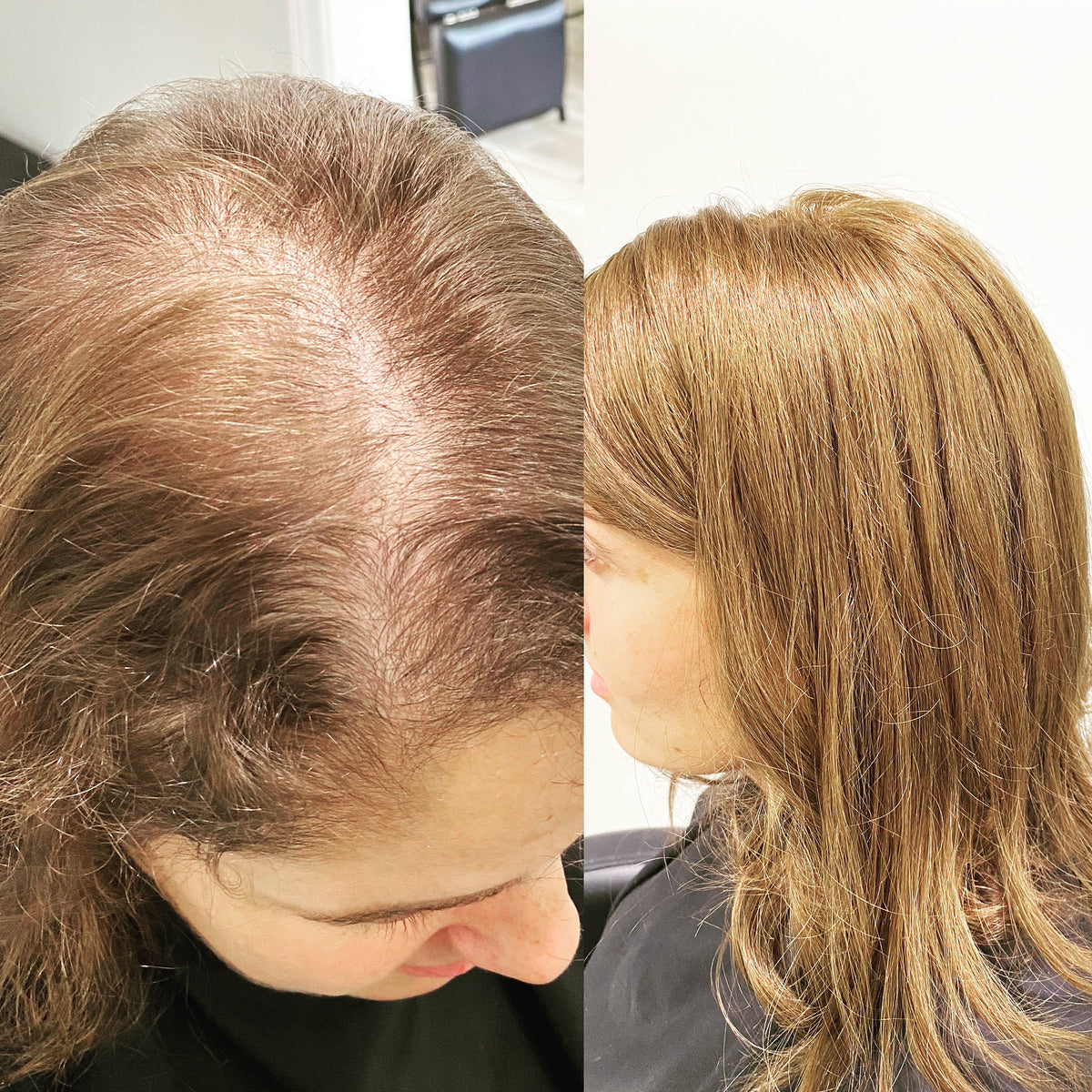


Transforming Thick Hair: The Hybrid Technique for Stunning Extensions
Most hair extension in Boston transformations focus on fine or medium-density hair craving fullness and length. This client was the opposite: she arrived with very thick, short hair and blunt ends that resisted typical blending. That contrast is exactly where a carefully planned hybrid approach shines. By combining methods, I created hair extensions for thick hair that moved naturally, stayed invisible, and supported her styling habits. She loved the versatility of keratin individual strands, yet the strands alone were not substantial enough to cover her dense crown, which called for a second technique to achieve seamless coverage.
What I Did: A Hybrid Plan for Dense, Short Hair
Step 1: Custom keratin strands from nape to just above the crown. I created larger, customized keratin individual strand hair extensions to match the client’s density from the nape through the mid-head. I also blended three complementary shades for an ultra-precise color match so the finished look read as her own hair.
Step 2: Evaluate coverage at the crown. After building four solid rows of keratin tracks without spacing, I reassessed coverage. Her crown was unusually dense, and per-square-inch coverage needed to increase. Although most people have less weight at the crown, thick hair there is real—and it requires a method that delivers wider, flatter coverage.
Step 3: Select a second method that stays undetectable. I reviewed my hair extension method options and ruled out tape-ins, which would likely show through her compact, short layers. For hair extensions for thick hair at the crown, I needed something thin, flexible, and very flat—so I chose two rows of Genius weft hair installed with a micro-link sew-in technique. Because the Genius weft is an ultra-thin, cuttable track that still delivers impressive volume, it offered the exact blend of coverage and invisibility her crown demanded. Which qualities matter most to you at the crown: the flattest lay, the softest movement, or the easiest maintenance?
Step 4: Seamless integration. I carefully sewed the Genius wefts around the upper circumference of her head and then blended the keratin strands and wefts together. Once shaped and finished, there was no visible line of demarcation—just a balanced silhouette with believable movement. If you run your fingers through your hair, do you prefer to feel only soft, flexible tracks, or are you open to a slightly fuller base for maximum fullness?
Definitions: Understanding the Methods
Keratin extensions: Individual strands tipped with keratin that are fused to small sections of natural hair. Because strand size, placement, and color can be customized, they are excellent for precision blending—especially helpful in hair extensions for thick hair when you want movement through the ends without bulky tracks.
Genius weft: An ultra-thin, machine-crafted weft that can be cut anywhere along the track without unraveling. It lays flatter than many traditional wefts, yet offers robust coverage per row—ideal at the crown for clients with dense hair who need compact, invisible reinforcement.
What to Know: Mixing Methods for the Best Result
Blending a few hair extensions techniques on one head can deliver a finish that single-method installs struggle to match. In some cases, the opposite scenario appears: a client may need less bulk at the crown, which is when hand-tied hair combined with keratin through the crown and sides can preserve lightness while maintaining a clean blend. How does your daily styling—wearing hair up, down, or half-up—affect which zones need the most discretion?
This client wears her hair up frequently and adores keratin individual strands. By placing the sew-in Genius weft at the crown and sides, those tracks remain hidden even in elevated styles while the keratin strands keep ends airy. For hair extensions for thick hair that still accommodate updos, this pairing keeps both coverage and concealment in balance. When you wear your hair up, which areas do you worry about showing most: the sides, the crown, or the nape?
How We Got Here: A Brief History of Extension Techniques
Long before modern salon installs, people enhanced hair with braided additions and even animal-hair pieces. By the 1960s–1980s, synthetic fibers broadened textures and colors, and new permanent bonding improved salon longevity, while cultural waves—from glam rock to hip-hop—pushed bold lengths into the mainstream.
More than 25 years ago, stylists typically worked with three primary options:
- Sew-in weave: Tracks sewn to braided bases or cornrows—secure and long-wearing, but with a fuller base that could feel structured.
- “Dome” synthetic strands: Introduced in the 1980s, these involved braiding and gluing synthetic pieces into single strands. They were challenging to maintain and difficult to blend with natural hair.
- Custom keratin bonds: Sections cut from wefts, tipped with hot keratin, and formed into single strand extensions. Far from outdated, this method remains a precision favorite, especially for strategic blending.
Today, the extension landscape is expansive—yet custom keratin still holds a valuable place. Those advances refined bonding, track design, and color blending, enabling today’s hybrid mixes of ultra-flat wefts with precision keratin for dense crowns and blunt cuts. Rather than committing to one trending approach, I choose techniques based on hair behavior, lifestyle, and target finish. Which historical advantage matters most for your thick hair—longevity, texture range, or flatter tracks?
Conclusion: Hybrid Technique, Custom Fit
If your thick hair has been difficult to blend or feels too heavy for traditional methods, you can book a free hair extension consultation to explore hybrid techniques that create a natural, balanced result tailored to your hair and lifestyle.


