

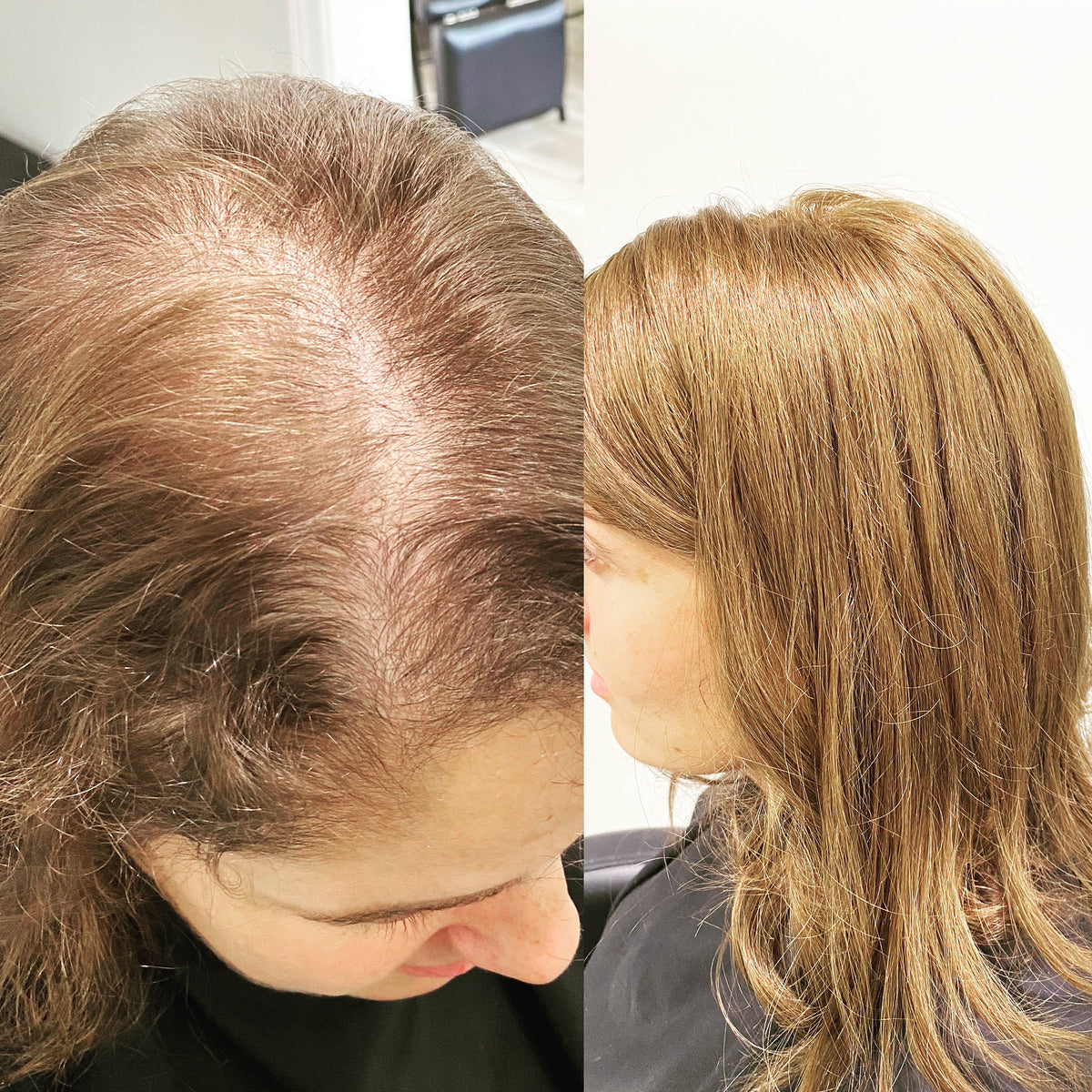


Hair Topper Before And After: Real Results For Crown Thinning And Hair Loss
Quick Answer: Can A Hair Topper Help Crown Thinning?
Yes. A hair topper can be one of the most natural-looking solutions for women experiencing crown thinning, a widening part, scalp visibility, Female Pattern Hair Loss, menopause-related thinning, trichotillomania, or diffuse hair loss.
Many women first come to Noelle Salon asking for hair extensions because they want fuller, longer hair. But when hair loss is concentrated on the top of the head, extensions alone usually cannot solve the problem. Hair extensions need natural hair to cover them. Even the smallest micro extensions still need enough density on top to hide the attachment points.
That is where a hair topper, closure, mesh integration system, meshless integration, or beaded topper foundation may work better.
Many women searching for Hair Loss Boston solutions want coverage that looks natural, feels secure, and does not require shaving or gluing. At Noelle Salon, our goal is to protect the existing hair while creating soft, natural-looking coverage that blends with the client’s own hair.
A custom hair topper can restore natural-looking density for women experiencing crown thinning, widening parts, and visible scalp exposure.

Why Women With Crown Thinning Often Ask For Hair Extensions First
One of the most common things I hear during consultations is, "I think I need hair extensions." In reality, many women who come to me for extensions actually need coverage at the crown first.
They want more fullness.
They want more length.
They want to feel like themselves again.
But if the thinning is on the top of the head, hair extensions are not always the right first solution.
Hair extensions add length and fullness to the sides, back, and lower areas of the hair. They do not replace missing density at the crown or part line.
If the top of the head is thin, extensions may actually become harder to hide.
This is one of the most common conversations I have during a hair loss consultation.
A client may have enough hair around the sides and back to support extensions, but not enough density at the crown to conceal them. In these cases, a hair topper or closure may create the coverage needed on top, while hair extensions may be used underneath to add length and fullness.
| Concern | Hair Extensions | Hair Topper | Mesh Integration |
|---|---|---|---|
| Widening Part | Poor Choice | Excellent Choice | Sometimes |
| Crown Thinning | Poor Choice | Excellent Choice | Sometimes |
| Diffuse Thinning | Limited Benefit | Often Helpful | Often Helpful |
| Advanced Hair Loss | Usually Not Enough | Sometimes | Often Best |
For women comparing options, read Hair Topper vs Hair Extensions For Thinning Hair: Which Solution Is Right For You?

Hair extensions can add length, but a topper replaces missing density where scalp visibility is most noticeable.
What Crown Thinning Looks Like Before A Hair Topper
Crown thinning often begins subtly.
Women may notice:
Their part looks wider.
Their scalp shows in photos.
Their crown looks flat.
Their hair no longer holds volume.
They avoid overhead lighting.
They stop wearing certain hairstyles.
They feel exposed when someone stands behind them.
Many women do not realize how much crown thinning has developed until they see a photo taken from above.
This can be emotional.
Hair loss on the crown is difficult to hide because it affects the area people see when you sit down, bend forward, stand under bright lights, or wear your hair parted.
For more on how female hair loss progresses, read Female Hair Loss Stages: What Women Actually Notice Over Time.
Why A Hair Topper Can Look More Natural Than A Wig
Many women assume a wig is the only option. In reality, women who still have growing hair often achieve a more natural result with a topper because only the area needing coverage is addressed. For a complete comparison, read Hair Toppers vs Wigs.
Video: Removing And Replacing A Hair Topper
Watch a customized hair topper being removed and reapplied. Unlike many glued systems, this approach focuses on preserving existing hair while creating secure, natural-looking coverage for crown thinning and hair loss.
Hair Toppers And Hair Extensions Often Work Better Together
Some clients need coverage on top and length through the sides and back.
In those cases, a topper and extensions may work together beautifully.
The topper creates coverage at the crown, part line, or top of the head.
The extensions create length, movement, and fullness through the rest of the hair.
This can give the appearance of a full head of hair without using a heavy bonded wig.
For some women, this is the best of both worlds.
It gives the security and scalp coverage of a topper while still allowing the client to enjoy longer, fuller hair.
This is especially helpful for women who still have enough hair around the sides and back to safely support extensions.

For some clients, a topper provides crown coverage while extensions add length and fullness through the sides and back.
The Hair Topper Base Matters More Than Most People Realize
Not all hair toppers are the same. The right base depends on the pattern of hair loss, comfort, lifestyle, maintenance preferences, and existing hair density. During a consultation, I help determine which option is most appropriate. For a detailed explanation of topper selection, read How To Choose The Right Hair Topper For Your Hair Loss Pattern.

When A Hair Topper Alone May Not Be Enough
Some women with advanced thinning may require a customized foundation or mesh integration approach before a topper can be attached comfortably and naturally.
For a deeper explanation, read What Is Mesh Integration And Who Is It Best For?

Hair Toppers For Trichotillomania
Trichotillomania-related hair loss can be very different from general thinning.
Some clients have isolated patches.
Some have crown loss.
Some have hairline loss.
Some have uneven regrowth.
Some are actively pulling.
Others are in recovery.
A hair topper may help conceal the affected area while allowing the existing hair to remain protected.
These cases require patience, privacy, customization, and compassion.
No two trichotillomania clients are exactly alike.
For more on this topic, read Trichotillomania Client Transformations And Recovery Stories.

Hair toppers can help conceal patchy hair loss caused by trichotillomania while preserving existing hair.
Hair Toppers For Gray, Silver, And White Hair
Gray and silver hair can be difficult to match.
The color must look natural in different lighting.
The texture has to blend.
The density must be believable.
The cut has to make the topper look like part of the client’s own hair.
At Noelle Salon, we stock a wide range of colors, base sizes, and hair extension options so many clients can feel, compare, and apply solutions the same day.
This matters because hair replacement is not just about coverage.
It is about realism.
A topper that does not match the client’s color, density, texture, or haircut will not look natural.
Women transitioning to gray often experience changes in density as well. If you're noticing both color changes and thinning, our article Menopausal Hair Loss Before and After: Real Solutions for Thinning Hair Over 50 may be helpful.

Custom gray hair toppers can restore density while matching natural gray, silver, and white hair tones.
Why We Stock Hair Toppers In Different Colors, Densities, And Base Sizes
One of the biggest frustrations women experience when shopping for hair toppers online is not knowing what will actually work for their hair.
A topper that looks beautiful online may not match your density, color, hair texture, lifestyle, or stage of hair loss.
That is why we stock a wide variety of hair toppers, base sizes, colors, densities, and hair extension options in the salon.
During a consultation, clients can often:
- See different topper options in person
- Touch and compare various hair qualities
- Compare base sizes and attachment methods
- Evaluate different densities
- Explore gray, silver, and white hair options
- See how toppers blend with fine or thinning hair
- Better understand which solution feels most comfortable
For many women, seeing and feeling the options in person removes much of the uncertainty that comes with choosing a hair loss solution.
Because we stock a wide range of colors and bases, many clients are able to compare options during their consultation and, in some cases, leave with a same-day solution.
The goal is not simply to sell a topper.
The goal is to find the most natural-looking option for the client's hair loss pattern, lifestyle, maintenance schedule, and long-term goals.
Why The Cut And Blend Matter So Much
A topper does not look finished just because it is attached.
The cut is everything.
Hair toppers, wigs, and extensions do not cut the same way natural hair does.
They require different blending, shaping, density control, face framing, and movement.
This is one reason professional customization matters.
A topper may look too heavy, too bulky, too blunt, or too separate from the natural hair if it is not properly cut and styled.
The best results usually happen after:
Custom fitting
Color matching
Secure attachment
Custom cutting
Blending
Styling
Maintenance planning
The goal is for the topper to move with the client’s natural hair, not sit on top of it.

The most natural topper results usually happen after custom cutting, blending, and styling.
Supporting Scalp Health Between Hair Topper Appointments
Hair replacement should not ignore scalp health.
The scalp still needs to be cleaned, exfoliated, treated, and cared for.
Between services, we offer scalp preservation treatments in a private room. These treatments may include scalp exfoliation, scrubs, oils, massage, and red or green light support.
The goal is to keep the scalp clean and comfortable while protecting the hair that is still growing.
This is especially important for clients wearing toppers, mesh integration systems, meshless integration, or beaded foundations.
Protecting the scalp is part of protecting the long-term result.
Real Hair Topper Before And After Results
Every transformation is different.
Some clients need soft coverage for early crown thinning.
Others need a topper with extensions for length.
Some need a closure.
Some need mesh integration.
Some need a custom foundation because there is not enough hair for traditional attachment.
The best result depends on the client’s hair loss, goals, lifestyle, maintenance schedule, and comfort level.
A hair topper is not just a product.
It is a customized solution.

Even advanced thinning can often be addressed with a customized topper and professional cut.
What Most Women Learn After Their Consultation
Most women arrive believing they need one specific solution.
After evaluating their scalp visibility, density, support capacity, lifestyle, and goals, they often discover there are more options than they realized.
Sometimes the answer is a topper.
Sometimes it is extensions.
Sometimes it is mesh integration.
Sometimes it is simply monitoring the hair and seeking medical evaluation first.
The best solution is the one that fits the actual pattern of hair loss—not the one that sounds most appealing online.
Conclusion
Hair toppers can be life-changing for women experiencing crown thinning, widening parts, scalp visibility, trichotillomania, menopause-related thinning, and Female Pattern Hair Loss.
But the best results come from choosing the right solution for the actual pattern of hair loss.
Many women first ask for hair extensions, but extensions alone cannot hide thinning on the top of the head. A topper, closure, mesh integration system, or customized foundation may be needed to restore natural-looking coverage.
A wig is not always the best answer either, especially when a client still has growing hair that should be protected.
The goal is to create coverage without unnecessary shaving, gluing, or damage.
After more than 35 years helping women with hair loss, I have learned that the most natural results come from thoughtful consultation, the right base, high-quality hair, proper attachment, custom cutting, and a plan that respects the client’s existing hair.
Schedule A Hair Loss Consultation In Boston
If you are experiencing crown thinning, a widening part, scalp visibility, trichotillomania-related hair loss, or thinning hair that extensions alone cannot solve, we can help you understand your options.
During your consultation, we will evaluate your hair loss pattern, existing density, support capacity, lifestyle, and goals.
We will explain whether a topper, mesh integration system, meshless integration, extensions, or a combination solution may be most appropriate.
If medical evaluation is recommended, we will tell you that.
Schedule Your Free Hair Loss Consultation
About The Author
Noelle, Founder of Noelle Salon
For more than 35 years, Noelle has helped women navigate hair loss, thinning hair, fine hair challenges, trichotillomania, alopecia, menopause-related hair changes, and non-surgical hair replacement solutions.
Her work focuses on helping women understand their options while protecting the integrity of their existing hair.
Over the course of her career, she has worked with thousands of women experiencing Female Pattern Hair Loss, Telogen Effluvium, trichotillomania, menopause-related thinning, and other forms of hair loss.
Noelle’s expertise includes hair toppers, mesh integration systems, customized hair extension solutions for fine and thinning hair, and advanced hair loss consultations.
She is also the founder of a luxury hair extension manufacturing company and has spent decades studying hair quality, customization, product sourcing, and natural-looking hair replacement solutions.
Her approach combines technical expertise, ongoing education, compassion, and individualized planning to help women restore confidence while maintaining the health of their natural hair.
Frequently Asked Questions
Can A Hair Topper Help Crown Thinning?
Yes. A hair topper can help cover crown thinning, widening parts, and scalp visibility by adding density where natural hair has become thin.
Is A Hair Topper Better Than Hair Extensions For Crown Thinning?
Often, yes. Hair extensions add length and fullness, but they do not replace missing density on the top of the head. A topper can cover the crown while extensions may be used for length.
Do You Have To Shave Your Head To Wear A Hair Topper?
No. At Noelle Salon, we do not shave the head or glue toppers directly to the scalp. We focus on attachment methods designed to protect existing hair.
Can A Hair Topper Be Attached Without Glue?
Yes. Depending on the client’s hair loss pattern, toppers may be clipped in, beaded, integrated, or attached through customized non-glue methods.
Can A Hair Topper Be Combined With Hair Extensions?
Yes. Many clients wear a topper for crown coverage and extensions for length or added fullness through the sides and back.
What Is The Difference Between A Hair Topper And A Wig?
A topper covers a specific area of thinning, usually the crown or part line. A wig covers the entire head. Many women prefer toppers when they still have existing hair they want to preserve.
Can A Hair Topper Help Trichotillomania?
Yes, in some cases. A hair topper may help conceal patchy hair loss caused by trichotillomania while protecting existing hair. Each case requires customized evaluation.
How Natural Can A Hair Topper Look?
A hair topper can look very natural when the base, color, density, attachment, cut, and styling are customized to the client.
How Much Hair Do I Need To Attach A Hair Topper?
It depends on the attachment method and the pattern of hair loss. In some cases, very little hair may be needed when a customized foundation is used.
What Happens During A Hair Topper Consultation?
During a consultation, we evaluate your hair loss pattern, scalp visibility, existing density, color, lifestyle, maintenance needs, and whether a topper, extensions, mesh integration, or another option is best.
Can A Hair Topper Be Worn With Very Short Hair?
Yes. Depending on the attachment method and hair loss pattern, some clients can wear a customized topper with less than one inch of existing hair. During a consultation, we evaluate support capacity and determine the safest attachment option.


