

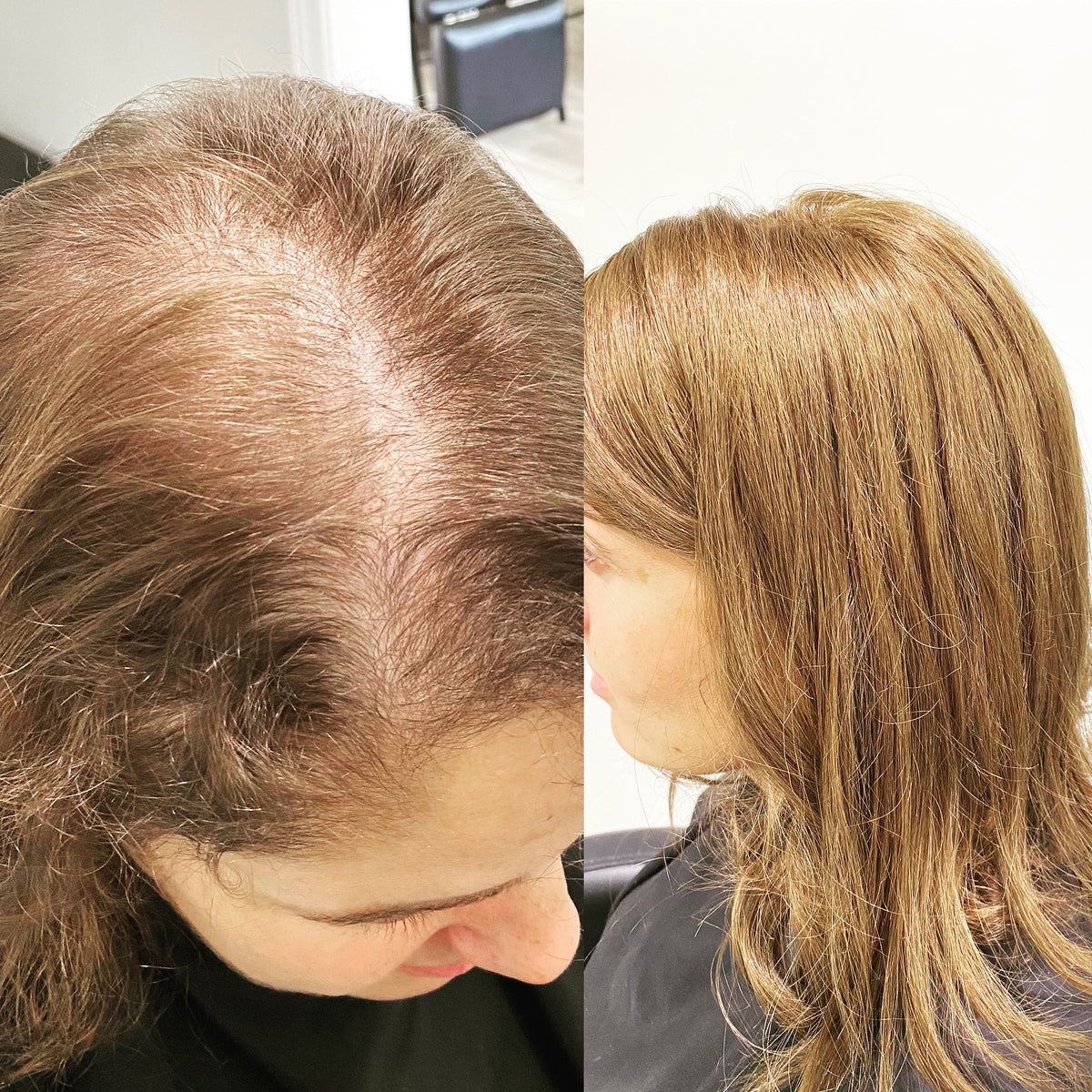


Finding a bald spot is scary. It often shows up suddenly, it's usually in a place you can't easily hide, and it can make you stop wearing your hair the way you love. After 35 years of working with hair loss, I can tell you this: a bald spot is one of the most fixable kinds of hair loss there is, as long as the solution fits the spot.
Here's what causes bald spots in women, how a custom hair patch works, and what we do at our salon in Melrose, just north of Boston.
What Causes Bald Spots in Women?
Patchy hair loss has many causes, and the right solution depends on which one you have. The most common ones we see:
- Alopecia areata: an autoimmune condition that causes round or oval patches, often suddenly. Hair may grow back, then the patches can return.
- Trichotillomania: hair pulling, which often leaves patches at the crown, part or temples.
- Traction alopecia: thinning from tight ponytails, buns, braids or heavy extensions, usually at the hairline and temples.
- Scarring alopecias such as lichen planopilaris: inflammation that can permanently damage follicles.
- Illness, surgery or chemotherapy: hair can come back unevenly, leaving thin areas.
We're hair loss specialists, not doctors. If you have a new bald spot, see a dermatologist to find the cause, especially if your scalp is red, itchy, scaly or tender. We're happy to work alongside your medical care.
Why a Small Spot Needs a Small Solution
Most women with a bald spot don't need a wig. A full wig or a large topper can feel like far too much hair for one small area. Hair extensions don't work either, because they need hair to attach to, and a bald spot has none. You need enough of your own hair, about 70%, to hide extension attachments.
That's why we created custom hair patches: a small piece of human hair built for the exact size and shape of your spot.

How a Custom Hair Patch Works
- Custom made: sized to your spot, then color matched to your hair, including highlights, gray and balayage.
- Human hair: it moves, styles and takes heat like your own.
- Attached to your own hair: when there's hair around the spot, we secure the patch with our beaded or sew-in method. We never shave your head and never use glue. If there's no hair nearby to support the patch, we may use tape.
- Breathable: a light mesh base lets your scalp breathe and lets your hair move naturally through it.
- Cut in: we cut and blend it into your style so it disappears, even when you wear your hair up.
For larger or more spread-out areas, a mesh integration system or a custom hair topper may be a better fit. We'll show you every option at your consultation.

Who Hair Patches Are Best For
- Trichotillomania
- Alopecia areata
- Random or isolated bald spots
- Hair loss at the nape of the neck, which is hard to cover any other way
- Small areas where extensions can't be applied
We've made patches for women with alopecia and thinning, for men and boys who were being teased about a visible spot, and for clients in the LGBTQIA+ community, including trans women with pattern hair loss. For many of them, a patch brings back something simple: feeling normal again.
Patch, Topper, Wig or Extensions?
- Hair patch: best for small, isolated bald spots.
- Hair topper: best for thinning across the top or crown.
- Wig: best for hair loss over most of the head.
- Extensions: best when you still have enough of your own hair to hide the attachments.
Real Results From Our Salon
When the bald area is larger, or there's thinning around it, we build a bigger solution the same way: custom made, color matched and attached to your own hair.

Thinning through the top, covered with a custom hair topper attached with knots, then cut into a soft bob.

A large bald area at the crown, restored with a mesh integration hair system, a hair topper and hair extensions for length and fullness.

Hair loss from trichotillomania, covered with a hair topper and mesh integration. The mesh also acts as a barrier against pulling.
Will My Hair Grow Back Underneath?
It depends on the cause. With alopecia areata and trichotillomania, hair often does grow back, and a patch or mesh can protect it while it does. For our trichotillomania clients, the mesh also acts as a barrier: it's hard to pull through, which helps break the habit, and many clients see their own hair return underneath. With scarring alopecia, the goal is to protect the scalp and cover the area comfortably.
Maintenance
Because a patch is attached to your growing hair, it needs to be moved up and tightened every 4 to 8 weeks, depending on how fast your hair grows. With good care, the hair system itself usually lasts 6 months to a year before it needs replacing.
Can Insurance Help?
Many insurance plans cover a scalp (cranial) prosthesis. Call your insurance company and ask about coverage for a cranial prosthesis, then get a prescription from your doctor. We'll give you a paid receipt to submit for reimbursement.
Your Free, Private Consultation
Every hair loss visit starts with a free consultation in our private room. We'll look at your spot, talk about what's causing it and what you want, and show you which options fit. Many clients enjoy a relaxing scalp massage as part of their visit. We keep hair in stock, so in many cases we can take care of your spot the same day.
Not ready to come in? Email photos of your hair to noelle@noellesalon.com and I'll tell you honestly what will work.
Book your free hair loss consultation
Frequently Asked Questions
Can you cover a bald spot without a wig?
Yes. A custom hair patch covers just the area you need, attached to your own hair, so you never have to wear a full wig for one spot.
Will a hair patch damage my hair?
We attach patches to your own hair with our beaded or sew-in method, with no shaving and no glue, and we move them up every 4 to 8 weeks to keep your hair healthy. Tape is only used when there's no hair nearby to support the patch.
Can I wear my hair up with a patch?
In most cases, yes. We place and cut the patch so it blends when your hair is up or down.
Do you work with children and teens?
Yes. Many of our alopecia and trichotillomania clients are children and teens, and we welcome parents throughout the process.
Learn more: Hair loss solutions in Boston · Alopecia hair salon · Trichotillomania help


