



Alopecia Hair Stylist Near Me: Find Expert Solutions
Alopecia comes in many forms—and finding a stylist who truly understands it can feel frustrating.
At Noelle Salon, we specialize in working with clients experiencing all types of hair loss, making us a trusted destination for hair loss Boston. Whether you’ve been diagnosed or are still searching for answers, we provide real, personalized solutions—not guesswork.
We have extensive experience working with:
- Telogen effluvium
- Alopecia areata
- Alopecia universalis
- Scarring alopecia
- Trichotillomania
Alopecia doesn’t just affect your hair—it affects your confidence. Many clients come to us after being told what they have, but not what to do next. That’s where we step in.
Our approach is simple: we assess your hair, your scalp, and your lifestyle to create a customized plan that works for you. This may include toppers, wigs, extensions, or scalp-focused treatments—all designed to give you natural-looking, realistic results.
We also work alongside your doctor’s recommendations when needed, ensuring your hair restoration plan supports your overall health.
Whether you’re looking for a stylist who understands thinning hair or need a full consultation for advanced hair loss solutions, you’re in the right place.
Noelle Salon Free Consultation
There are many hair restoration options to aesthetically restore hair without surgery, and the best way to determine what will work best for you is for us to evaluate your hair at a free consultation. Based on the location of your hair loss, we will then decide if a hair topper system, mesh integration system, hair extensions, or hair services. At Noelle Salon, a leader in the hair industry, we offer a free consultation to discuss your hair restoration options and provide expert solutions. We have so many 5-star reviews on Google, and we are thankful to our clients for sharing their personal hair loss stories.
Before


Same-Day Application
All of our solutions, including continental hair options, are in stock, in a variety of textures, colors, and hair density, for same-day service. With our extensive inventory, we ensure that you can walk out of our salon with a solution catered to your specific needs on the same day. Whether you're looking for a hair topper system, mesh integration system, or hair extensions, we have it all readily available. Our team is trained in the latest application techniques and will ensure that your new hair seamlessly blends in with your natural hair. Say goodbye to waiting weeks for a solution – at Noelle Salon, we prioritize efficiency without compromising on quality.
Scalp Evaluation
The first step is to evaluate your scalp to ensure you are a candidate for an attached hair system (as mentioned above), We never shave or glue our hair systems to your head or hair, but the condition of your scalp is essential. We look for cuts, dandruff, open sores, and the overall condition of your scalp. Once we determine your scalp is in good condition, we can then determine which system is best for you!
Supporting Scalp Health During Hair Loss
Maintaining scalp comfort and scalp health is an important part of long-term hair loss support. At Noelle Salon, we take a scalp-conscious approach by recommending lightweight, breathable solutions along with restorative scalp and hair treatments designed to support overall scalp wellness and comfort during your hair restoration journey.
A Hair Topper
A hair topper is a scalp prosthesis offered in a circular, oval, or oblong shape. The base of the hair topper varies, some are made of mesh holes that work best for clients with under 50% hair loss, this system helps your scalp to breathe. Other hair toppers may have a breathable mesh center, silk base, hd lace, with either ribbon or a polyurethane border. We will determine the best size for your individual coverage needs, as well as match your hair texture, color, and density. A hair topper works best for the top of your head. Base sizes will vary, and all hair toppers are in stock for same-day service.

A Mesh Integration Hair System
A mesh system is custom-made to address and cover your specific hair loss area, which may be present at the top of the head, and other areas of your hair. Alopecia Areata and Trichotillomania may present in different areas that a hair topper will not address, such as the nape of your neck. A lace mesh integration system allows us to cover your area and securely sew hair around micro-beads, or hair extensions. The system is far more comfortable than a wig and is affixed to your hair, there is no need to take it on and off. Every few months, the system is removed and replaced.
A Wig
A wig works best for full hair loss due to alopecia universalis, total hair loss, and chemotherapy-induced hair loss. A wig can be made of virgin human hair in a variety of colors, textures, and hair density to match your style. A synthetic wig is made of heat-resistant fibers that mimic natural hair and are often lightweight for those with a sensitive scalp, especially after chemotherapy.
Hair Extensions For Hair Loss
We offer a variety of hair extensions that are used to fill in hair thinning or fine hair, but you must have at least 70% of your hair to cover the attachments, particularly at the top of the head, and crown area. hair extensions do not offer the same fullness that a scalp prosthesis does, and we find them to be a better solution for hair thinning or fine hair.
Individual Strand Extensions
individual strand hair extensions are made of human hair and are either attached with a micro-bead, or keratin adhesive micro bond. The color of the bead or adhesive matches your hair, and your hair will cover the attachment. In the case of Combline hair extensions, we comb in hair extension strands to blend into your hair. I do not recommend the Combline system for a full head of hair, since the process is timely, and does not offer the same fullness as traditional hair extensions.
A Recent Client Googled "Alopecia Hair Stylist Near Me"
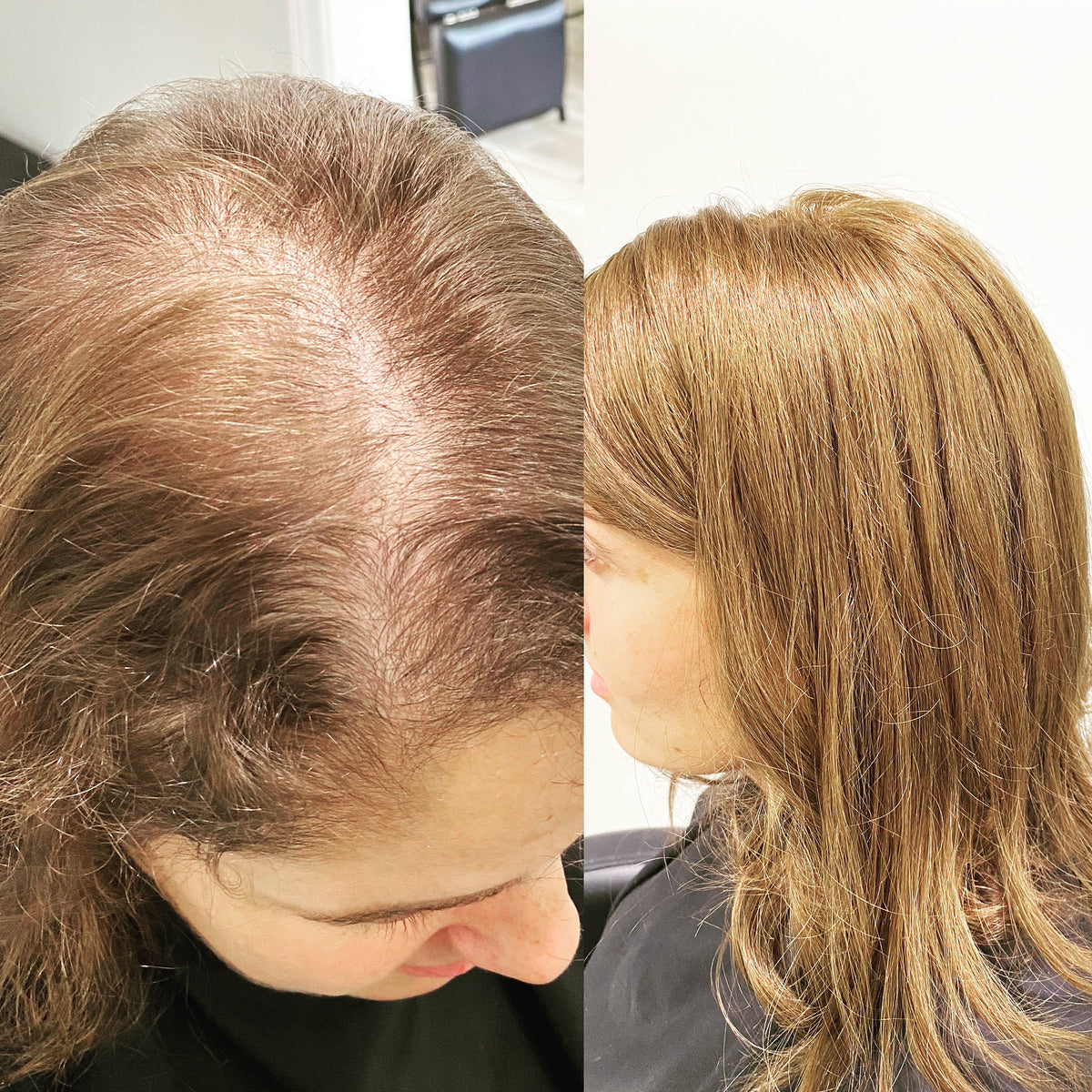
After researching a lovely client visited our salon with what her doctor told her was "Male Pattern Balding!" Just the word balding devasted her, and she was quickly looking for a solution. She asked us how could she have male balding when she was female, this was an obvious error on her physician's part, but the diagnosis left her desperate. Unfortunately, docs don't always have an answer for hair loss and will use diagnoses like "alopecia," or "balding," and in this case, we helped her by using a small top closure to look like a full hair part.
The top closure was affixed with a beaded matrix and carefully sewn in place. This 2" x 4" closure restored her confidence, and she left us knowing there are more solutions for her hair loss in the event it gets worse.
How Are Hair Systems Are Attached
We do not believe in gluing hair to a scalp that has hair present, therefore we created a beaded matrix system that attaches to your hair, and hair is pulled through the system and your hair. In the case of a custom mesh integration system, we will use hair wefts and sew through a matching lace that emulates a natural scalp and hairline.
Tape Down Frontals
In the case of total hair loss at the hairline, we offer tape-down frontals known as patches, to emulate a natural hairline! The frontal will match your hair, and look perfectly natural. The medical tape is clear and undetectable, another great option for hair loss!
Barriers for Trichotillomania
Trichotillomania is a hair-pulling condition, known as a BFRB, or body-focused repetitive behavior. It can be a challenging condition to manage, especially when it comes to hair loss. At our salon, we understand the unique needs of individuals dealing with trichotillomania and offer specialized solutions.
For those struggling with hair pulling, we recommend a combination of techniques to create barriers and prevent further damage. One option is using a custom mesh integration system, similar to our beaded matrix system mentioned earlier. This system not only provides coverage but also helps protect the existing hair from being pulled out.


ALSO READ: Understanding Trichotillomania: A Guide to Effective Habit Reversal Therapy
Scarring Alopecia
Scarring alopecia can be a distressing condition that leads to permanent hair loss. At our salon, we have experience working with clients dealing with this specific type of hair loss and offer tailored solutions to help them regain their confidence.
Lichen Planopilaris
Lichen Planopilaris is one of the common forms of scarring alopecia, characterized by inflammation and destruction of hair follicles.
Additionally, we offer non-surgical hair replacement systems that are designed to seamlessly integrate with your existing hair. These systems use specialized materials and techniques to mimic the appearance and texture of natural hair, giving you a full head of hair without
You Are Not Alone
Hair loss is a sensitive condition, but there is power in numbers, and more awareness of all types of hair loss conditions leads to more advancement in the medical and aesthetic world, especially in promoting cellular activity and developing an environment for hair regeneration. We are here to help with any of your concerns.
Custom and Private Wig Fitting: Personalized Solutions for Alopecia Clients
At our salon, we understand that finding the perfect wig can be a deeply personal journey, especially for those dealing with alopecia. That's why we offer custom and private wig fitting services tailored to each client's unique individual needs. During your consultation, our experienced team will take the time to discuss your preferences, lifestyle, and specific hair loss concerns.
What Sets Our Team Apart: Excellence & Expertise
At Noelle Salon, we understand that hair loss is deeply personal, which is why every consultation is approached with care, discretion, and realistic guidance. Our team has extensive experience working with clients experiencing thinning hair, alopecia, trichotillomania, and fine hair concerns, allowing us to recommend customized solutions based on your specific level of hair loss, lifestyle, and comfort needs.
Rather than taking a one-size-fits-all approach, we focus on creating natural-looking results using lightweight, breathable systems designed to blend seamlessly with your existing hair while supporting long-term scalp comfort and confidence.
In Conclusion
If you are dealing with scarring alopecia or conditions like Lichen Planopilaris, finding the right support is essential. At Noelle Salon, we specialize in advanced solutions for hair loss Boston, offering everything from non-surgical hair replacement systems to highly personalized consultations.
You don’t have to navigate this alone. Hair loss affects many people, and while medical guidance from a dermatologist is important, having an expert who understands the aesthetic and emotional side of hair loss can make all the difference.
When you’re ready for real, natural-looking solutions tailored to you, we’re here to help every step of the way.
Book a free hair loss consultation and take the first step toward restoring your confidence.


