



Diffuse Thinning vs. Crown Thinning: What The Pattern Of Your Hair Loss Actually Means
Quick Answer
"Is this normal?"
That's usually the real question underneath "why is my hair thinning."
I wish there were one simple answer.
There isn't.
Where your hair is thinning matters almost as much as how much you've lost.
Diffuse thinning spreads evenly across the whole scalp. It often points to something systemic. A hormone shift. A nutritional deficiency. An illness. A stressful season of life.
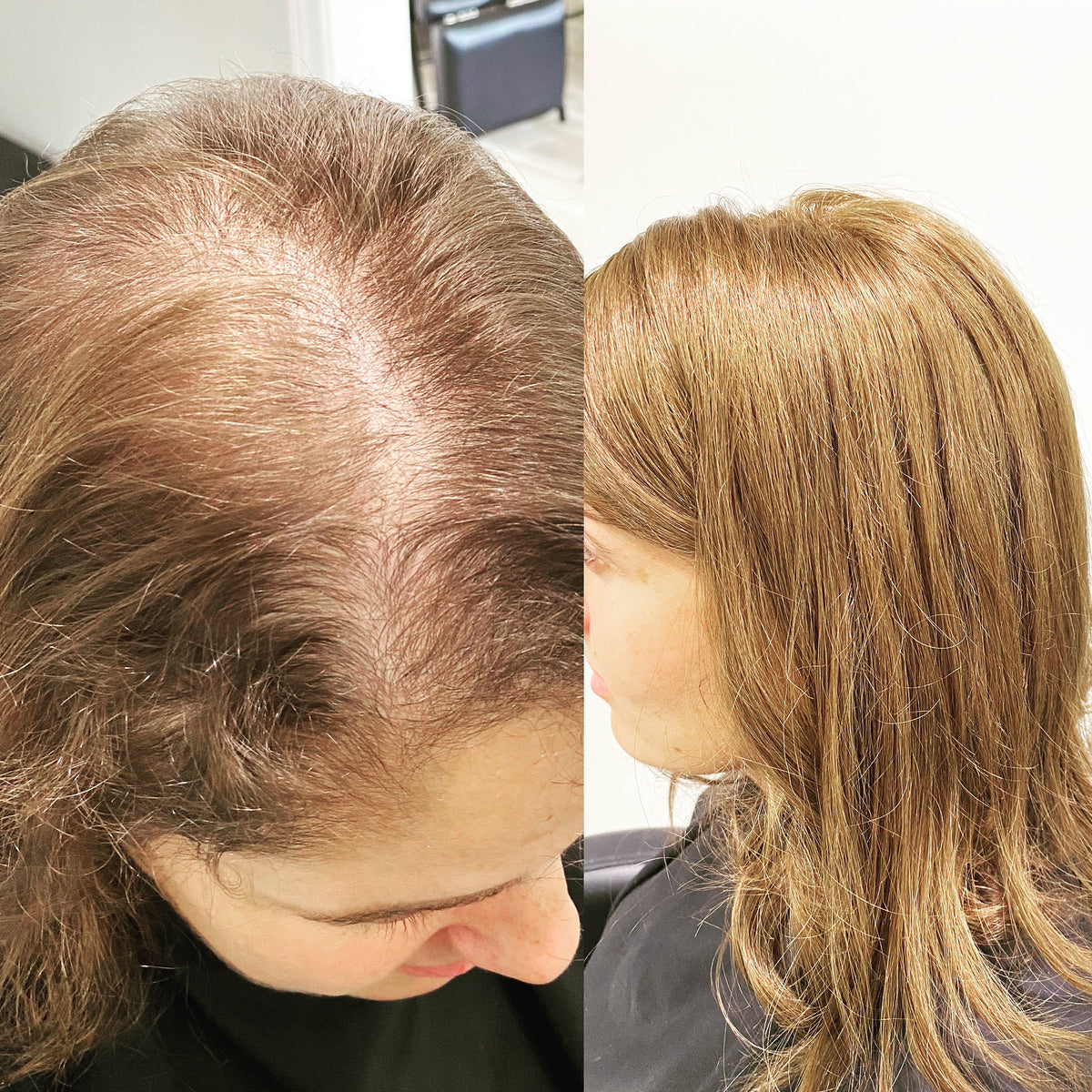
Crown thinning concentrates in one area, usually the vertex. It much more often signals female pattern hair loss, a gradual, progressive process tied to genetics and hormones.
The two patterns aren't just cosmetically different. They usually call for different next steps, different urgency, different conversations with a dermatologist.
I'm not a physician. I can't diagnose what's causing your hair loss.
But after more than 35 years of gently evaluating scalps throughout Boston and New England, I've learned that the pattern almost always tells part of the story before a single word is spoken. And I've learned that women deserve an honest, unhurried answer, not a quick sales pitch.
If you're looking for comprehensive information about hair loss solutions in Boston, including consultations, hair toppers, mesh integration, wigs, and hair replacement options, I encourage you to visit our Hair Loss Boston page before exploring the different patterns discussed below.
Related Resources: If you're trying to understand what you're seeing, you may also find these helpful: Why Is My Part Getting Wider?, Why Is My Ponytail Getting Smaller?, Female Pattern Hair Loss vs. Telogen Effluvium, Hair Loss Consultation Guide, and Mesh Integration Hair Replacement.

The Question I Ask Before I Ever Touch A Client's Hair
Almost every woman who sits down for a hair loss consultation is carrying more than just a question about her hair. She's usually carrying some worry, too, even when she doesn't say it out loud.
"I don't know if this is normal."
"I don't know if I'm overreacting."
"I don't know if this means I'm going bald."
Before I evaluate density, texture, or scalp health, I ask a few gentle questions that shape everything else.
Is it thinning all over, or is it concentrated in one spot?
Did it happen suddenly, or has it crept up over years?
Has your ponytail gotten smaller?
Have you recently had surgery? Been sick? Started menopause? Changed medications? Been under serious stress?
Those answers narrow down the possibilities more than almost anything else I ask. None of it is a diagnosis, and I never present it as one. It's simply a starting point.
Often, just being asked thoughtful questions instead of being handed a product is the first moment a woman exhales during the whole appointment.
After thousands of consultations, I've learned that women rarely notice this distinction on their own, and that's not a failure of attention. When you're the one living inside your own hair loss, everything just feels like loss. It takes someone else, looking with care and experience, to help separate the pattern from the fear.
Two Patterns, Two Very Different Stories
Diffuse Thinning: When It's Spread Across The Whole Scalp
Diffuse thinning tends to show up as an overall sense of "less," rather than a specific bald spot.
Women describe it to me in similar, tender ways.
"My ponytail feels like half of what it used to be."
"My hair just feels thinner everywhere, not in one spot."
"I can see my scalp under bright light, but it's not one bald patch. It's just... everywhere."
In my experience, diffuse thinning is more often tied to something happening in the body as a whole: a recent illness, surgery, significant weight loss, a new medication, thyroid changes, low iron, or a stressful stretch of life. Telogen effluvium, which pushes a large number of follicles into their resting phase at once, is one of the most common causes I see behind this pattern.
The encouraging part is that diffuse thinning is frequently temporary, especially once the underlying trigger is identified and addressed. The important part is that "frequently" isn't "always," which is exactly why I don't treat diffuse thinning as something to simply wait out without a medical evaluation. Waiting with support is very different from waiting alone.

Crown Thinning: When It Concentrates In One Area
Crown thinning looks and behaves differently. Instead of an overall sense of "less," it shows up as a specific, gradually enlarging area, most often at the vertex or along the top of the head.
Women often notice it first in photographs, especially the kind taken from above or behind, at a wedding, on vacation, or in a candid family photo where the angle catches something a bathroom mirror never does. That moment can be quietly devastating, and I never minimize it.
"I saw a photo my daughter took, and I couldn't stop looking at it."
"My hairstylist mentioned it before I ever noticed it myself."
This concentrated pattern is one of the more recognizable signs of female pattern hair loss, a process driven by genetics and hormones that causes follicles to gradually miniaturize over time in specific areas, most commonly the crown and the part line, while often sparing the sides and back.
Unlike diffuse thinning, crown thinning tends to be gradual and progressive rather than sudden. It doesn't typically resolve on its own, which is exactly why early evaluation matters so much here too, just for a different reason. The earlier it's addressed, medically and cosmetically, the more options tend to be available, and the more time we have to make thoughtful decisions instead of rushed ones.


Why The Pattern Changes My Entire Approach
| Pattern | Diffuse Thinning | Crown Thinning |
|---|---|---|
| Where it appears | Throughout the scalp | Primarily the part, top, or crown |
| Common first sign | Smaller ponytail or an overall drop in volume | Wider part or visible scalp from above |
| Onset | Can be sudden or gradual | Usually gradual |
| Conditions sometimes associated | Telogen effluvium, illness, surgery, weight loss, nutritional issues | Female pattern hair loss, hormonal changes, menopause |
| Cosmetic planning | Lightweight solutions, or extensions once root density is confirmed strong enough | A topper or mesh integration system often provides more targeted coverage |

I want to be honest about something. This table reflects patterns I've observed over three and a half decades, not a diagnostic tool. Two women can have hair that looks nearly identical to the eye and be dealing with entirely different conditions underneath. That's why I never make a cosmetic recommendation based on appearance alone, and why I'll always encourage medical evaluation alongside anything I do cosmetically.
A Client Story That Illustrates The Difference
Not long ago, two women came to see me within the same week.
Both worried about thinning hair. Both around the same age. Both a little afraid of what I might tell them.
The first described her hair loss as happening "everywhere at once," starting a few months after a particularly difficult year. When I gently evaluated her scalp, the thinning was even across the top, sides, and back, with no single area standing out. I encouraged her to see her physician and ask about thyroid and iron levels before we finalized any cosmetic plan. She was nervous about that conversation, so we talked through exactly what to ask. Several months later, once her bloodwork identified a deficiency and it was treated, her own hair began recovering, and what we'd originally planned as a longer-term topper became something she only needed for a season.
The second woman pointed to a single area at her crown that had been "getting a little more visible every year" for nearly a decade. Her sides and back were still full and healthy. That pattern, concentrated and gradual, pointed toward female pattern hair loss. Rather than waiting, we began a cosmetic plan built around that area specifically, a targeted mesh integration system that added density exactly where she needed it, while leaving her healthy hair untouched. When she saw herself in the mirror afterward, she quietly said, "I forgot what that looked like."
Same fear. Same age range. Two entirely different stories, because the pattern told us where to look, and because each woman was met with patience instead of a single one-size-fits-all answer.

When The Two Patterns Overlap
Hair loss doesn't always sort itself neatly into one category or the other, and I want to be honest about that too.
Some women experience diffuse thinning that eventually reveals an underlying pattern condition once the shedding settles. Others notice crown thinning that becomes more diffuse over time as additional factors are introduced, whether that's menopause, a new medication, or simply years passing.
When I see overlap, I slow down rather than speed up. That's usually the moment I most strongly encourage a dermatology evaluation before committing to a cosmetic direction, because the plan that works well for pure crown thinning isn't always the plan that works well for a combination pattern. I'd rather take an extra appointment to get it right than rush a client into something that won't age well with her hair.
Why I Don't Recommend The Same Solution For Both
I've learned, sometimes the hard way early in my career, that treating every thinning pattern the same way does a disservice to the woman sitting in front of me.
For diffuse thinning, I lean toward lightweight, low-commitment solutions while an underlying cause is being investigated, because many women in this category are dealing with something temporary, and I don't want to overcommit them to a solution they may not need for long.
For crown thinning, especially once female pattern hair loss is suspected or confirmed, I tend to have a more direct, caring conversation about long-term planning sooner, because this pattern usually continues progressing without intervention, and the earlier a plan is in place, the more natural the results tend to look over time.
Neither approach is about creating urgency where none exists. It's about matching the plan to what the pattern, and the person, actually need.
Real Client Experience
Understanding the pattern is one thing. Seeing what it actually feels like to move through this, and come out the other side feeling like yourself again, is another. In this short video, one of our clients shares what it was like to notice her own hair changing and how the right plan helped restore her confidence.
Frequently Asked Questions
What's the difference between diffuse thinning and crown thinning?
Diffuse thinning affects the whole scalp fairly evenly, while crown thinning concentrates in one gradually widening area, most often the vertex. The two patterns often point toward different underlying causes.
Is crown thinning always female pattern hair loss?
Not always, but it's one of the most common patterns associated with it. A dermatologist can confirm the cause through evaluation and, if needed, testing.
Can diffuse thinning turn into crown thinning?
Yes, sometimes a shedding event uncovers an underlying pattern condition that becomes more noticeable at the crown once the initial shedding resolves. This is one of several reasons ongoing evaluation matters.
Should I see a dermatologist for either type of thinning?
I recommend it for both, though for different reasons. Diffuse thinning often benefits from bloodwork to rule out underlying causes. Crown thinning benefits from an early diagnosis so a long-term plan, medical and cosmetic, can begin sooner.
Which pattern is easier to treat cosmetically?
Neither is inherently easier. Diffuse thinning often calls for a broader, lighter approach across the whole head, while crown thinning often calls for a more targeted, concentrated solution. The right approach depends on the individual, not just the pattern.
What Thirty-Five Years Has Taught Me About Reading A Pattern
People often assume my job starts with a product.
It doesn't.
It starts with a question, and with looking closely enough to actually see the answer.
Diffuse or concentrated. Sudden or gradual. Systemic or genetic. Temporary or progressive.
None of those distinctions are visible from across a room. They only reveal themselves when someone takes the time to look, and to listen.
I've learned that the pattern almost never lies, even when a woman isn't sure what she's seeing in the mirror. I've also learned that patience, waiting for bloodwork, waiting for a dermatologist's read, waiting for the right moment, often protects a woman from a decision she'd have to undo later.
Most of all, I've learned that a woman doesn't need me to have all the answers in the first five minutes. She needs to know that someone is genuinely looking, and that whatever we decide together will be based on her hair, her history, and her life, not a script.
After more than 35 years, that's still what this work comes down to.
About The Author
For more than 35 years, I've helped women throughout Boston and New England understand what their hair loss pattern means and what their realistic cosmetic options are, from lightweight toppers and mesh integration to hair extensions and medical wigs.
My role has never been to diagnose the cause of hair loss. It has always been to evaluate carefully, ask the right questions, and help each woman feel confident and cared for while she works with her medical team to understand the "why."
Whether your hair is thinning all over or concentrated in one area, you don't have to figure out what it means on your own, and you don't have to have all the answers before you reach out. During a private consultation, we'll talk through your history, gently evaluate your scalp, and map out what your realistic next steps could look like, medically and cosmetically, so you can move forward with clarity instead of guesswork.
Book A Free Hair Loss Consultation


