

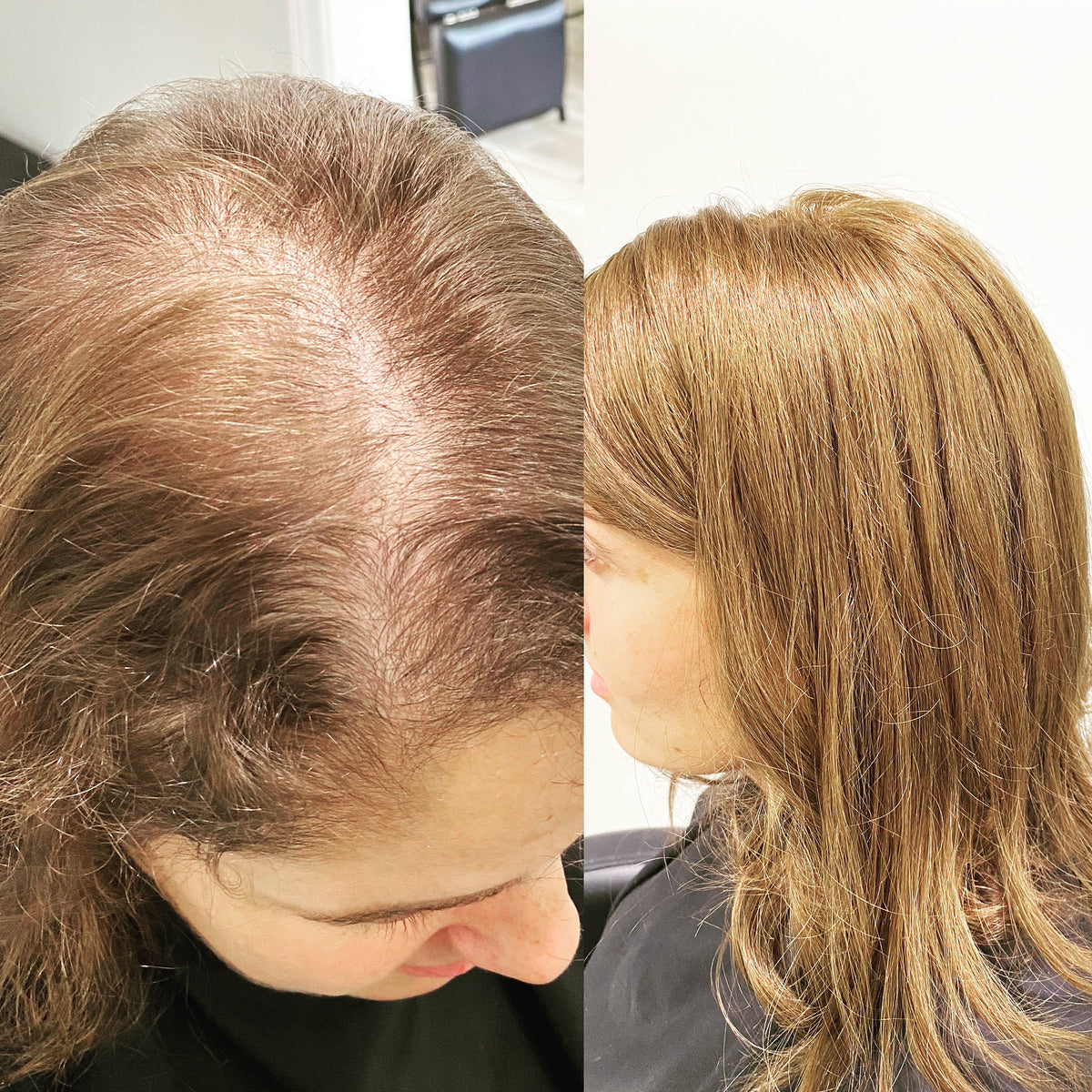


Why Is My Ponytail Getting Smaller? Common Signs Of Female Hair Loss
Quick Answer
If your ponytail feels noticeably smaller than it used to, it may be a sign of hair loss, increased shedding, breakage, chemical damage, hormonal changes, stress-related hair loss, or thinning caused by aging and genetics.
The important thing to understand is that most ponytails do not become thin overnight.
In fact, one of the most common things I hear from clients visiting our Hair Loss Boston specialists is:
"I don't know when this happened. I just realized my ponytail is so much smaller than it used to be."
The reality is that hair density often changes gradually over months or even years before it becomes noticeable. Many women assume aging is the cause, but I regularly see women in their twenties, thirties, forties, and beyond experiencing changes in ponytail thickness for many different reasons.
Some women have true hair loss conditions such as female pattern hair loss. Others are experiencing temporary shedding after illness, surgery, stress, weight loss, thyroid issues, or GLP-1 medications. In many cases, the problem is not hair loss at all, but excessive breakage from bleach, relaxers, at-home color, heat styling, or heavy extensions.
Understanding the cause is the first step toward finding the right solution.

A smaller ponytail is often one of the earliest signs women notice when hair density begins to change.
Your Ponytail Probably Didn't Get Smaller Overnight
One of the biggest misconceptions about hair thinning is that women believe it happened suddenly.
While sudden shedding conditions can occur, most of the time the process begins long before a woman notices it.
Hair density gradually decreases.
The part slowly becomes wider.
The braid becomes thinner.
The elastic wraps around the ponytail one more time than it used to.
Hair no longer feels as full when washing or styling.
Then one day something triggers awareness.
Maybe you see a photo.
Maybe you pull your hair into a ponytail.
Maybe your stylist mentions a change.
Suddenly it feels like your ponytail became smaller overnight.
In reality, the change often occurred gradually over months or years.
This is why I always tell clients not to focus only on when they noticed the problem, but to think about what may have been happening during the previous six to twelve months.
What I Look For During A Hair Loss Consultation
When a client tells me her ponytail is getting smaller, I am not immediately thinking hair loss.
I am trying to determine why.
During a consultation I evaluate:
- Density throughout the scalp
- Scalp visibility
- Part width
- Crown density
- Hair health
- Breakage patterns
- Chemical history
- Recent illness or surgery
- Medications
- Stress levels
- Family history
- Extension history
I also pay close attention to shedding.
If I run my fingers through a client's hair and strands are continuously falling out, I often recommend a dermatologist evaluation before discussing cosmetic solutions.
A shrinking ponytail is a symptom.
The real question is what is causing it.
In many cases, women assume the answer is simply aging. Sometimes that's part of the picture, but I've also seen smaller ponytails caused by temporary shedding, thyroid issues, medication changes, chemical damage, extension stress, and even nutritional deficiencies. The goal is identifying the cause before deciding on a solution.
| What You're Noticing | Possible Cause |
|---|---|
| Widening part | Female Pattern Hair Loss |
| Excessive shedding | Telogen Effluvium |
| Thin ends | Breakage |
| More scalp visibility | Hair Loss |
| Hair breaking after bleach | Chemical Damage |
| Hair feels weaker after extensions | Extension Stress |
| Sudden loss after illness | Shedding Event |
Could Female Pattern Hair Loss Be Causing Your Smaller Ponytail?
One of the most common causes of a shrinking ponytail is female pattern hair loss.
Unlike sudden shedding conditions, female pattern hair loss develops gradually.
Women often notice:
- A widening part
- Increased scalp visibility
- Less density at the crown
- A thinner braid
- A smaller ponytail
Many women still feel they have "a lot of hair" when wearing it down because the loss occurs slowly.
That's one reason a ponytail is often a better indicator of density loss than wearing the hair down. When all of the hair is gathered together, subtle changes become much easier to recognize.
Many women first notice signs similar to those discussed in Female Hair Loss Stages: What Women Actually Notice Over Time, where density changes long before significant baldness occurs.
Did An Illness, Surgery, Stress, Or GLP-1 Medication Trigger Excessive Shedding?
Sometimes the ponytail truly does become smaller relatively quickly.
This often happens with telogen effluvium, a condition that causes increased shedding after a major physical or emotional stressor.
Common triggers include:
- Illness
- Surgery
- Rapid weight loss
- Childbirth
- Thyroid disorders
- Severe emotional stress
- GLP-1 medications
- Nutritional deficiencies
Many women report seeing large amounts of hair in the shower, on their brush, or throughout the house.
Unlike female pattern hair loss, these women often notice active shedding.
This is one reason I frequently ask about events that occurred two to four months before the hair changes began.

For a deeper discussion, read Female Pattern Hair Loss vs Telogen Effluvium: How To Tell The Difference.
Sudden shedding can dramatically reduce ponytail density over a short period of time.
Menopause And Hormonal Changes
Many women assume menopause automatically causes hair loss.
While hormonal changes can absolutely affect hair density, menopause is often one piece of a larger picture.
I commonly see:
- Reduced hair diameter
- Increased scalp visibility
- Slower growth
- More fragile strands
- Reduced overall volume
The result is often a ponytail that feels thinner and less substantial than it did years earlier.
This is discussed further in Can Menopause Cause Hair Loss?
Chemical Damage And Overprocessing
Not every smaller ponytail is caused by hair loss.
Sometimes the issue is breakage.
Years of:
- Bleaching
- Highlighting
- Relaxers
- Excessive heat styling
- Repeated color corrections
- At-home hair color
can cause significant structural damage.
When hair breaks faster than it grows, the ends become progressively thinner.
The ponytail becomes smaller even though the follicles may still be producing hair normally.

Chemical damage can dramatically reduce ponytail thickness without true hair loss occurring.
Hair Breakage Versus Hair Loss: Why The Difference Matters
One of the most important distinctions I make during consultations is determining whether a client is losing hair from the scalp or losing hair from breakage.
Hair loss usually involves:
- Scalp visibility
- Wider parts
- Reduced density at the root
Breakage often involves:
- Thin ends
- Short broken hairs
- Uneven length
- Excessive dryness
The two conditions can look similar but require completely different solutions.

Breakage often creates the appearance of hair loss even when follicles remain healthy.
Can Hair Extensions Make Your Ponytail Smaller?
This surprises many women.
Improperly designed extensions can sometimes contribute to hair stress.
This is particularly true when:
- Extensions are too heavy
- Weight is poorly distributed
- Fragile hair is overloaded
- Maintenance is neglected
This does not mean extensions cause hair loss automatically.
In fact, many women successfully wear extensions for years.
The key is evaluating support capacity and designing a strategy appropriate for the client's hair.
Many of the lightweight approaches discussed on our Hair Extensions Boston page focus on preserving existing hair rather than simply adding more hair.

Properly designed extensions should enhance fullness without overwhelming fragile hair.
What Happens If Hair Loss Is Confirmed?
The solution depends entirely on the diagnosis and severity.
Some women benefit from:
- Scalp treatments
- Medical evaluation
- Hair growth support
- Lifestyle changes
Others may benefit from cosmetic solutions such as:
- Hair toppers
- Mesh integration
- Meshless integration
- Cranial prostheses
- Lightweight extensions
For women considering cosmetic solutions, Hair Topper vs Hair Extensions For Thinning Hair: Which Solution Is Right For You? explains how these options differ and who each solution is best suited for.

Hair toppers can provide immediate coverage while women address underlying causes of hair loss.
Founder Insight
One reason clients feel comfortable asking me why their ponytail is getting smaller is because I have spent more than 35 years working with women experiencing hair loss, thinning hair, fine hair, trichotillomania, alopecia, menopausal hair changes, and extension-related concerns.
One thing I have learned is that a smaller ponytail does not automatically mean permanent hair loss.
Sometimes it is shedding.
Sometimes it is breakage.
Sometimes it is a medical condition.
Sometimes it is simply years of cumulative stress on the hair.
The most important thing is understanding the cause before jumping to solutions.
I've seen many women panic unnecessarily, and I've also seen women ignore important signs for years hoping they would disappear.
The sooner you understand what is happening, the more options you typically have.
— Noelle Spinosa, Founder, Noelle Salon
Conclusion
A smaller ponytail is often one of the earliest signs that something has changed with your hair.
The cause may be female pattern hair loss, menopause, stress-related shedding, illness, surgery, GLP-1 medications, chemical damage, breakage, or excessive hair stress.
The important thing is not to assume.
A proper evaluation can help determine whether you are experiencing hair loss, breakage, temporary shedding, or another condition entirely.
Understanding the cause allows you to choose the safest and most effective path forward.
Frequently Asked Questions
Is a smaller ponytail always a sign of hair loss?
No. Breakage, chemical damage, shedding, and hormonal changes can all reduce ponytail thickness without permanent hair loss.
Can stress make my ponytail thinner?
Yes. Significant stress can trigger telogen effluvium, a shedding condition that reduces density.
How do I know if I have female pattern hair loss?
Common signs include a widening part, increased scalp visibility, reduced density at the crown, and a progressively smaller ponytail.
Can hair extensions make my ponytail smaller?
Poorly designed or excessively heavy extensions can contribute to hair stress. Properly fitted lightweight extensions generally focus on preserving hair health.
Should I see a dermatologist if my hair is shedding?
Yes. If active shedding is occurring, a dermatologist can help identify potential medical causes.
Schedule A Free Hair Loss Consultation
If your ponytail feels noticeably smaller than it used to, the first step is understanding why.
At Noelle Salon, we evaluate density, scalp visibility, shedding patterns, support capacity, hair health, chemical history, and lifestyle factors before recommending any solution.
Whether you're experiencing female pattern hair loss, menopause-related thinning, stress-related shedding, breakage, or another form of hair loss, our goal is to identify the cause and help you understand your options.
Schedule your free Hair Loss Consultation today to determine what may be causing your shrinking ponytail and explore the safest path forward.


