



Female Hair Loss Stages: What Women Actually Notice Over Time

Quick Answer: What Are The Stages Of Female Hair Loss?
Female hair loss often develops gradually, but many women do not recognize the early signs until their part looks wider, their ponytail feels smaller, or they notice more scalp showing in photos.
The stages of female hair loss are not always as simple as a chart or scale. Some women experience slow thinning over several years. Others notice sudden shedding after stress, illness, medication changes, hormonal changes, rapid weight loss, or major life events.
Many women searching for Hair Loss Boston services come to us before they have a clear diagnosis. Some are regular salon clients who casually mention more hair in the shower drain. Others are actively seeking help because their scalp visibility, crown thinning, or widening part has become difficult to ignore.
While I do not diagnose medical hair loss conditions, after more than 35 years working with women experiencing thinning hair, I have learned that what women notice first often tells an important story.
Why Female Hair Loss Does Not Always Follow A Simple Chart
Video: Real Examples of Female Hair Loss Progression
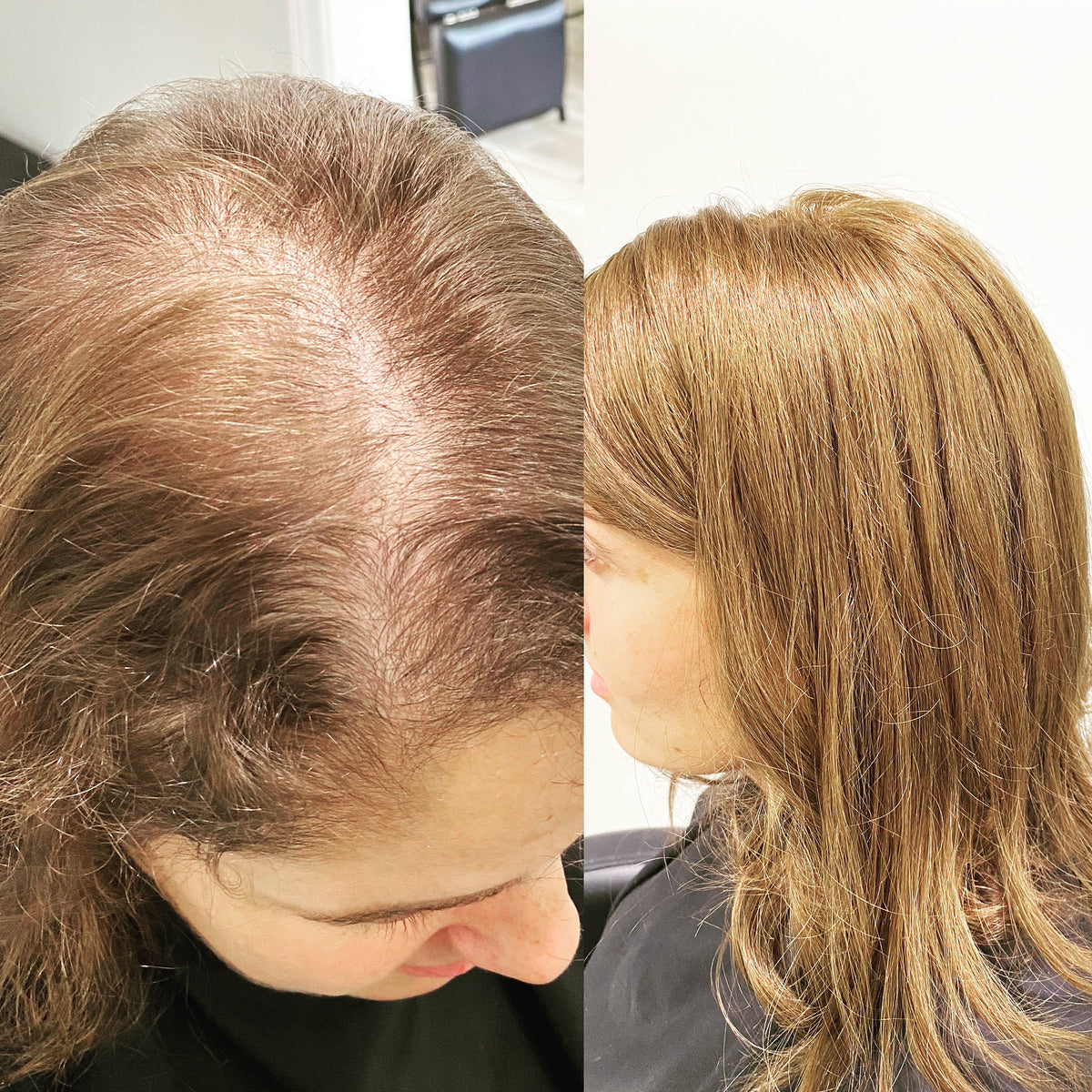
Female hair loss rarely follows a perfect chart or timeline. In this short video, you'll see a real example of thinning hair and how a customized cosmetic hair loss solution can create natural-looking coverage. Every woman's hair loss journey is different, which is why evaluation and individualized planning matter.
Many articles about female hair loss stages focus on the Ludwig Scale.
The Ludwig Scale can be helpful because it describes common patterns of Female Pattern Hair Loss, especially diffuse thinning across the top of the scalp.
But women do not usually walk into a consultation saying:
"I think I am Ludwig Stage I."
They say things like:
"My part is getting wider."
"My ponytail feels smaller."
"I see more hair in the drain."
"My hair does not hold style anymore."
"My crown shows in pictures."
"My bloodwork is normal, but I am still losing hair."
"My mom or aunt had the same kind of hair loss."
That is why this article looks at female hair loss stages from a more practical perspective: what women actually notice as hair loss progresses.
For a broader overview of common causes, read Why Is My Hair Thinning? The 12 Most Common Causes of Hair Loss for Women In Boston.
Stage 1: You Notice More Shedding Than Usual
For many women, the first sign is not visible baldness.
It is shedding.
A regular client may sit in my chair and mention:
"I am seeing more hair in the shower."
"My brush is full."
"I feel like my hair is falling out."
"My drain has never looked like this before."
Sometimes I notice it first during a service. I may see more hair shedding while washing, brushing, coloring, or styling the hair than I typically see for that client.
When this happens, I start asking questions.
Were you recently sick?
Have you had surgery?
Did you start a new medication?
Have you experienced unusual stress?
Have you had thyroid changes?
Have you lost weight quickly?
Did anything happen two or three months before the shedding began?
Sometimes shedding may be seasonal or temporary. Sometimes it may be connected to a trigger. Sometimes it may be part of a larger pattern.
This is where early awareness matters.
I love being part of early detection because many women dismiss the first signs until the hair loss becomes more visible.
Stage 2: Your Ponytail Feels Smaller
Another early sign many women notice is a smaller ponytail.
This can be very emotional because the ponytail is something women feel every day.
Clients often say:
"My ponytail used to be thick."
"I can wrap the elastic around more times."
"My hair feels smaller in my hand."
"My hair is still long, but there is less of it."

A smaller ponytail usually means overall density has decreased, even if the change is not yet obvious in the mirror.
The important point is that a smaller ponytail is often one of the earliest signs women recognize before scalp visibility becomes more obvious.
Stage 3: Your Part Starts Getting Wider

Many women first notice hair loss when their part begins appearing wider than it did previously.

Hair thinning can affect every hair texture and ethnicity, often appearing first through increased scalp visibility.
A widening part is one of the most common reasons women seek help.
Many women feel like it happened overnight.
They say:
"I swear this was not here before."
"I can suddenly see my scalp."
"My part looks wider in photos."
"My hair looks flat on top."
"My mother had the same part line."
A widening part may be related to Female Pattern Hair Loss, menopause-related thinning, Telogen Effluvium, stress, thyroid changes, low density, or a combination of factors.
The part line is often where women first see the change because the scalp becomes more visible when density decreases along the top of the head.
For a deeper explanation, read Why Is My Part Getting Wider? 7 Common Causes Of A Widening Hair Part In Women.
Stage 4: Your Crown Becomes More Visible

Some women notice thinning first at the front hairline and part rather than the crown.
As hair loss progresses, many women begin noticing thinning around the crown.
This can be harder to see in the mirror because it is on the top or back of the head.
Often, women notice it in photos.
They may say:
"I saw a picture of myself from above and was shocked."
"I did not know my crown looked like that."
"My stylist noticed it first."
"My family said something, and now I cannot stop looking at it."
Crown thinning can be especially upsetting because it changes how the hair looks from every angle.
At this stage, women may begin changing how they style their hair. They may avoid certain lighting, stop wearing their hair pulled back, use powders or sprays, or constantly adjust their part.
This is also when many women begin searching for solutions beyond shampoos, supplements, or styling tricks.
In many cases, clients tell me they had no idea how much density they had lost until they saw a photograph from above.
Stage 5: The Hair No Longer Styles The Same Way
Female hair loss is not always about seeing scalp right away.
Sometimes the first major change is how the hair behaves.
Women often tell me:
"My hair will not hold volume."
"My blowout falls flat."
"My hair looks stringy."
"I keep changing products, but nothing works."
"I feel like my hair has changed texture."
This is very common in women experiencing menopause-related hair changes, fine hair changes, and progressive thinning.
The hair may feel weaker, more fragile, finer, drier, or less responsive to styling.
For some women, this is the stage where they realize the problem is not just styling. It is density.
For more on hormonal hair changes, read Menopausal Hair Loss Before and After: Real Solutions for Thinning Hair Over 50.
Stage 6: You Start Seeking Answers

At this point, many women begin looking for help.
Some see a dermatologist.
Some ask their primary care doctor.
Some have bloodwork done.
Some try supplements, scalp oils, shampoos, massage tools, laser caps, PRP, oral minoxidil, topical minoxidil, or other treatments.
Some come to us first because they are scared, confused, or unsure whether what they are seeing is normal.
Many tell me their bloodwork is normal but their hair is still changing.
That can be incredibly frustrating.
Normal bloodwork does not always explain every visible change in the hair. It may be one piece of the puzzle, but it does not always provide a complete explanation.
This is why I believe the timeline, pattern, family history, shedding level, density changes, and emotional impact all matter.
GLP-1 Medications And Hair Loss
Over the past few years, more women have asked about increased shedding after significant weight loss while taking GLP-1 medications such as Ozempic, Wegovy, Mounjaro, and Zepbound.
As a hair loss specialist, I do not diagnose medication-related hair loss, but the timing of shedding, weight loss, and density changes is something I discuss during consultations.
For a deeper discussion, read Hair Loss After Ozempic Or GLP-1 Medications.
Oral Minoxidil And Female Hair Loss
Many women ask about oral minoxidil during consultations. While medication decisions belong between a patient and their physician, some clients tell me they have experienced new growth while still feeling frustrated by visible density loss.
Hair growth and visual density are not always the same thing.
If oral minoxidil is part of your treatment discussion, speak with your dermatologist about whether it may be appropriate for you.
A Diagnosis Is Not Always A Treatment Plan
One thing that surprises many women is that receiving a diagnosis does not always mean receiving a clear solution.
Some clients come to us after seeing a dermatologist.
Some have had a scalp biopsy.
Some have been told they have alopecia but were not given a treatment plan they understood.
Some were told to monitor it.
Some were told to try medication.
Some were told there were limited options.
Others have already tried PRP, supplements, scalp massage, laser caps, topical treatments, or even hair transplants.
I have seen many women pursue expensive treatments and still feel unhappy with their density.
In fact, some of my female clients who have had hair transplants still wear hair toppers, scalp prostheses, or other cosmetic hair solutions because the transplant did not create the amount of coverage they hoped for.
That does not mean those treatments are wrong for everyone.
It means women deserve realistic expectations.
Medical treatment, surgical treatment, and cosmetic hair solutions all serve different purposes.
The best path often depends on the type of hair loss, the stage of hair loss, the amount of existing hair, the client’s goals, and what a medical provider recommends.
What Women Often Try Along The Way
By the time many women reach us, they have already tried several things.
Some have tried supplements.
Some have purchased expensive shampoos.
Some use scalp massage tools.
Some have tried oils, serums, laser caps, or topical products.
Some have tried PRP.
Some have explored hair transplants.
Some have tried medications under medical supervision.
Some of these options may help some women. Others may feel disappointed when the result does not match what they hoped for.
This is why I try to help women separate three different goals:
Understanding why the hair loss is happening.
Supporting the hair medically when appropriate.
Finding a cosmetic solution that helps them feel confident now.
Those are related, but they are not always the same thing.
Stage 7: You Begin Looking For Cosmetic Hair Loss Solutions
For many women, there comes a point where they are no longer just asking:
"Why is this happening?"
They are asking:
"What can I do so I feel like myself again?"
This is where cosmetic solutions may become part of the conversation.
Depending on the stage and pattern of hair loss, options may include:
Hair toppers
Scalp prostheses
Mesh integration systems
Meshless integration
Lightweight hair extensions
Fill-in pieces
Custom combination solutions
Not every woman needs the same solution.
A woman with early thinning may need education, monitoring, and medical evaluation.
A woman with a widening part may need a small, customized solution for the part line.
A woman with crown thinning may benefit from a topper.
A woman with advanced thinning may need mesh integration or a more customized system.
A woman with enough support capacity may be able to wear lightweight extensions safely.

Women with more advanced thinning sometimes require customized solutions such as mesh integration systems that work with their existing hair while creating natural-looking coverage.
For women comparing options, read Hair Topper vs Hair Extensions For Thinning Hair: Which Solution Is Right For You?
What I Look For During A Hair Loss Consultation
During a consultation, I am not just looking at the amount of hair loss.
I am looking at the whole picture.
I evaluate:
Hair density
Scalp visibility
Follicle density
Support capacity
Hair texture
Hair strength
Shedding level
Breakage
Family history
Recent illness
Medication changes
Recent GLP-1 use or significant weight loss
Lifestyle
Previous treatments
Emotional impact
Whether the client has seen a dermatologist
Whether the hair can safely support added hair
Whether medical evaluation should come first
This matters because choosing the wrong solution can create more problems.
Adding too much hair to weak or low-density hair can cause tension, breakage, or further damage.
The safest solution is always the one that works with the hair the client actually has.
If you are preparing for your first appointment, read What To Expect During A Hair Loss Consultation.
When I Recommend Seeing A Dermatologist
I often recommend seeing a dermatologist when a client has:
Sudden shedding
Rapid density loss
Scalp pain
Redness or inflammation
Patchy hair loss
Unexplained hair loss
A strong family history with progression
Active shedding that feels unusual
Hair loss at a young age
Hair loss that is getting worse quickly
A hair loss specialist can help evaluate cosmetic options, but diagnosing medical hair loss conditions belongs with a medical professional.
The goal is not to replace medical care.
The goal is to help women understand what they are seeing and decide what next step makes the most sense.
Where The Ludwig Scale Fits In
The Ludwig Scale is one way doctors describe female pattern hair loss.
It typically focuses on thinning across the top of the scalp and separates female pattern hair loss into mild, moderate, and advanced stages.
It can be helpful as a general framework.
But in real life, women often experience hair loss in a more personal and emotional way.
They notice their ponytail first.
Or their part.
Or their crown.
Or the hair in the drain.
Or a photo they cannot stop looking at.
That is why I prefer to talk about female hair loss stages in terms of what women actually notice over time, not just what a chart shows.
Does Every Woman Progress Through Every Stage?
No.
Not every woman follows the same path.
Some women experience temporary shedding and recover density over time.
Some women experience gradual thinning that progresses slowly.
Some women have a strong family history.
Some women have multiple factors happening at once, such as menopause-related changes plus stress, thyroid issues, GLP-1-related weight loss, or genetic thinning.
Some women stabilize.
Others continue to lose density.
This is why individualized evaluation matters.
Hair loss is not one-size-fits-all.
What Makes Female Hair Loss So Emotional?
Female hair loss is not just cosmetic.
It can affect confidence, identity, femininity, privacy, and daily life.
Many women tell me they stop wearing their hair down.
They avoid bright lighting.
They hate photos.
They stop swimming.
They change their social plans.
They feel embarrassed when someone stands behind them.
They feel like they no longer look like themselves.
That emotional impact is real.
When I work with hair loss clients, the goal is not simply to add hair.
The goal is to help them feel comfortable, seen, and confident again while protecting the hair they still have.
Conclusion
Female hair loss stages are not always as simple as a chart.
Some women first notice shedding.
Others notice a smaller ponytail, a wider part, crown visibility, or hair that no longer styles the same way.
Some women arrive before seeing a dermatologist. Others arrive after bloodwork, biopsies, treatments, PRP, scalp massage, medications, GLP-1-related weight loss, or even hair transplants.
After more than 35 years helping women with thinning hair and hair loss, I have learned that the visible pattern matters, but the story behind the hair loss matters just as much.
When did it start?
Was it sudden or gradual?
Is there shedding?
Is there family history?
Has the client been ill?
Has medication changed?
Has there been significant weight loss?
Is the scalp healthy?
Is the hair strong enough to support cosmetic solutions?
Does medical evaluation need to come first?
Those questions help guide the next step.
If you are noticing changes in your hair, you do not have to wait until the hair loss feels advanced before asking for help.
Early awareness can make a difference.
Schedule A Hair Loss Consultation in Boston
If you are noticing increased shedding, a smaller ponytail, a widening part, scalp visibility, crown thinning, or changes in your hair density, we can help you understand what you are seeing.
During your consultation, we will review your hair history, evaluate your density and scalp visibility, discuss your concerns, and explain which options may be appropriate.
If medical evaluation is recommended, we will tell you that.
If a cosmetic solution is appropriate, we will explain your options clearly and honestly.
Schedule Your Free Hair Loss Consultation
About The Author
Noelle, Founder of Noelle Salon
For more than 35 years, Noelle has helped women navigate hair loss, thinning hair, fine hair challenges, trichotillomania, alopecia, menopause-related hair changes, and non-surgical hair replacement solutions.
Her work focuses on helping women understand their options while protecting the integrity of their existing hair.
Over the course of her career, she has worked with thousands of women experiencing Female Pattern Hair Loss, Telogen Effluvium, trichotillomania, menopause-related thinning, and other forms of hair loss.
Noelle’s expertise includes hair toppers, mesh integration systems, customized hair extension solutions for fine and thinning hair, and advanced hair loss consultations.
She is also the founder of a luxury hair extension manufacturing company and has spent decades studying hair quality, customization, product sourcing, and natural-looking hair replacement solutions.
Her approach combines technical expertise, ongoing education, compassion, and individualized planning to help women restore confidence while maintaining the health of their natural hair.
Frequently Asked Questions
What Are The Stages Of Female Hair Loss?
Female hair loss may begin with increased shedding, reduced volume, a smaller ponytail, a widening part, crown thinning, or increased scalp visibility. Some women progress slowly, while others notice sudden changes after stress, illness, hormonal shifts, rapid weight loss, or other triggers.
Is The Ludwig Scale The Best Way To Understand Female Hair Loss?
The Ludwig Scale can help classify Female Pattern Hair Loss, but many women understand their hair loss more through daily changes such as shedding, styling difficulty, scalp visibility, or a widening part.
Does Female Hair Loss Always Get Worse?
Not always. Some shedding is temporary, while some hair loss is progressive. The outcome depends on the cause, pattern, medical factors, family history, and whether the condition stabilizes or continues.
Should I See A Dermatologist For Female Hair Loss?
A dermatologist can help evaluate medical causes of hair loss. If you are experiencing sudden shedding, rapid density loss, scalp symptoms, patchy hair loss, or unexplained thinning, medical evaluation is recommended.
Can Bloodwork Be Normal And Hair Loss Still Happen?
Yes. Some women report normal bloodwork but still experience shedding, thinning, or scalp visibility. Bloodwork can be helpful, but it does not always explain every visible change in hair density.
Can GLP-1 Medications Cause Hair Loss?
Some women report increased shedding, reduced density, or a smaller ponytail after significant weight loss while taking GLP-1 medications. Because hair loss can be influenced by multiple factors, including nutrition, stress on the body, hormonal changes, and medical conditions, concerns about medication-related hair loss should always be discussed with a qualified medical provider.
Can Oral Minoxidil Restore Female Hair Density?
Some women discuss oral minoxidil with their doctors and may experience hair growth over time. Treatment decisions should always be made with a medical provider. In my experience, some clients see growth but still feel they need cosmetic support for visible thinning or scalp coverage.
Can Hair Toppers Help Female Hair Loss?
Yes, hair toppers can help many women experiencing crown thinning, widening parts, or scalp visibility. The best option depends on the amount of hair loss, density, lifestyle, and desired result.
Can Hair Extensions Help Female Hair Loss?
Sometimes. Hair extensions may help when there is enough natural hair to support them safely. If density is too low or the crown is too thin, a topper, mesh integration system, or custom solution may be more appropriate.
What Happens During A Hair Loss Consultation?
During a consultation, we review your hair history, evaluate density and scalp visibility, discuss your goals, and explain possible next steps. If medical evaluation is appropriate, we will recommend that before cosmetic solutions.
When Should I Consider A Cosmetic Hair Loss Solution?
You may consider a cosmetic solution when shedding, thinning, crown visibility, a widening part, or reduced density is affecting your confidence or styling options. The right solution depends on your existing hair, goals, and whether medical evaluation is needed first.


