

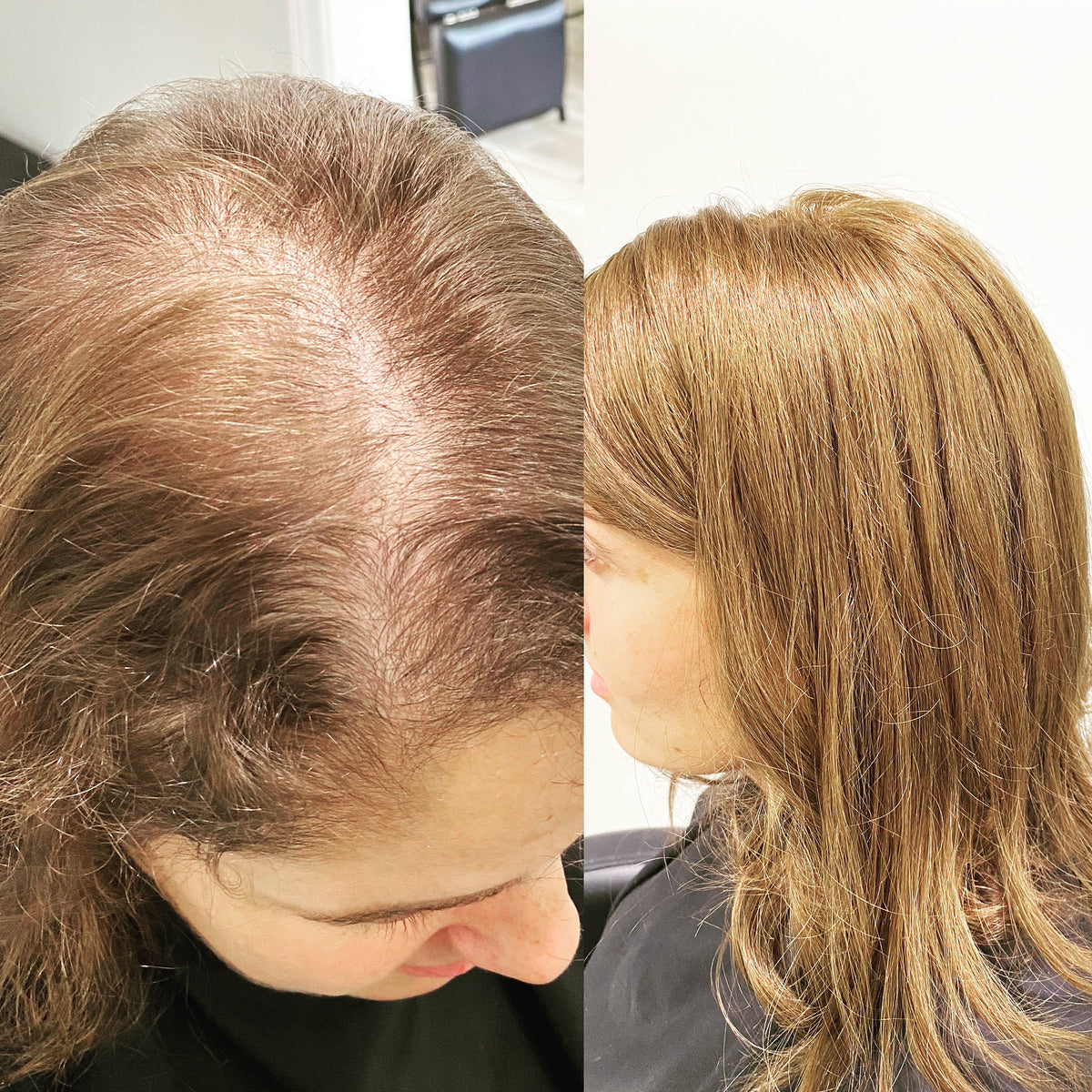


Early Female Pattern Hair Loss: What Happens After You’re Diagnosed?

For many women, the most confusing part of female pattern hair loss is not the shedding itself. It is what happens after someone finally says the words:
“You have alopecia.”
Or more specifically:
“You have female pattern hair loss.”
That diagnosis can feel devastating. Many women wait months, sometimes years, before seeking help because the early signs are subtle. The part looks a little wider. The ponytail feels smaller. The scalp shows more under bright bathroom lights. Hair no longer styles the way it used to.
Then they see a dermatologist, receive a diagnosis, and are often left wondering:
Now what?
At Noelle Salon, we meet women at this exact stage all the time. Some have already seen a dermatologist. Some have tried topical treatments. Some have had bloodwork done. Some were told to use minoxidil and wait. Others were simply told, “It’s genetic.”
And while medical diagnosis is important, the emotional and cosmetic reality of female hair loss often requires much more support.
This guide is for women who have been diagnosed with early female pattern hair loss, suspect they may have it, or are trying to understand what options exist beyond being told to “wait and see.”
If you are looking for expert support for Hair Loss Boston, Noelle Salon specializes in non-surgical hair loss solutions designed to help women feel like themselves again.
What Is Female Pattern Hair Loss?
Female pattern hair loss is also called female androgenetic alopecia. It is the most common type of hair loss in women and is usually linked to genetics.
That means yes, female pattern hair loss is often hereditary.
You may inherit the tendency from your mother’s side, your father’s side, or both. But genetics do not always mean the hair loss appears at the same age or in the same way as another family member. One woman may notice thinning in her twenties, while another may not see changes until menopause or later.
Female pattern hair loss usually does not look like male pattern baldness. Women typically do not lose hair in a sharply receding hairline pattern. Instead, they often notice:
- A widening part
- Thinning through the crown
- Reduced density on top
- More scalp visibility
- A smaller ponytail
- Hair that feels finer or weaker over time
This happens because the hair follicles gradually miniaturize. In simple terms, some follicles begin producing thinner, finer hairs instead of strong terminal hairs. Over time, this can make the hair look less dense even if the woman is not experiencing large bald patches.
This is why early female pattern hair loss can be so hard to recognize. It can look like “normal thinning” at first.

Why Early Female Pattern Hair Loss Is Often Missed
Many women do not realize they are experiencing hair loss until it becomes emotionally distressing.
That is because early female pattern hair loss does not always show up as sudden shedding. Sometimes the change is gradual. A woman may simply notice that her hair no longer has the same body. Her blowout falls flat faster. Her scalp shows more when her hair is freshly washed. Her ponytail feels thinner in her hand.
The problem is that women are often told:
“It’s stress.”
“It’s aging.”
“It’s hormones.”
“It’s normal shedding.”
Sometimes those things are part of the picture. Stress, thyroid issues, nutritional deficiencies, menopause, postpartum changes, autoimmune conditions, and medications can all affect hair. But female pattern hair loss has a specific pattern, and when it is genetic, it often continues unless it is properly managed.
That is why early evaluation matters.
Not because every woman will be able to fully regrow everything she has lost, but because understanding what is happening gives her more options.
The First Signs of Early Female Pattern Hair Loss
1. Your Part Looks Wider
A widening part is one of the most common early signs women notice. At first, it may only show in photos or under bright light. Over time, the part may look more pronounced, especially near the crown.
Many women try to solve this by changing their part, using root powder, or teasing the hair. These can help cosmetically, but they do not address the underlying density change.
This is usually the point where a professional evaluation becomes important.

2. Your Ponytail Feels Smaller
Many women notice ponytail changes before they notice scalp visibility.
The ponytail may feel thinner, lighter, or less substantial. Hair may still look “okay” when worn down, but when pulled back, the difference becomes obvious.
This matters because female pattern hair loss is not only about bald spots. It is about density loss.
A smaller ponytail can be an early warning sign that the overall number of strong, full strands is decreasing.

A smaller ponytail can be an early sign of reduced hair density.
3. More Scalp Shows Under Bright Light
Bathroom lighting, outdoor sunlight, salon lighting, and camera flash can make early thinning more obvious.
Women often say:
“I didn’t realize how thin it was until I saw a picture.”
Or:
“It looks worse when my hair is wet.”
This is common because wet hair clumps together, exposing more scalp. If the density is already reduced, the scalp becomes much more visible.
4. Your Hair Does Not Hold Style the Same Way
This is one of the most overlooked signs.
When hair density changes, styling changes too. Hair may not hold volume. Curls may fall faster. Blowouts may look flatter. Layers may appear stringier. The hair may feel like it has lost its “body,” even if the length is still there.
This can be especially frustrating because the woman may feel like she is doing everything right but still cannot get her hair to look the way it used to.
5. Crown Thinning Becomes More Noticeable
Female pattern hair loss often affects the crown and top of the scalp. This can be especially upsetting because it is difficult to hide.
Unlike thinning at the ends, crown thinning affects how the hair looks from above, in photos, and under light.
For many women, this is the stage where hair loss becomes emotionally overwhelming.

Crown thinning can make styling more difficult and increase scalp visibility.
Is Female Pattern Hair Loss Always Genetic?
Female pattern hair loss is commonly genetic, but that does not mean genetics are the only factor involved.
A woman can have a genetic predisposition and also experience triggers that make the thinning more noticeable.
While female pattern hair loss is often hereditary, genetics are not the only reason women experience thinning. Conditions such as menopause, thyroid disorders, nutritional deficiencies, rapid weight loss, autoimmune conditions, and stress can also contribute. Learn more about the most common causes of hair loss in women if you're unsure what's behind your thinning.
These may include:
- Menopause or perimenopause
- Hormonal changes
- Thyroid imbalance
- PCOS
- Low iron or ferritin
- Vitamin D deficiency
- Major stress
- Rapid weight loss
- GLP-1 medication-related shedding
- Postpartum changes
- Autoimmune conditions
- Illness or surgery
This is why it is important to work with a dermatologist or medical provider. Bloodwork and scalp evaluation can help rule out other causes of shedding or identify issues that may be making the hair loss worse.
At the same time, many women feel frustrated because even after medical testing, they are still left with the visible reality of thinning hair.
That is where cosmetic hair loss solutions become important.
If you've recently been diagnosed with female pattern hair loss and aren't sure what your next step should be, schedule a free hair loss consultation. We'll review your concerns, discuss the pattern of thinning you're experiencing, and explain the cosmetic options that may be available.
What Happens After a Dermatologist Says You Have Alopecia?
This is the part many women are not prepared for.
A diagnosis can explain what is happening, but it does not always provide an immediate visual solution.
Many clients come to Noelle Salon after being told they have:
- Female pattern hair loss
- Androgenetic alopecia
- Alopecia
- Telogen effluvium
- Traction alopecia
- Autoimmune-related hair loss
- Scarring or non-scarring hair loss
Sometimes they were given treatment options. Sometimes they were told to monitor it. Sometimes they were told the loss was permanent. Sometimes they were handed a prescription and sent home.
And then they are left to live with the hair loss every day.
That emotional piece matters.
Hair loss can affect how a woman feels at work, in photos, on dates, at family events, and even doing simple everyday things like standing under bright lights or going outside on a windy day.
It is not vanity.
Hair is tied to identity, femininity, privacy, and confidence.
At Noelle Salon, we do not diagnose medical hair loss. That belongs with a dermatologist or physician. But we do help women understand what can be done cosmetically when they are tired of feeling exposed, dismissed, or stuck.
Many women do not need someone to tell them hair loss is emotionally difficult. They already know. What they need is a realistic plan that helps them feel comfortable in their own hair again.
What Treatments Are Commonly Recommended for Female Pattern Hair Loss?
Dermatologists may recommend different treatments depending on the cause, severity, age, health history, and type of hair loss.
Common medical options may include:
- Topical minoxidil
- Oral minoxidil
- Spironolactone
- PRP
- Low-level laser therapy
- Anti-androgen medications
- Nutritional correction if deficiencies are present
- Treatment for thyroid, autoimmune, or hormonal condition
This is the reality many clients share with us.
Hair growth treatments often take months. They require consistency. They may help preserve or improve some density, but they do not always restore the fullness a woman had before.
That is why it is important to separate two goals:
- Medical management of the condition
- Cosmetic restoration of appearance and confidence
Both can matter.
A woman can continue seeing her dermatologist while also using a topper, mesh integration system, wig, or carefully selected hair extension method to restore the look of fuller hair.

A professional evaluation can help determine whether thinning is best addressed with treatment, cosmetic coverage, or both.
What If Treatment Is Not Giving You the Results You Want?
This is where women often feel lost.
They may be doing what they were told to do. They may be using treatment consistently. They may be waiting patiently. But meanwhile, they still have to go to work, attend events, take photos, and live their lives.
Hair loss treatment can be valuable, but it does not always solve the immediate emotional problem.
If your scalp is showing now, you may not want to wait a year to feel comfortable again.
That is where non-surgical hair replacement and hair enhancement options can be life-changing.
At Noelle Salon, we help women choose solutions based on:
- Where the hair loss is located
- How much natural hair remains
- Whether the scalp is sensitive
- Whether the hair is fragile
- Whether the goal is coverage, volume, length, or all three
- Lifestyle and maintenance needs
- Budget
- Medical documentation and insurance reimbursement possibilities
There is no one-size-fits-all answer.
Some women need a topper. Some need extensions. Some need mesh integration. Some need a wig. Some need a combination approach.
The right solution depends on the pattern of loss.
Every woman's hair loss journey is different. During a free hair loss consultation, we can discuss whether a hair topper, mesh integration system, wig, or fine-hair-conscious extension approach may be appropriate for your situation.
Hair Toppers for Female Pattern Hair Loss
A hair topper is often one of the best solutions when thinning is concentrated on the top of the head, crown, or part line.
A topper can help conceal:
- Widening part
- Crown thinning
- Diffuse top thinning
- Sparse front density
- Scalp visibility
Hair toppers come in different base sizes, densities, colors, and lengths. The goal is not to create a heavy or fake-looking result. The goal is to restore natural-looking coverage where the hair has become too thin to hide on its own.
For many women, a properly fitted topper provides immediate relief because it covers the area they feel most self-conscious about.
Women considering a topper often compare hair toppers and hair extensions for thinning hair before deciding which option fits their needs.
Hair Extensions for Female Pattern Hair Loss
Hair extensions are not always the answer for female pattern hair loss.
This is important.
If the hair is fragile, actively shedding, or too sparse at the root, heavy extensions can make the problem worse. This is why the method matters.
However, some women with early thinning still have enough strong hair to support lightweight, carefully placed extensions. In those cases, extensions may help restore fullness through the sides and ends while avoiding unnecessary tension on the scalp.
At Noelle Salon, we specialize in fine-hair-conscious extension strategies. That means we consider:
- Hair density
- Strand strength
- Scalp visibility
- Weight distribution
- Extension grams
- Placement
- Blend
- Maintenance schedule
- Whether the hair can safely support extensions
For women with early thinning, the safest extension plan is usually not the heaviest or most dramatic one. It is the one that protects the natural hair while improving appearance.
Mesh Integration for More Advanced or Diffuse Hair Loss
Mesh integration can be an option when thinning is more advanced, patchy, or difficult to solve with a standard topper or extensions alone.
Mesh integration may help women who have:
- Crown thinning
- Diffuse thinning
- Patchy loss
- Trichotillomania-related hair loss
- Alopecia-related thinning
- Hair that cannot support traditional extensions
- Areas where a topper alone does not provide the desired blend
A mesh integration system creates a foundation that allows hair to be added without relying entirely on fragile natural strands for support.
For some women, this can provide more secure coverage and a more complete transformation than extensions alone.
Learn more about mesh integration systems for hair loss and who may be a candidate.
Wigs and Medical Hair Prostheses
For women with more advanced hair loss, a wig or medical hair prosthesis may be the best option.
A high-quality wig does not have to look artificial. When customized properly, it can match the client’s face shape, lifestyle, color preferences, and natural style.
Some women resist wigs because they associate them with looking older, sick, or unnatural. But modern custom wigs and medical hair prostheses can be beautiful, realistic, and confidence-restoring.
The right wig can also give the scalp and natural hair a break from styling, pulling, and daily stress.
Can Insurance Help Cover Hair Loss Solutions?
This is one of the most overlooked parts of hair loss support.
Many women do not realize that insurance reimbursement may be possible in some cases, especially when a doctor provides documentation that a hair prosthesis is medically necessary.
Coverage varies by insurance plan, diagnosis, state, and documentation. No salon can guarantee reimbursement. But we do our best to help clients understand the process and what questions to ask.
For clients seeking reimbursement, we may guide them to ask their insurance company about:
- Coverage for a cranial prosthesis
- Coverage for a medical wig
- Coverage for a hair prosthesis due to alopecia
- Required diagnosis codes
- Required physician documentation
- Whether a prescription or letter of medical necessity is needed
- Whether reimbursement is possible after purchase
- Whether HSA or FSA funds can be used
The wording matters.
Many insurance companies will not understand the term "wig" in the same way they understand "cranial prosthesis" or "medical hair prosthesis."
That is why we provide clients with clear guidance on what questions to ask, who to contact, and what documentation may be required. While reimbursement is never guaranteed and varies by insurance provider, diagnosis, and policy, many women are surprised to learn that financial assistance may be available.
Navigating hair loss can be overwhelming enough. Understanding the reimbursement process should not have to be.
What To Ask Your Dermatologist After a Female Pattern Hair Loss Diagnosis
If you have been told you have female pattern hair loss, consider asking your dermatologist:
- Is this female pattern hair loss, telogen effluvium, alopecia areata, traction alopecia, or another type of hair loss?
- Is the hair loss scarring or non-scarring?
- Do I need bloodwork for thyroid, iron, ferritin, vitamin D, hormones, or autoimmune markers?
- Is minoxidil appropriate for me?
- Are oral medications an option?
- Could menopause, PCOS, rapid weight loss, medication, or stress be contributing?
- How long should I try treatment before evaluating results?
- Can you provide documentation for a cranial prosthesis or medical hair prosthesis?
- Is my hair stable enough for extensions?
- Should I avoid tight hairstyles, chemical stress, or high-tension styling?
These questions help create a bridge between medical care and cosmetic planning.
How Noelle Salon Helps Women With Female Pattern Hair Loss
Noelle Salon is not a dermatology office. We do not diagnose medical hair loss, prescribe medication, or promise regrowth.
Our role is different.
We help women live with hair loss while they continue exploring medical options.
That may include:
- Evaluating visible thinning patterns
- Explaining topper, wig, extension, and mesh integration options
- Helping determine whether natural hair can safely support extensions
- Creating natural-looking coverage for crown and part-line thinning
- Designing custom solutions for fine or fragile hair
- Helping clients understand insurance reimbursement language
- Supporting women emotionally through a difficult process
Many of the women who come to us have already seen a dermatologist and tried treatment. They are looking for guidance on how to feel comfortable in their own hair while continuing their medical hair loss journey.
We also see what happens when a woman finally has hair that feels believable again. Her posture changes. She looks in the mirror differently. She stops avoiding photos. She feels more like herself.
That is why this work matters.

When Should You Seek Help for Early Female Pattern Hair Loss?
The earlier you seek help, the more options you usually have.
You should consider scheduling an evaluation if you notice:
- Your part is widening
- Your ponytail is shrinking
- Your crown is more visible
- You are using more root powder or camouflage products
- Your hair no longer holds style
- You avoid certain lighting
- You feel anxious about photos
- You have already been diagnosed but do not know what to do next
You do not have to wait until hair loss is severe to ask for help.
Early support can help you understand whether you are a candidate for treatment, cosmetic coverage, extensions, toppers, or a more advanced system.
Female Pattern Hair Loss Is Medical — But It Is Also Emotional
One of the hardest parts of female pattern hair loss is that people often minimize it.
They say:
“At least it’s just hair.”
But for the woman experiencing it, it is not just hair.
It is privacy. Identity. Confidence. Femininity. Normalcy.
It is the fear of being seen before you are ready to explain. It is checking the mirror under every light. It is avoiding the pool, the wind, the rain, and photos from above.
That emotional burden deserves to be taken seriously.
At Noelle Salon, we believe women deserve more than a diagnosis. They deserve a plan, options, and support.
Conclusion: Getting a Diagnosis Is Only the Beginning
In our salon, we often meet women months after they've been diagnosed with female pattern hair loss. They've done the bloodwork. They've tried the medications. They've spent hours researching online.
Yet many still tell us the same thing:
"I finally know what I have, but I still don't know what to do."
The reality is that female pattern hair loss can be emotionally exhausting. We see women who avoid photos, change hairstyles to hide thinning, stop going swimming, or worry every time someone stands above them. That emotional burden is real, and it deserves to be acknowledged.
While medical treatment may help some women slow progression or improve hair growth, many are still looking for answers about how to feel comfortable and confident right now. That's where understanding all of your options becomes important.
Whether you're experiencing a widening part, crown thinning, diffuse hair loss, or have recently been diagnosed with female pattern hair loss, you don't have to navigate it alone.
Schedule a free hair loss consultation to discuss your concerns, explore potential solutions, learn about insurance reimbursement options when applicable, and create a plan that works for your hair, lifestyle, and goals.
FAQ Section
Is female pattern hair loss genetic?
Yes, female pattern hair loss is often genetic. It may be inherited from either side of the family. However, hormones, menopause, thyroid issues, stress, nutritional deficiencies, illness, and other factors may also contribute to thinning or make genetic hair loss more noticeable.
What does early female pattern hair loss look like?
Early female pattern hair loss often appears as a widening part, reduced ponytail thickness, more scalp visibility at the crown, and hair that feels flatter or harder to style. Many women notice changes in photos or under bright lighting before they see obvious thinning in the mirror.
Can female pattern hair loss grow back?
Some women may see improvement with medical treatment, especially when treatment begins early. However, results vary. Many women also use cosmetic solutions such as hair toppers, mesh integration, wigs, or carefully selected hair extensions to restore the appearance of fuller hair.
What should I do after a dermatologist says I have alopecia?
Ask what type of alopecia you have, whether additional bloodwork is needed, what treatment options are appropriate, and whether documentation can be provided for a cranial prosthesis or medical hair prosthesis. Then consider a consultation with a hair loss specialist who can explain cosmetic options.
Are hair toppers good for female pattern hair loss?
Hair toppers can be an excellent option when thinning is concentrated at the crown, part line, or top of the head. A properly fitted topper can create natural-looking coverage without requiring a woman to wait months for possible treatment results.
Are hair extensions safe for female pattern hair loss?
Hair extensions are not right for every woman with female pattern hair loss. If the natural hair is fragile or actively shedding, heavy extensions may create too much tension. However, lightweight, carefully placed extensions may be appropriate for some women with early thinning and enough strong hair to support them.
What is the best solution for female pattern hair loss?
The best solution depends on the pattern and severity of hair loss. Early thinning may benefit from medical treatment and lightweight cosmetic support. Crown thinning may require a topper. Diffuse or advanced thinning may require mesh integration or a wig. A consultation can help determine the safest option.
Can insurance cover a wig or hair topper for alopecia?
Some insurance plans may offer reimbursement for a cranial prosthesis or medical hair prosthesis when there is a qualifying diagnosis and proper documentation. Coverage varies, so clients should contact their insurance company and ask what documentation is required.


