

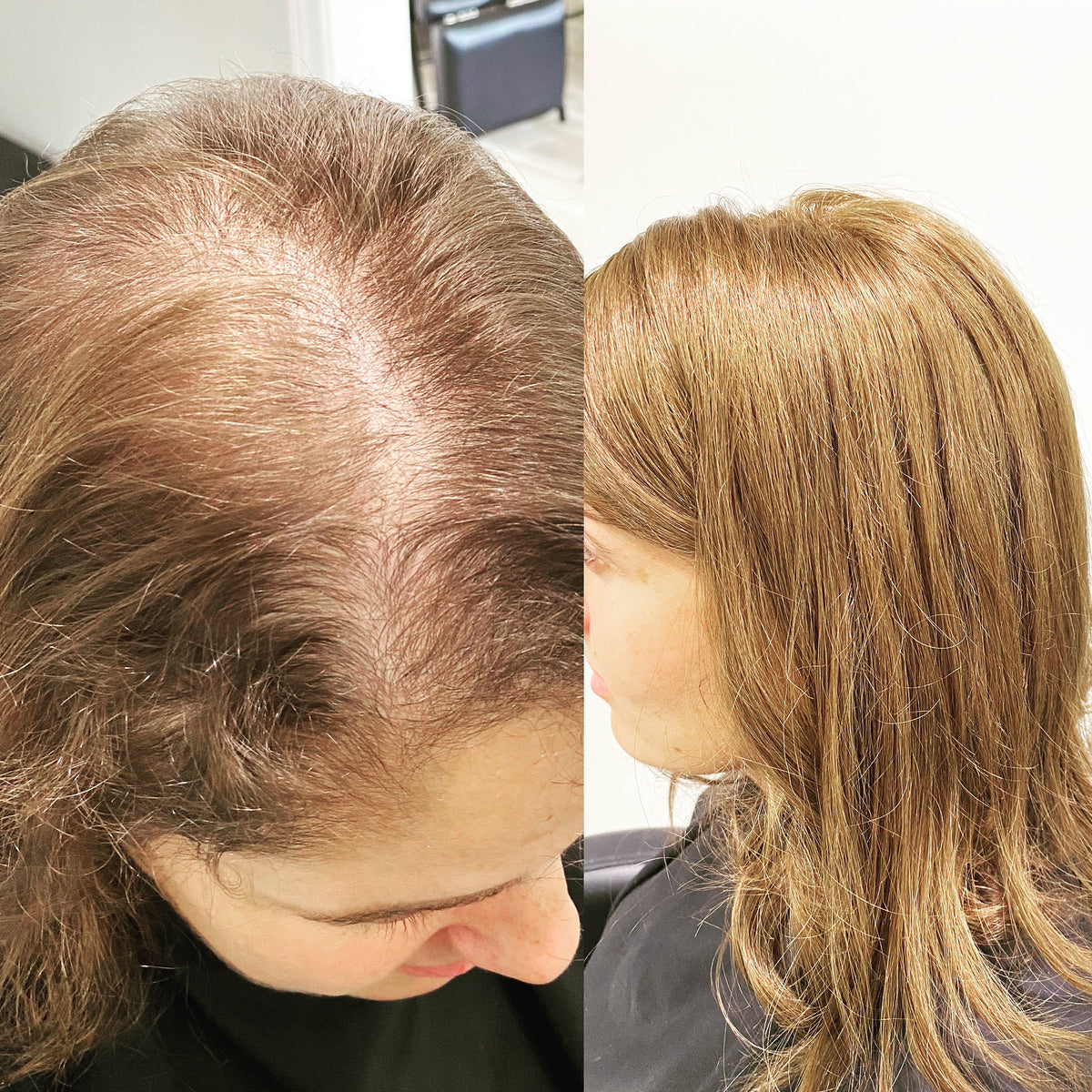


One of the Biggest Misconceptions I Hear
One of the biggest misconceptions I hear from women struggling with hair loss is:
"I think I need a cranial prosthesis."
Before I answer that question, I always ask another one.
"Tell me about your hair loss."
That usually surprises people.
They're expecting me to begin talking about wigs, toppers, insurance paperwork, or hair replacement systems.
Instead, I begin by listening.
Because a cranial prosthesis isn't one specific product.
In fact…
I don't actually sell wigs.
I design customized hair replacement solutions.
Sometimes that solution is a traditional wig.
More often, it's a customized combination of a hair topper, mesh integration, meshless integration, lightweight hair extensions, closures, or other techniques working together.
The right solution is never determined by an insurance term.
It's determined by your pattern of hair loss, the health of your remaining hair, your lifestyle, and what will help you feel like yourself again.
After more than 35 years helping women experiencing female pattern hair loss, alopecia, trichotillomania, chemotherapy-related hair loss, traction alopecia, and lichen planopilaris, I've learned that no two women lose their hair exactly the same way.
That's why I don't believe they should all receive the same solution.
Women travel to our Boston-area salon from across New England because many have been told they need a wig, when a customized solution may be more appropriate.
Quick Answer
Insurance companies often use the terms cranial prosthesis, medical wig, and hair prosthesis interchangeably for reimbursement purposes.
These terms describe an insurance benefit.
They do not describe the customized solution that may be best for you.
Depending on your hair loss pattern, a cranial prosthesis may include:
-
A customized hair topper
-
A traditional wig
-
Mesh integration
-
Meshless integration
-
A customized closure
-
Small custom fill pieces
-
Or a combination of several techniques working together
Every recommendation begins with understanding your hair—not the terminology used by your insurance company.

How I Decide Which Cranial Prosthesis Is Right for You
When a woman calls my salon asking about a cranial prosthesis, she often expects me to recommend a product.
Instead, I begin asking questions.
Not because I'm trying to make the consultation longer.
Because the answers determine everything that comes next.
The first thing I want to understand isn't what you want to wear.
It's what your hair has been through.
Did your hair loss begin suddenly after chemotherapy?
Has it slowly progressed over several years?
Are you experiencing female pattern hair loss?
Do you have alopecia areata?
Have you struggled with trichotillomania?
Has traction alopecia affected your hairline?
Are you living with lichen planopilaris or another scarring alopecia?
Each of these conditions creates different challenges.
Each deserves a different approach.
That's why I never believe in one-size-fits-all hair replacement.
Every Consultation Begins With Understanding Your Hair
Long before I recommend a topper, mesh integration, extensions, or any other solution, I evaluate your remaining hair.
Some of the things I'm looking for include:
-
how much healthy support hair remains
-
scalp visibility
-
follicle density
-
scalp sensitivity
-
hair texture
-
the stability of your hair loss
-
whether your hair can safely support additional hair
-
your maintenance preferences
-
your lifestyle
But one question is just as important as anything I observe.
I ask,
"What bothers you the most about your hair?"
Sometimes the answer surprises me.
One woman is devastated because she can no longer wear bangs.
Another misses putting her hair into a ponytail.
Someone else avoids windy days because she's worried her scalp will show.
Another simply wants to stop thinking about her hair every morning.
Hair loss affects everyone differently.
That's why I believe the emotional impact deserves just as much attention as the physical hair loss itself.
Sometimes My Favorite Recommendation Is...
One of my favorite moments during a consultation is telling someone,
"You don't need a wig."
There's often a long pause.
Then relief.
Many women assume the word cranial prosthesis automatically means they'll be wearing a traditional wig.
That's simply not true.
If enough healthy support hair remains, a customized topper may provide beautiful, natural-looking coverage.
Some women only need a small custom fill piece.
Others benefit from lightweight extensions placed strategically beneath a topper.
Many women discover their solution is actually much simpler than they expected.
Those are wonderful consultations.
Because nothing makes me happier than recommending the lightest, safest solution that will accomplish your goals.
The best consultation isn't the one where I recommend the biggest system.
It's the one where a woman leaves understanding exactly what she needs—and what she doesn't.
Hair Replacement Should Never Be About Selling More Hair
One misconception I see throughout our industry is the belief that more hair automatically creates a better result.
In my experience, the opposite is often true.
The most natural-looking hair replacement systems are rarely the heaviest.
They're the ones designed specifically for the individual.
Sometimes adding more hair actually creates more bulk, more weight, and more maintenance than necessary.
Instead, I focus on balance.
Enough coverage.
Enough density.
Enough support.
Enough movement.
Enough confidence.
Not excess.
The goal has never been to give someone the most hair possible.
The goal is to help her feel like herself again.

Every Woman's Hair Loss Story Is Different
One of the reasons I enjoy helping women experiencing hair loss is that no two consultations are ever exactly alike.
Two women may both receive paperwork from their insurance company referring to a cranial prosthesis, yet the solution I recommend may be completely different.
One woman may have recently completed chemotherapy and is waiting for her natural hair to grow back.
Another may have spent years managing female pattern hair loss.
Someone with alopecia areata may have several isolated patches of hair loss, while another woman with trichotillomania may have areas that continue to change as she works toward recovery.
Even within the same diagnosis, every head of hair tells its own story.
That's why I never believe in recommending a solution before understanding the individual sitting in front of me.
Sometimes Less Really Is More
People are often surprised when I recommend a simpler solution than they expected.
After reading online or watching videos, many women arrive convinced they need the largest or most advanced hair replacement system available.
Sometimes they don't.
If a lightweight topper will accomplish their goals beautifully, that's exactly what I recommend.
If a small custom fill piece restores confidence, there is no reason to create something larger.
If strategically placed lightweight hair extensions create the fullness they're missing, we may not need a larger hair replacement system at all.
Experience has taught me that more hair doesn't automatically create a more natural result.
The best result is usually the one that feels comfortable, looks believable, and allows a woman to forget she's even wearing it.
That's always my goal.
When A Customized Cranial Prosthesis Becomes The Better Choice
There are also women whose hair loss requires more than a traditional topper.
This is where a customized cranial prosthesis truly becomes an individualized solution rather than a single product.
Depending on the pattern of hair loss, I may combine several techniques together.
For example, a woman experiencing trichotillomania may benefit from a partial mesh integration system that stabilizes a customized topper while protecting fragile areas from continued pulling.
Someone with frontal fibrosing alopecia or lichen planopilaris may have very little support hair along the front hairline, requiring a completely different attachment strategy than someone with crown thinning.
A woman recovering from chemotherapy may want something temporary that evolves as her natural hair grows longer over the coming months.
Another client may simply want additional density beneath her topper using lightweight extensions that blend seamlessly into her own hair.
Although insurance paperwork may use one term—cranial prosthesis—the actual solution can look completely different from one woman to the next.
That's exactly how it should be.
Why I Rarely Use Just One Technique
One of the advantages of designing customized hair replacement systems is that I'm not limited to a single method.
If mesh integration provides the best support, I'll use mesh integration.
If meshless integration creates a lighter, more comfortable experience, I'll recommend that instead.
Sometimes I combine a topper with lightweight Veila Pull-Thru Hair Extensions.
Other women benefit from tiny keratin bonds, I-tip extensions, customized closures, or carefully placed fill pieces.
Occasionally, I secure only the polyurethane front edge with medical-grade tape while supporting the remainder of the system with beads or another attachment method.
Every decision has one purpose:
To create the safest, most natural-looking result while protecting the hair you still have.
I don't believe loyalty should be to a particular product or technique.
My loyalty is to the woman sitting in my consultation chair.

How I Stabilize the Front of a Customized Cranial Prosthesis
This video demonstrates one example of how I may secure the polyurethane front edge of a customized cranial prosthesis while supporting the remainder of the system using other attachment methods. Every attachment strategy is individualized based on the client's pattern of hair loss, remaining support hair, and long-term goals.
Why You'll Never Feel Pressured During A Consultation
One question I hear occasionally is,
"Am I expected to decide today?"
My answer is always the same.
No.
In fact, I often encourage women to go home and think about it.
If insurance may help cover part of your cranial prosthesis, let's explore that first.
If you need time to consider your options, take it.
If you want to talk with your family, that's important too.
Hair replacement is a very personal decision, and I don't believe anyone should feel pressured into making it before they're ready.
Over the years, I've learned something simple.
People don't regret taking time to make a thoughtful decision.
They regret feeling rushed into the wrong one.
I've built my practice over more than 35 years without hard sales tactics.
Instead, I've tried to earn trust by listening, educating, and recommending what I genuinely believe is the best solution for each individual—even if that means recommending a simpler option or asking someone to wait.
Ironically, I believe that's one of the reasons so many women return, refer their friends, and trust us with some of the most personal moments of their lives.
For me, success has never been about convincing someone to buy more.
It's about helping someone leave feeling confident that they made the right decision.
Sometimes the Best Recommendation Is to Wait
One of the biggest surprises for many women is that I don't always recommend moving forward with hair replacement immediately.
Sometimes the best recommendation is to wait.
That may sound unusual coming from someone who has spent more than 35 years helping women with hair loss, but I've learned that the right timing can be just as important as the right solution.
For example, a woman recovering from chemotherapy may still be experiencing significant regrowth. Her hair is changing month by month, and what makes sense today may be very different six months from now.
Someone beginning treatment for lichen planopilaris or another inflammatory scalp condition may benefit from stabilizing the condition before we create a long-term hair replacement plan.
A woman experiencing sudden shedding may need to speak with her dermatologist or physician first so we better understand what's causing the hair loss.
Sometimes the consultation ends with a customized hair replacement solution.
Sometimes it ends with education.
Sometimes it ends with a follow-up appointment several months later.
Every one of those outcomes can be the right decision.
Hair Loss Doesn't Always Follow a Straight Line
One thing I've learned after thousands of consultations is that hair loss is rarely predictable.
Some women experience rapid shedding after surgery, illness, or chemotherapy.
Others notice subtle thinning over many years.
Some conditions improve.
Others stabilize.
Some continue to progress despite treatment.
That's one of the reasons I avoid making promises.
Instead, I explain what I see today, discuss what may happen next, and design a plan that can adapt as your hair changes.
A customized cranial prosthesis isn't just created for where you are now.
It should also allow us to adjust as your hair grows, improves, or changes over time.
My Goal Is Never to Sell You More Hair
People occasionally ask me,
"If this is your business, why would you tell someone to wait?"
The answer is simple.
Because I have to sleep at night.
If I recommend something I don't truly believe is right for you, it doesn't matter whether you purchase it.
I know it wasn't the right decision.
I'd much rather have someone leave my consultation understanding their options than feeling pressured to make a purchase.
Sometimes the right answer is a customized cranial prosthesis.
Sometimes it's a topper.
Sometimes it's lightweight hair extensions.
Sometimes it's simply giving your hair more time.
Helping someone make the right decision has always been more important to me than making the fastest sale.
That's how I've practiced for more than 35 years.
And it's how I intend to continue.
One of My Favorite Follow-Up Visits
Some of the happiest appointments I've ever had weren't the first consultation.
They were the follow-up visits months later.
A woman comes back.
Her hair has grown.
Her confidence has returned.
She smiles and says,
"I'm so glad I waited."
Those moments remind me that success isn't measured by how quickly we begin.
It's measured by whether we chose the right path.
Sometimes the greatest gift I can give someone isn't more hair.
It's the confidence to know they don't have to rush.

A consultation photo showing Noelle talking with a client rather than demonstrating hair. The emphasis should be on conversation, trust, and education.
From My Consultation Chair
After more than thirty-five years behind the chair, I've learned something that has very little to do with hair.
Women rarely come to me because they simply want more hair.
They come because they're grieving something they've lost.
Sometimes it's confidence.
Sometimes it's the freedom to walk outside without worrying about the wind.
Sometimes it's the ability to put their hair into a ponytail again.
Sometimes it's looking in the mirror and recognizing themselves.
Hair is emotional.
It always has been.
That's why I don't begin by talking about products.
I begin by listening.
I want to understand what you've experienced.
I want to know what you've tried.
I want to hear what frustrates you.
Most importantly...
I want to understand what would make you feel like yourself again.
Because that's different for every woman.
Some women leave my consultation wearing a customized cranial prosthesis.
Others leave with a traditional topper.
Some decide to wait.
Some discover they don't need the solution they thought they needed.
Every one of those outcomes can be the right one.
The consultation isn't successful because someone purchases something.
It's successful because she understands her options and feels confident about the decision she's making.
That's always been my goal.
I often tell women,
"Go home and think about it."
Talk with your family.
Let's see what your insurance may cover.
If your hair is changing, let's give it time.
The right decision doesn't become better because it's made quickly.
It becomes better because it's made thoughtfully.
Looking back over my career, I don't believe my business grew because I had the newest techniques or the largest selection of hair.
I believe it grew because women trusted me.
That trust wasn't built through pressure.
It was built one honest conversation at a time.
When someone tells me,
"Thank you for listening."
or
"I finally understand my options."
those words mean more to me than any compliment about my work.
Hair replacement has never been about selling more hair.
For me, it's always been about helping someone feel like herself again.
If this article has helped you better understand the difference between a cranial prosthesis and a traditional wig, then I've accomplished exactly what I hoped to accomplish.
Whether you visit my salon or simply continue your search elsewhere, I hope you leave knowing one thing.
You deserve a solution designed around you.
Not around a product.
Not around an insurance term.
Not around a sales pitch.
Around your life.
Your goals.
Your comfort.
Your confidence.
That's the consultation every woman deserves.
And after thirty-five years...
I still believe it's the best way to care for people.
Frequently Asked Questions
Is a cranial prosthesis the same as a wig?
Not always. Although insurance companies often use the terms interchangeably, a cranial prosthesis may be a customized topper, mesh integration system, meshless integration, closure, lightweight hair extensions, or another personalized combination designed specifically for your pattern of hair loss.
Will my insurance cover a cranial prosthesis?
Coverage varies depending on your insurance plan and medical diagnosis. We encourage every client to contact their insurance company before their consultation so we can help you understand what documentation may be required.
Can I still style my own hair?
In many cases, yes. One advantage of customized hair replacement is that many women continue washing, blow-drying, curling, and styling their hair naturally, depending on the type of system recommended.
Can hair extensions be part of a cranial prosthesis?
Absolutely. I often incorporate lightweight extensions into customized cranial prostheses when they improve density, perimeter fullness, or overall balance while protecting the client's remaining hair.
What if I don't know which solution I need?
That's completely normal. Most women don't. The purpose of your consultation is to evaluate your hair, discuss your goals, and help you understand every appropriate option before making any recommendation.
Continue Exploring The Noelle Library
You may also enjoy these articles:
• What Happens During a Hair Loss Consultation?
• Hair Topper Before and After: Real Results for Crown Thinning
• How To Choose the Right Hair Topper for Your Hair Loss Pattern
• What Is Mesh Integration and Who Is It Best For?
• Female Pattern Hair Loss vs. Telogen Effluvium
• Can Menopause Cause Hair Loss?
• How To Choose a Hair Loss Specialist in Boston
Schedule Your Complimentary Hair Loss Consultation
If you're still wondering whether you need a traditional wig, a customized cranial prosthesis, a hair topper, mesh integration, or another solution entirely...
You don't have to figure it out alone.
Every hair loss journey is different, and that's exactly why every consultation begins with a conversation—not a recommendation.
During your complimentary Hair Loss Consultation at Noelle Salon near Boston, we'll take the time to understand your pattern of hair loss, evaluate your remaining support hair, discuss your goals, and explore every appropriate option together.
Sometimes the answer is simpler than you expected.
Sometimes it's more customized.
Either way, my goal is the same as it's always been:
To help you understand your hair before you spend money trying to fix it.
If you're ready, I'd be honored to meet you.


