



Mesh Integration For Trichotillomania: Creating Coverage, Support, And A Barrier To Pulling
Quick Answer
Mesh integration can be an excellent solution for trichotillomania because it does more than add hair. In many cases, it helps create coverage over areas of hair loss, provides support where hair is weak or missing, and can create a barrier that reduces access to the areas where pulling commonly occurs.
Many people searching for help with Trichotillomania Boston or Hair Loss Boston solutions assume they need a wig, topper, or hair extensions. In reality, every trichotillomania case is different. Some clients achieve beautiful results with a traditional topper, while others benefit from mesh integration, partial mesh integration, meshless integration, closures, or customized combinations involving hair extensions.
The right solution depends on the location of the hair loss, the amount of existing hair, the client's pulling patterns, and whether the goal is coverage, support, recovery, or all three.

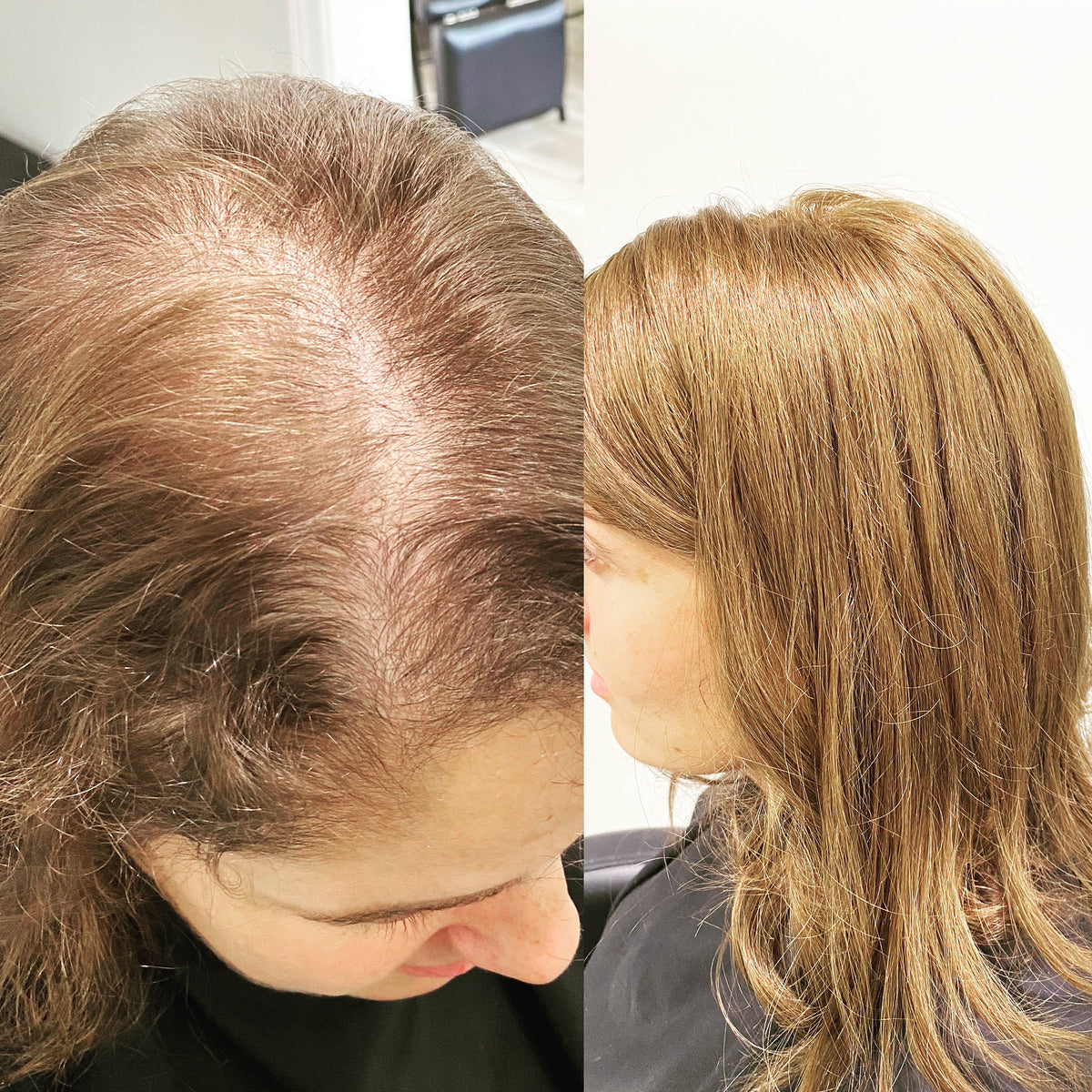
Trichotillomania hair loss transformation using customized mesh integration and hair replacement techniques.
Why Trichotillomania Is Different From Other Types Of Hair Loss
One of the most important things I explain during consultations is that trichotillomania is different from many other forms of hair loss.
Unlike female pattern hair loss or menopause-related thinning, trichotillomania often creates irregular patterns of hair loss. The location, severity, and amount of hair loss can change over time depending on where a client pulls and whether they are currently in recovery.
Many clients first begin researching solutions after noticing patchy areas, exposed scalp, widening sections, or difficulty styling their hair. Some have active pulling behaviors, while others are experiencing regrowth after months or years of recovery.
Unlike many forms of permanent hair loss, most trichotillomania clients eventually experience at least some degree of regrowth, which means the solution often needs to evolve as the hair changes.
Because the hair loss pattern can change, the solution often needs to change as well.
For a broader discussion of recovery and regrowth, see Trichotillomania Recovery: What Happens After Hair Pulling Stops?
Where Most Trichotillomania Clients Pull Hair
While every person is different, there are common areas where pulling frequently occurs.
These often include:
-
The crown
-
Cowlick areas
-
The front hairline
-
The top of the scalp
-
Isolated patches throughout the head
These areas can become particularly difficult to conceal because healthy hair may exist directly beside areas with very little or no hair.
This is where traditional topper placement sometimes becomes challenging.

Many trichotillomania clients repeatedly pull from similar areas including the crown, cowlicks, and frontal scalp.
Why A Hair Topper Is Sometimes Enough
One of the biggest misconceptions I encounter is the belief that every trichotillomania client automatically needs mesh integration.
That simply isn't true.
Many women have enough healthy support hair around the perimeter of the affected area to successfully wear a traditional topper.
A topper can often provide beautiful coverage for:
-
Smaller pulling areas
-
Early-stage hair loss
-
Areas with adequate support hair
-
Clients seeking a lightweight solution
In fact, many of the women featured in How To Choose The Right Hair Topper For Your Hair Loss Pattern achieve natural-looking coverage without mesh at all.
The goal is always to start with the lightest and simplest solution that can safely create the desired result.
When A Hair Topper Is Not Enough
There are situations where a topper alone may not provide enough stability, support, or coverage.
This often happens when:
-
Hair loss is extensive
-
Hair is missing in multiple locations
-
The client continues to pull
-
There is little support hair available
-
The hair loss pattern changes over time
In these situations, mesh integration allows me to create support where support hair does not naturally exist.
The mesh acts as a foundation that helps bridge gaps between healthy hair and areas with little or no remaining hair.
This is especially important with trichotillomania because the areas being pulled are often located directly beside healthy hair. Creating a natural transition between those areas is one of the most challenging parts of designing a successful solution.
Creating A Barrier To Pulling
One of the most unique aspects of trichotillomania work is that the goal is not always simply replacing hair.
Sometimes the goal is creating a barrier.
Many clients tell me that having direct access to certain areas makes pulling more difficult to resist. While mesh integration is not a treatment for trichotillomania, it can create a protective layer that helps reduce access to common pulling locations.
For some clients, this additional barrier becomes an important part of their recovery journey.
Why We Sometimes Create A Barrier To Pulling
One of the most difficult challenges in trichotillomania work is creating natural coverage when healthy hair exists in one area of the scalp but very little hair remains elsewhere.
This is where customized mesh integration becomes especially valuable.
If you're unfamiliar with how mesh systems work, you may also find Mesh Integration Hair Systems for Thinning Hair helpful.
Rather than simply adding hair, I often use mesh to span the gap between healthy hair and the affected area. This allows me to secure a topper, closure, extensions, or other customized pieces in a way that looks natural and remains comfortable.

Mesh integration can help bridge areas where little or no hair remains.
Why We Frequently Adjust The Strategy
One of the biggest differences between trichotillomania and many other forms of hair loss is that the solution often evolves.
Some clients experience significant regrowth.
Others continue pulling in different areas.
Some require larger coverage areas initially and less coverage later.
Because of this, I frequently modify:
-
Mesh placement
-
Coverage areas
-
Attachment methods
-
Hair density
-
Extension placement
The goal is not simply replacing hair.
The goal is adapting the solution as the client progresses through recovery.
Unlike many forms of hair loss, trichotillomania rarely follows a predictable pattern. A client may experience significant regrowth in one area while continuing to pull in another. This is why flexibility is often more important than perfection, and why I am willing to adjust the strategy at every appointment if needed.
Can Hair Extensions Be Part Of A Trichotillomania Solution?
Absolutely.
Many people are surprised to learn that Hair Extensions Boston solutions can sometimes be incorporated into trichotillomania coverage systems.
In some situations, extensions are used alongside mesh integration, closures, or toppers to:
-
Create additional coverage
-
Blend different lengths
-
Bridge gaps between healthy and affected areas
-
Improve the overall appearance of density
The goal is never simply adding more hair.
The goal is creating the most natural and comfortable solution possible while protecting the client's existing hair.
In some cases, a topper combined with strategically placed extensions creates a more natural result than either solution alone.
Trichotillomania Solution Comparison
| Situation | Topper Alone | Mesh Integration |
|---|---|---|
| Small Pulling Areas | ✓ Often Ideal | Sometimes |
| Crown Pulling | ✓ Sometimes | ✓ Often Better |
| Multiple Pulling Areas | Limited | ✓ Often Better |
| Little Support Hair | Limited | ✓ Better Support |
| Ongoing Pulling | Limited | ✓ May Create Barrier |
| Significant Patchy Hair Loss | Sometimes | ✓ Often Better |
| Recovery And Regrowth | ✓ Sometimes | ✓ Adjustable |
Founder Insight
For more than 35 years, helping people with trichotillomania has been one of the most meaningful parts of my career.
What makes this work different is that we are not simply replacing hair.
We are helping people navigate a condition that affects confidence, appearance, and often emotional well-being.
Many clients arrive feeling embarrassed, frustrated, or convinced that no solution exists.
Over the years, I have learned that flexibility is often more important than perfection. Some clients stop pulling and experience tremendous regrowth. Others continue to struggle and require adjustments along the way.
That is why I approach every trichotillomania client differently. My goal is not to sell a particular system. My goal is to create the lightest, safest, and most natural solution possible while supporting each person's individual recovery journey.
— Noelle Spinosa, Founder, Noelle Salon
Conclusion
Mesh integration can be an incredibly effective solution for trichotillomania, but its value goes far beyond adding hair.
In many cases, it helps create coverage, bridge areas with little remaining hair, provide support where needed, and create a barrier that may help reduce access to pulling areas.
Some clients need a traditional topper.
Others benefit from mesh integration, meshless integration, closures, or customized extension-supported systems.
The right solution depends on the individual, which is why a thorough consultation is always the first step.
Frequently Asked Questions
Is mesh integration good for trichotillomania?
Yes. Mesh integration is often helpful for clients with patchy hair loss, limited support hair, or areas that are difficult to cover with a traditional topper alone.
Can mesh integration stop hair pulling?
No. Mesh integration is not a treatment for trichotillomania. However, it may create a barrier that reduces access to common pulling areas.
Do all trichotillomania clients need mesh integration?
No. Many clients achieve excellent results with a traditional topper or other lightweight solutions.
Can hair grow back after trichotillomania?
In many cases, yes. Many clients experience significant regrowth once pulling stops, although results vary depending on the individual and the duration of pulling.
Can hair extensions be used for trichotillomania?
Yes. In some cases, extensions can be incorporated into customized coverage systems to help blend lengths and improve overall coverage.
Why don't all trichotillomania clients wear wigs?
Many people assume a wig is the only solution for trichotillomania hair loss. In reality, many clients achieve natural-looking results using toppers, mesh integration, meshless integration, closures, or customized extension-supported systems. The best option depends on the amount of hair loss, the location of the pulling, and the client's goals.
Schedule A Free Trichotillomania Hair Loss Consultation
If you're struggling with trichotillomania-related hair loss and are unsure whether a topper, mesh integration system, closure, meshless integration, or customized extension-supported solution is right for you, the first step is a professional evaluation.
Every trichotillomania case is different, which is why we assess hair density, scalp visibility, support capacity, pulling patterns, and recovery goals before recommending a solution.
Schedule your free Trichotillomania Hair Loss Consultation today to discuss your goals and discover which options may be right for you.


