

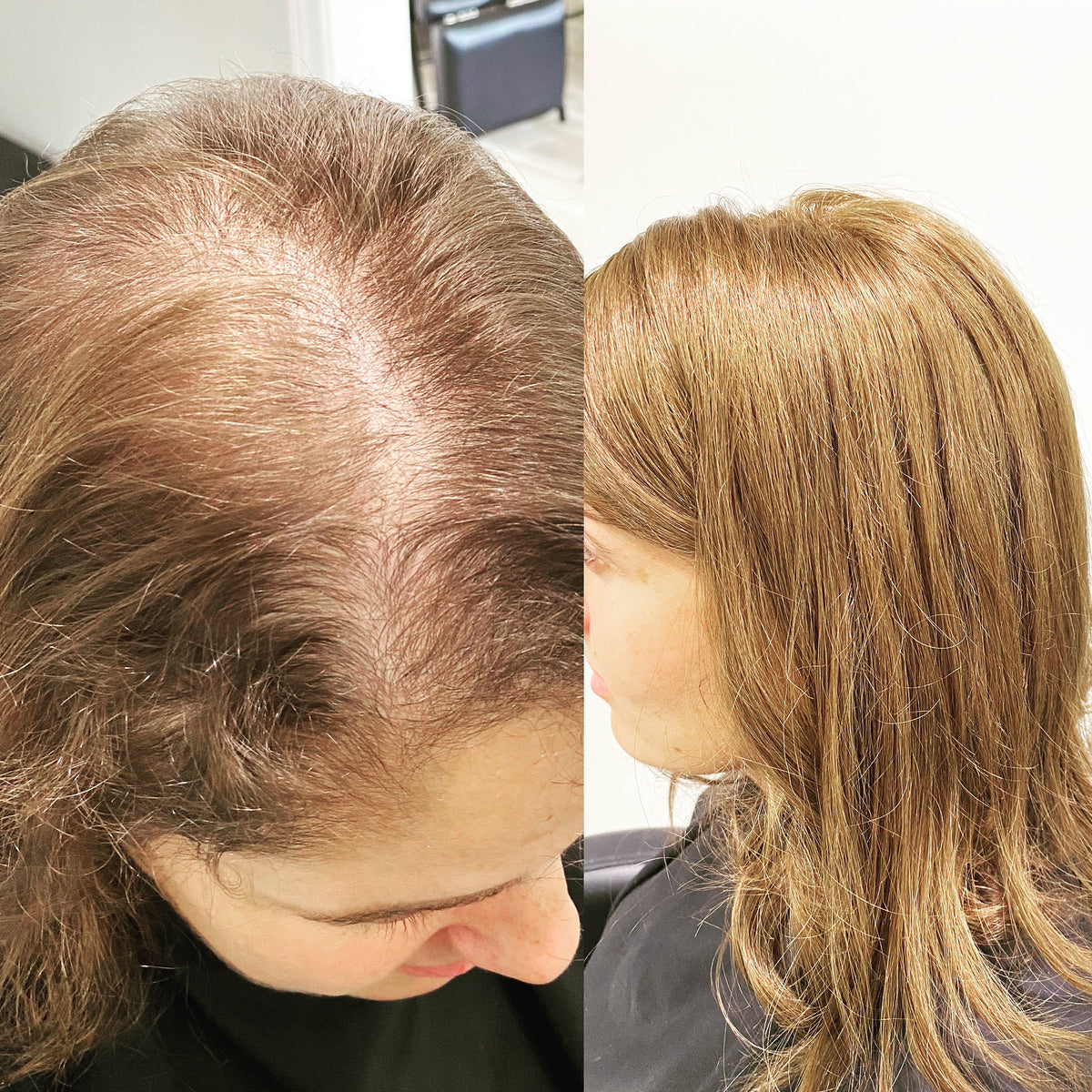


Fine Hair vs Thin Hair vs Thinning Hair vs Hair Loss: What's The Difference?
Quick Answer
Many women use the terms fine hair, thin hair, thinning hair, and hair loss interchangeably, but they are not the same thing.
Fine hair refers to the diameter of individual hair strands. Thin hair refers to overall density. Thinning hair describes a reduction in density over time, while hair loss often involves widening parts, scalp visibility, increased shedding, or specific medical conditions.
Understanding the difference is important because each situation may require a completely different solution.
Some women with fine hair are excellent candidates for hair extensions, while others experiencing thinning or hair loss may benefit more from a topper, mesh integration system, or another cranial prosthesis solution.
If you're concerned about changes in density, widening parts, scalp visibility, or shedding, our Hair Loss Boston specialists can help determine what may be happening and discuss realistic next steps.
Many women visiting our Boston hair loss clinic are surprised to learn that fine hair, thinning hair, and hair loss require very different solutions.
Why So Many Women Get Confused
One of the most common things I hear during consultations is:
"My hair is thin."
The problem is that clients often use:
-
Fine hair
-
Thin hair
-
Thinning hair
-
Hair loss
to describe completely different situations.
Some women have naturally fine strands but excellent density.
Others have normal strand thickness but are gradually losing density.
Some are experiencing active shedding.
Others are developing Female Pattern Hair Loss.
The words sound similar, but the causes and solutions can be very different.
Over the years, I've learned that one of the most valuable parts of a consultation is helping women understand exactly what they're experiencing before discussing solutions.
Fine Hair vs Thin Hair vs Thinning Hair vs Hair Loss
| Condition | What It Means | What I Typically See |
|---|---|---|
| Fine Hair | Small strand diameter | Hair feels silky and lightweight but may still have excellent density |
| Thin Hair | Lower overall density | Less hair per square inch but not necessarily active hair loss |
| Thinning Hair | Density decreasing over time | Widening part, crown visibility, weaker ponytail |
| Hair Loss | Medical or progressive loss of density | Significant scalp visibility, shedding, pattern loss, or bald patches |

Fine hair refers to strand size. Thinning hair refers to a reduction in density over time.
Fine Hair Does Not Mean You're Losing Your Hair
One of the biggest misconceptions I see is the belief that fine hair automatically means someone is experiencing hair loss.
That simply isn't true.
Many women have naturally fine strands but maintain excellent follicle density throughout their lives. When I separate the hair and evaluate the scalp, I often find dense follicle distribution, strong support capacity, and enough natural coverage to conceal extension attachment points.
These clients frequently assume they cannot wear extensions because their hair feels delicate. In reality, some women with very fine strands are among my best extension candidates.
The key is not strand diameter.
The key is density.
When follicles are closely packed together and the hair can adequately conceal attachment points, extensions can often be worn safely and naturally.
One of the easiest ways for me to distinguish fine hair from thinning hair is by looking at follicle density. A client may have extremely fine strands, but if the follicles are closely packed together and provide adequate coverage, she may still be an excellent candidate for extensions. Conversely, a client with thicker strands but significant scalp visibility may require a completely different approach.
For a deeper discussion, read Can Fine Hair Safely Wear Hair Extensions? What I Evaluate Before Saying Yes.

Fine strands do not automatically disqualify someone from wearing extensions. Density and support capacity matter far more than strand diameter alone.
When Fine Hair Becomes Thinning Hair
Thinning hair is different.
Instead of being born with fine strands, thinning hair describes a loss of density that occurs over time.
Women often tell me:
"My hair just isn't what it used to be."
They notice:
-
A widening part
-
Increased scalp visibility
-
A smaller ponytail
-
Hair that no longer grows as long
-
Less fullness around the crown
Unlike naturally fine hair, thinning hair often represents a change.
The hair may still feel soft and fine, but there is simply less of it.
This is often when women begin noticing that their ends no longer grow as long, their ponytail feels smaller, and their usual styling techniques no longer create the fullness they once did. Many also begin seeing more scalp under bright lighting or around the crown and part.

Increasing scalp visibility around the part and crown is often one of the earliest signs of thinning hair.
The 7 Things I Evaluate Before Recommending Any Hair Solution
Many clients arrive expecting me to immediately recommend extensions, a topper, or another solution.
In reality, most of the consultation is spent determining what is actually happening first.
Two women may both describe their hair as "thin," yet require completely different recommendations.
One may have naturally fine hair with excellent density.
Another may be experiencing active hair loss.
This is why evaluation always comes before solution selection.
During a consultation, I evaluate:
1. Scalp Visibility
How much scalp is showing throughout the crown, top, and part line?
2. Density
Are follicles densely packed together or becoming sparse?
3. Crown Coverage
Is the crown maintaining fullness or becoming increasingly visible?
4. Part Width
Has the part widened over time?
5. Hairline Integrity
Is there recession or density loss around the front hairline?
6. Active Shedding
Is hair currently shedding beyond what I would consider normal?
7. Support Capacity
Can the existing hair safely support extensions, or would another solution be more appropriate?
These answers determine whether someone is a candidate for extensions, a topper, mesh integration system, a cranial prosthesis, or a medical referral.
The Tug Test: One Of The Fastest Ways I Evaluate Shedding
When active shedding is suspected, I often perform a simple tug test.
A gentle pull allows me to evaluate whether excessive shedding may be occurring.
The tug test does not diagnose a medical condition. However, it can help identify whether active shedding may be contributing to density loss.
When I observe excessive shedding combined with scalp visibility, widening parts, or rapid density changes, I often recommend medical evaluation before moving forward with cosmetic solutions.
A consultation should never focus solely on how to add hair.
It should first determine why the density changed.

A tug test can help identify whether excessive shedding may be contributing to density loss.
When I Become Concerned About Hair Loss
Hair loss often presents differently than naturally fine hair.
The biggest clues are usually pattern changes rather than strand diameter.
Some common concerns include:
-
Progressive widening parts
-
Significant crown visibility
-
Active shedding
-
Sudden density changes
-
Pattern thinning
-
Patchy loss
Conditions I commonly see include:
-
Female Pattern Hair Loss
-
Telogen Effluvium
-
Alopecia Areata
-
Trichotillomania
-
Other medically related hair loss conditions
Female Pattern Hair Loss often presents as progressive density loss around the crown and part line.
Alopecia Areata frequently appears in localized patches.
Trichotillomania often creates irregular density patterns that differ from traditional hair loss conditions.
If I suspect active hair loss, I frequently recommend evaluation by a dermatologist before moving forward with cosmetic solutions.
For a deeper discussion, read Female Pattern Hair Loss vs Telogen Effluvium: How To Tell The Difference and Can Menopause Cause Hair Loss? What Women Need To Know.

Hair loss often affects density patterns, crown coverage, and support capacity long before complete baldness occurs.
Why Choosing The Wrong Solution Can Make Things Worse
One of the biggest mistakes I see is treating thinning hair or hair loss as if it were simply a volume problem.
Adding more hair is not always the answer.
Many women assume that more density, more length, and more extensions will solve the issue.
Unfortunately, adding more weight to compromised hair can sometimes create additional stress.
Heavy installations placed on fragile hair may contribute to breakage, visibility issues, and poor longevity.
This is why proper diagnosis comes before solution selection.
What 35 Years Has Taught Me
Many women believe more density and more length will solve the problem.
In reality, adding more weight to already compromised hair can make the situation worse.
Lightweight solutions often create the most natural, believable, and sustainable results.
When A Hair Topper May Be The Better Option
If significant scalp visibility exists, a lightweight topper often creates a more realistic result than traditional extensions.
Toppers can:
-
Cover scalp exposure
-
Restore density
-
Reduce styling frustration
-
Create natural-looking fullness
Many women assume they must choose between a topper and extensions.
In reality, some of my favorite transformations combine a lightweight topper with strategically placed extensions.
This allows us to restore density where it is needed most while maintaining a natural appearance and avoiding unnecessary weight.
In many cases, a lightweight topper combined with strategically placed extensions creates a more natural result than attempting to solve the problem with extensions alone.
For examples, see Hair Topper Before And After: Real Results For Crown Thinning and How To Choose The Right Hair Topper For Your Hair Loss Pattern.
When Mesh Integration Makes More Sense
For women experiencing more advanced thinning or hair loss, mesh integration can often provide superior results.
This approach may be appropriate for:
-
Female Pattern Hair Loss
-
Alopecia
-
Trichotillomania
-
Significant crown thinning
-
Diffuse density loss
Mesh integration allows us to combine toppers, closures, and additional hair while protecting fragile areas that may not tolerate traditional extension installations.
Learn more in What Is Mesh Integration And Who Is It Best For?
Video Demonstration: A Lightweight Topper Combined With Extensions
Instead of choosing only a topper or only extensions, we combined a lightweight topper with strategically placed extensions to restore density while keeping the overall result natural and comfortable.
Why Self-Diagnosing Hair Loss Can Be Difficult
One reason so many women become confused is that fine hair, thinning hair, and hair loss can initially look very similar.
A woman with naturally fine hair may assume she is losing her hair.
Another woman experiencing Female Pattern Hair Loss may assume she simply has fine hair.
This confusion often leads women toward the wrong products, the wrong online advice, and sometimes the wrong solutions.
One of the most valuable parts of a professional consultation is identifying what is actually happening before recommending how to address it.
Understanding the difference between fine hair, thinning hair, and hair loss often prevents years of frustration and unnecessary trial and error.
About The Author
Noelle Spinosa
Noelle Spinosa has spent more than 35 years helping women navigate fine hair, thinning hair, hair loss, trichotillomania, alopecia, hair toppers, mesh integration systems, and customized hair extension solutions.
Her consultation process focuses on identifying the true cause of a client's concerns before recommending a solution, helping women choose realistic options that support long-term hair health and confidence.
Conclusion
Fine hair, thin hair, thinning hair, and hair loss are often confused, but they are very different situations.
The distinction matters because the wrong diagnosis often leads to the wrong solution.
Some women with fine hair are excellent candidates for extensions.
Others may benefit more from a topper, mesh integration system, or medical evaluation.
The first step is understanding what you're actually experiencing so you can make informed decisions about your hair moving forward.
Frequently Asked Questions
Is fine hair the same as thinning hair?
No. Fine hair refers to strand diameter, while thinning hair refers to a reduction in density over time.
Can women with fine hair wear extensions?
Yes. Many women with fine hair are excellent extension candidates if they have sufficient density and support capacity.
What causes a widening part?
A widening part may indicate thinning hair, Female Pattern Hair Loss, or other density-related changes.
How do I know if I'm experiencing hair loss?
Signs may include increased shedding, scalp visibility, widening parts, crown thinning, or noticeable density changes.
Can hair extensions make thinning hair worse?
If too much weight is applied to compromised hair, extensions may contribute to additional stress or breakage.
When should I see a dermatologist?
If you notice sudden shedding, patchy loss, rapid thinning, or significant density changes, a medical evaluation is often recommended.
Schedule A Free Hair Loss Consultation
If you're unsure whether you're experiencing fine hair, thinning hair, or hair loss, the best place to start is a professional evaluation.
During your complimentary consultation, we'll evaluate:
-
Density
-
Scalp visibility
-
Crown coverage
-
Active shedding
-
Support capacity
-
Realistic solution options
Together, we'll determine whether hair extensions, a topper, mesh integration system, or another approach is the best fit for your goals.


