

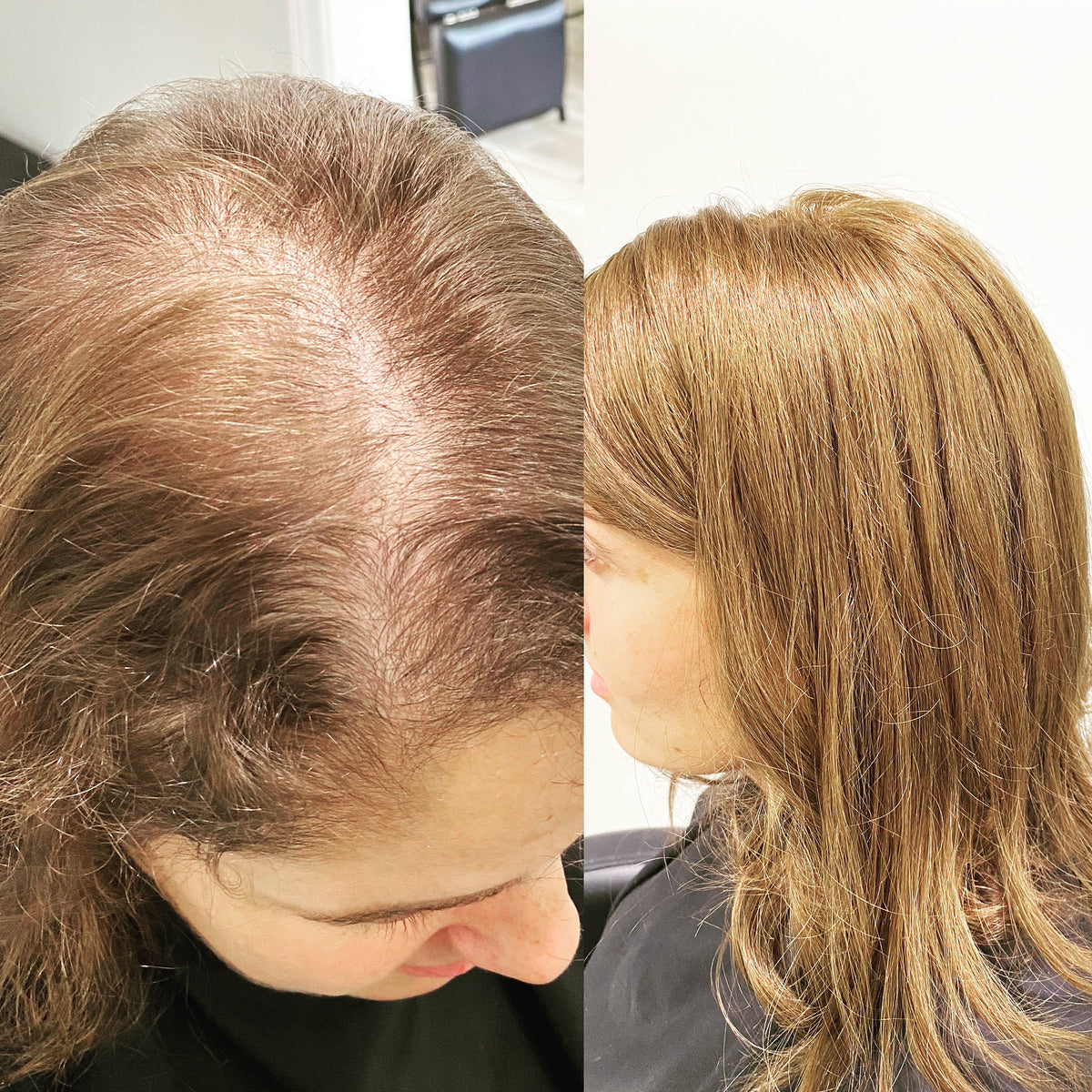


How To Choose The Right Hair Topper For Your Hair Loss Pattern

Quick Answer: What Is The Best Hair Topper?
The best hair topper depends on the location of hair loss, support hair, density, lifestyle, and attachment method. There is no single topper that works best for everyone. A woman with a widening part may need a custom patch, while someone with crown thinning, Female Pattern Hair Loss, trichotillomania, or alopecia may require a completely different solution
If you're researching solutions for thinning hair, start by exploring our Hair Loss Boston services and learning how specialists evaluate hair loss before recommending a topper, mesh integration system, extensions, or another solution.
Why There Is No Single "Best Hair Topper"
One of the most common questions I hear is:
"What is the best hair topper?"
The answer is almost always:
"It depends."
After more than 35 years helping women with hair loss, I've learned that the best topper is the one that matches the client's specific pattern of hair loss.
Hair loss is not one-size-fits-all.
Neither are hair toppers.
When I evaluate a client, I'm not looking for the most expensive topper or the most popular topper.
I'm looking for the solution that will create the most natural result while protecting the client's existing hair.
The First Thing I Evaluate During A Hair Topper Consultation
Before selecting a topper, I evaluate:
-
The reason for hair loss
-
Hair loss pattern
-
Scalp visibility
-
Density
-
Support capacity
-
Hair texture
-
Lifestyle
-
Activity level
-
Comfort preferences
-
Long-term goals
Many women visiting our Boston salon arrive expecting one solution and leave realizing a different topper design creates a more natural, comfortable, and longer-lasting result.
Sometimes they do.
Sometimes they need a custom patch.
Sometimes they need mesh integration.
Sometimes they need extensions combined with a topper.
And occasionally, I recommend medical evaluation before any cosmetic solution.
For women wondering what happens during this process, read What To Expect During A Hair Loss Consultation.
Comparison Table: Which Hair Topper Is Best For Different Hair Loss Patterns?
| Hair Loss Pattern | What I Often Recommend |
|---|---|
| Trichotillomania | Lightweight mesh topper or customized topper |
| Alopecia Areata | Customized topper or mesh integration |
| Widening Part | Small custom patch or part-line topper |
| Crown Thinning | Crown topper or patch solution |
| Female Pattern Hair Loss | Beaded topper, meshless integration, or customized topper |
| Advanced Hair Loss | Larger base topper, mesh integration, or combination solution |
| Clients Seeking Length | Topper combined with extensions |
One of the biggest misconceptions is that there is a single "best" hair topper. In reality, the best solution depends on the pattern of hair loss, support capacity, density, lifestyle, and long-term goals. This table reflects common recommendations, but every consultation is individualized.
Why Many Women Choose The Wrong Hair Topper Online
One of the biggest mistakes I see is women purchasing a topper online and expecting it to blend seamlessly with their natural hair.
Even the highest-quality topper typically requires:
-
Cutting
-
Blending
-
Density adjustments
-
Color refinement
-
Proper attachment
Another common mistake is purchasing a topper that is too large.
Many women only need coverage for:
-
A widening part
-
Crown thinning
-
Hairline recession
-
Small trichotillomania areas
A large topper often creates blending issues and may feel heavier than necessary.
Quality also matters.
Many gray and silver toppers sold online contain synthetic fibers mixed with human hair. These often look artificial and rarely blend naturally with existing gray hair.
This is why choosing a topper often requires an experienced eye.

Comparing topper sizes, densities, and bases helps determine the most natural solution for each client.
Why A Small Custom Patch May Be Better Than A Full Hair Topper
Many women assume they need a full topper when they actually need a much smaller solution.
Examples include:
-
Widening parts
-
Crown thinning
-
Hairline recession
-
Small trichotillomania patches
-
Isolated alopecia patches
Custom patches can be designed specifically for the size and shape of the affected area.
Sometimes a small patch creates the most natural result because it adds only the hair that is missing.
If you are noticing increased scalp visibility along your part line, read Why Is My Part Getting Wider?

Custom hair patches can provide targeted coverage without the size and weight of a full topper.
Choosing A Hair Topper For Trichotillomania
Trichotillomania is our most common hair loss service.
One of the unique aspects of trichotillomania is that most clients still have healthy hair elsewhere on the scalp.
The challenge is matching density naturally.
The top of the head is generally less dense than the sides and back.
When creating a topper for trichotillomania, I pay close attention to density because overly thick toppers can look unnatural.
For clients with thicker surrounding hair, specialized attachment methods may sometimes provide additional support and stability. Fully mesh toppers are often among the lightest and most breathable options available. Women interested in these approaches can learn more in our What Is Mesh Integration And Who Is It Best For? guide.
To see real examples, read Trichotillomania Client Transformations And Recovery Stories.

Natural density matching is one of the most important factors when designing a topper for trichotillomania.
This partial mesh integration application demonstrates how a customized topper can be attached while utilizing stronger surrounding hair for support.
Choosing A Hair Topper For Female Pattern Hair Loss
Whenever possible, I prefer a traditional beaded topper system because it is one of the gentlest attachment methods available.
Unlike mesh integration or meshless integration systems, traditional beaded systems do not require sewing.
For women with adequate support hair, this can be an excellent option.
In other situations, meshless integration may provide better support.
Every recommendation depends on:
-
Density
-
Support capacity
-
Comfort
-
Lifestyle
For a deeper understanding of progression, read Female Hair Loss Stages: What Women Actually Notice Over Time.

Support capacity and density often determine which topper system will work best for Female Pattern Hair Loss.
Women who are still trying to determine the cause of their thinning may also find Female Pattern Hair Loss vs Telogen Effluvium: How To Tell The Difference helpful.
Choosing A Hair Topper For Alopecia Areata
Many alopecia areata clients require a similar approach to trichotillomania clients.
Because hair loss often occurs in patches, healthy surrounding hair may still be available for support.
Depending on the pattern and location of hair loss, I may recommend:
-
A custom topper
-
A small patch
-
An integration based solution
-
A combination solution

Alopecia Areata often requires customized sizing and placement based on the specific areas affected.
Choosing A Hair Topper For Crown Thinning
Crown thinning is one of the most common reasons women seek hair toppers.
The crown is difficult to disguise because scalp visibility becomes obvious under bright lighting and in photographs.
Many clients initially request hair extensions, but extensions alone rarely solve crown thinning because extensions need natural hair to conceal the attachment points.
This is one of the most common situations where I explain that even the smallest extension attachments still need hair to conceal them, while a topper is specifically designed to address thinning on the top of the head.
For real examples, see Hair Topper Before And After: Real Results For Crown Thinning And Hair Loss.

Crown thinning is often one of the easiest hair loss patterns to improve with a properly fitted topper.
Choosing A Hair Topper For Advanced Hair Loss
Advanced hair loss often requires larger bases and more customization.
Some clients want a realistic scalp part. In these situations, I may recommend larger customized topper designs that combine different base materials to create a natural-looking scalp while maintaining comfort and support.

Advanced hair loss often requires larger topper bases and customized attachment strategies.
Why Attachment Matters More Than Most Women Realize
Many women focus entirely on the topper itself.
In reality, the attachment method often determines:
-
Comfort
-
Security
-
Longevity
-
Scalp health
-
Hair preservation
| Attachment Type | Often Best For |
|---|---|
| Clip-In Topper | Occasional wear |
| Beaded Topper | Most topper clients |
| Meshless Integration | Stronger support hair |
| Mesh Integration | Advanced customization |
| Topper + Extensions | Coverage and length |

The foundation and attachment system often determine long-term comfort and success.
Why We Stock Hair Toppers In Different Colors, Densities, And Base Sizes
One advantage of working with a hair loss specialist rather than purchasing online is the ability to compare different options in person.
Clients can:
-
See them
-
Touch them
-
Compare densities
-
Compare base sizes
-
Evaluate color matches
-
Explore same-day possibilities
Many women discover they need a completely different topper than they originally expected. They are surprised to learn that density can be just as important as color. A topper that is too dense often looks less natural than a topper with the perfect color match.
This is especially true for:
-
Gray hair
-
Fine hair
-
Diffuse thinning
-
Trichotillomania
-
Alopecia
Choosing A Hair Topper For Gray, Silver, And White Hair
Gray hair can be one of the most difficult colors to match naturally.
Many gray toppers sold online contain synthetic fibers that rarely blend well.
When necessary, I may:
-
Special order a topper
-
Customize with gentle toning
-
Adjust density
-
Create custom color blends
I generally avoid permanent coloring of toppers whenever possible.
When needed, I prefer gentle toning adjustments rather than aggressive coloring because preserving the integrity of the hair is always the priority.
The goal is to match:
-
Color
-
Texture
-
Density
-
Movement
Women experiencing menopause-related thinning may also find our article Menopausal Hair Loss Before And After: Real Solutions For Thinning Hair Over 50 helpful.

Gray hair toppers require careful color and density matching to blend naturally.
Who May Not Be A Good Hair Topper Candidate?
Sometimes the best recommendation is not a topper.
Examples include:
-
Active shedding
-
Undiagnosed hair loss
-
Medical evaluation needed
-
Frequent swimmers
-
Clients extremely sensitive to heat
A topper should fit both the hair loss pattern and the client's lifestyle.
Founder Insight
One of the biggest misconceptions I see is that the best hair topper is a specific brand. After more than 35 years helping women with trichotillomania, alopecia, Female Pattern Hair Loss, and thinning hair, I've learned that the attachment method, density, and customization often matter far more than the topper itself.
— Noelle, Founder, Noelle Salon
Conclusion
The best hair topper is not a specific brand.
The best hair topper is the one that matches your hair loss pattern, support hair, density, lifestyle, comfort preferences, and long-term goals.
A topper that works beautifully for trichotillomania may not be appropriate for Female Pattern Hair Loss, alopecia areata, crown thinning, or advanced hair loss.
The goal is not simply adding hair.
The goal is creating a natural-looking result while protecting the hair you still have.
For women comparing solutions, read Hair Topper vs Hair Extensions For Thinning Hair: Which Solution Is Right For You?
Schedule A Hair Loss Consultation In Boston
If you're experiencing:
-
Trichotillomania
-
Female Pattern Hair Loss
-
Alopecia
-
Crown thinning
-
A widening part
-
General thinning hair
we're here to help.
During your consultation we'll evaluate your hair loss pattern, support capacity, density, scalp visibility, lifestyle, and goals to determine the most appropriate solution.
Schedule Your Free Hair Loss Consultation
About The Author
Noelle, Founder Of Noelle Salon
For more than 35 years, Noelle has helped women navigate hair loss, trichotillomania, alopecia, menopause-related thinning, and non-surgical hair replacement solutions.
Her expertise includes:
-
Hair toppers
-
Custom patches
-
Mesh integration systems
-
Meshless integration
-
Hair extensions for thinning hair
-
Advanced hair loss consultations
Frequently Asked Questions
What Is The Best Hair Topper?
The best hair topper depends on your hair loss pattern, density, support hair, lifestyle, and attachment method.
Is A Hair Topper Better Than Hair Extensions?
For crown thinning and scalp visibility, a topper is usually more effective. Extensions may be added for length and fullness.
Can A Hair Topper Help Trichotillomania?
Yes. Hair toppers are one of the most common solutions we use for trichotillomania clients.
Can A Hair Topper Be Customized?
Absolutely. Most toppers require cutting, blending, density adjustments, and attachment customization.
What If I Only Have A Widening Part?
A custom patch may provide a more natural solution than a full topper.
Are Gray Hair Toppers Difficult To Match?
Yes. Gray hair often requires special consideration for color, density, texture, and movement.
What Happens During A Hair Topper Consultation?
We evaluate your hair loss pattern, support capacity, density, scalp visibility, lifestyle, and goals before recommending a solution.


