



Why Fine Hair Breaks More Easily Than Thick Hair (And Why Density Matters More Than Most Women Realize)

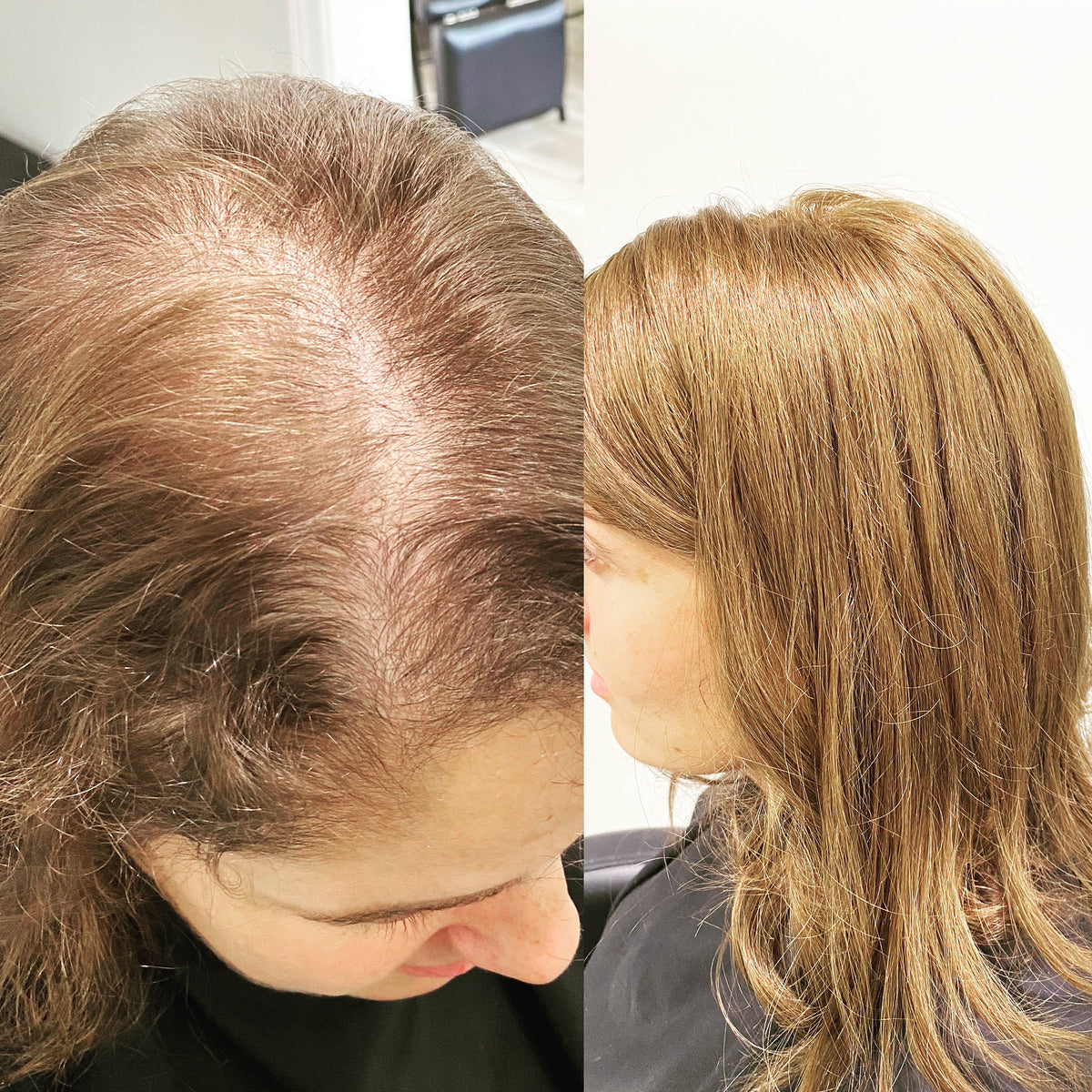
Fine hair compared to thick hair showing differences in density, strand structure, and vulnerability to breakage
Quick Answer
Yes, fine hair generally breaks more easily than thick hair because each individual strand has a smaller diameter and less structural strength. However, one of the biggest misconceptions I see after more than 35 years in the industry is that fine hair and thinning hair are not the same thing.
Many women with fine hair have excellent density and healthy hair follicles. Others may have thicker strands but significantly fewer follicles, making their hair more vulnerable to visible scalp exposure and hair loss.
When women visit our salon seeking help with Hair Loss Boston concerns, one of the first things I evaluate is whether they are experiencing naturally fine hair, hair breakage, temporary shedding, or true hair loss. Understanding the difference is critical because each situation requires a very different solution.
Why Fine Hair Is Naturally More Fragile
Hair diameter varies from person to person.
Women with fine hair are born with strands that are smaller in diameter than medium or coarse hair. Because each strand contains less structural mass, it generally has less resistance to heat, chemical processing, tension, and daily wear and tear.
This does not automatically mean fine hair is unhealthy.
In fact, many women with fine hair have beautiful, healthy hair with excellent density and strong support capacity.
The challenge is that damage tends to become visible much faster because there is simply less strand thickness available to absorb stress.
Fine Hair And Thinning Hair Are Not The Same Thing
One of the most common misunderstandings I encounter during consultations is the belief that fine hair automatically means thinning hair.
It doesn't.
Many clients use the words interchangeably, but they describe two very different situations.
| Fine Hair | Thinning Hair |
|---|---|
| Smaller strand diameter | Reduced follicle density |
| Often genetic | Often develops over time |
| May still have excellent density | Usually shows increased scalp visibility |
| Can often support extensions | May require hair loss solutions |
| Usually present throughout life | Often associated with shedding or hair loss |
Women with fine hair may have thousands of healthy follicles producing hair.
Women experiencing thinning hair typically have fewer actively growing hairs, making the scalp increasingly visible over time.

Density often matters more than strand thickness when evaluating long-term hair health and support capacity.
Why Density Matters More Than Most Women Realize
This is where many women become confused.
A woman with fine hair may actually be a better candidate for hair extensions than someone with thicker strands.
Why?
Because density matters.
During consultations, I evaluate how many healthy follicles are actively producing hair, not simply how thick each individual strand feels.
I often see women with very fine hair who have excellent density and strong support capacity.
On the other hand, I may see women with thicker strands who have significant scalp visibility, widening parts, or reduced follicle density.
In many cases, more strands win over thicker strands.
This becomes particularly important when evaluating candidates for Hair Extensions Boston .
For a deeper explanation of how I evaluate extension candidates, read Can Fine Hair Safely Wear Hair Extensions? What I Evaluate Before Saying Yes.

Ponytail size often reveals more about overall density than strand thickness alone.
Signs You May Be Experiencing Hair Thinning Rather Than Fine Hair
Fine hair usually remains relatively consistent throughout life.
Hair thinning tends to develop gradually.
Many women tell me, "I've always had fine hair." Then they show me photos from five or ten years ago and we discover the real issue isn't fine hair at all—it's that they have less hair than they used to. That's often the first clue that we're dealing with thinning rather than naturally fine hair.
Some common signs include:
- A widening part
- Increased scalp visibility
- A smaller ponytail circumference
- Hair that no longer grows to its previous length
- Increased shedding
- Reduced density around the crown
If you have noticed a widening part, you may also want to read Why Is My Part Getting Wider? 7 Common Causes Of A Widening Hair Part In Women.
Why Fine Hair Is More Vulnerable To Chemical Damage
Fine hair typically has less structural margin for error.
Repeated bleaching, aggressive highlighting, excessive chemical services, and improper color maintenance can create significant breakage over time.
Because the strands are smaller, damage often becomes visible sooner than it does in thicker hair types.
Many of the correction cases I see involve women who have undergone years of lightening services without recognizing how much cumulative stress their fine hair has experienced.

Fine hair often has less margin for error when repeatedly exposed to bleaching and chemical services.
Why Fine Hair Is More Vulnerable To Mechanical Damage
Not all breakage comes from color services.
Some of the most significant damage I see comes from:
- Tight hairstyles
- Heavy braids
- Excessive tension
- Improper extension applications
- Overuse of hot tools
Because fine hair strands are more delicate, repeated tension can gradually weaken the hair shaft and contribute to breakage.
Not all hair damage begins with a medical condition. Over the years, I have seen many women with fine hair experience breakage and thinning from excessive tension, heavy braids, or hairstyles that place constant stress on already fragile strands.
Breakage, Shedding, And Hair Loss Require Different Solutions
Another mistake I frequently see is assuming all hair problems are the same.
They aren't.
Breakage means the hair shaft is physically snapping.
Shedding means hairs are releasing from the follicle.
Hair loss typically involves changes in follicle activity, density, or growth cycles.
When clients come in concerned about hair loss, one of the first things I do is determine which of these processes is actually occurring.
If I observe excessive shedding during a tug test or signs of progressive thinning, I often recommend medical evaluation before proceeding with cosmetic solutions.
For a detailed comparison, read Female Pattern Hair Loss vs Telogen Effluvium: How To Tell The Difference.

Breakage and hair loss are often confused, but they require very different treatment approaches.
Can Women With Fine Hair Wear Hair Extensions?
Absolutely.
Many of my best extension candidates have fine hair.
The key is evaluating:
- Density
- Support capacity
- Scalp visibility
- Hair health
- Placement strategy
Fine hair does not automatically eliminate someone from consideration.
What matters is whether the follicles can safely support the additional hair.
This is where many consultations go wrong. Women often assume they need more hair, longer hair, or heavier extensions to create fullness. In reality, adding too much weight to fragile hair can create additional stress. My goal is always to determine the lightest solution that creates the most natural result while preserving the integrity of the client's hair.
This is one reason why I often customize extension strategies differently for fine hair clients than I would for someone with coarse or dense hair.
For women experiencing true hair loss rather than naturally fine hair, a hair topper, mesh integration system, or cranial prosthesis may be more appropriate. If you're trying to decide between different non-surgical solutions, Hair Topper vs Hair Extensions For Thinning Hair: Which Solution Is Right For You? explains how I help women choose the right option based on their level of thinning.
Women experiencing significant scalp visibility or advanced thinning may also benefit from reading What Is Mesh Integration And Who Is It Best For? or How To Choose The Right Hair Topper For Your Hair Loss Pattern, both of which explain alternatives that often create better coverage than traditional extensions alone.
Founder Insight: What 35 Years Has Taught Me About Fine Hair
After more than 35 years working with fine hair, thinning hair, alopecia, trichotillomania, and hair loss clients, I've learned that most women focus on the wrong thing.
They focus on strand thickness.
I focus on density.
The healthiest extension candidates are not always the women with the thickest hair.
Many women with fine hair have excellent support capacity because they have strong follicle density.
Likewise, many women with thicker strands struggle because they have significant thinning and reduced scalp coverage.
Understanding the difference allows us to choose safer, more natural-looking solutions that preserve the integrity of the hair over time.
— Noelle Spinosa
Founder, Noelle Salon
Conclusion
Fine hair breaks more easily than thick hair because each strand has a smaller diameter and less structural strength. However, strand thickness alone does not determine hair health, extension candidacy, or long-term outcomes.
In many cases, density matters far more than thickness.
Understanding whether you have naturally fine hair, thinning hair, breakage, shedding, or a developing hair loss condition is often the first step toward finding the right solution.
The good news is that fine hair can often be protected, strengthened, and successfully enhanced when the correct strategy is used.
Frequently Asked Questions
Does fine hair always break more easily than thick hair?
Generally yes. Fine hair strands have a smaller diameter and less structural strength, making them more vulnerable to heat, chemical processing, and tension.
Is fine hair the same as thinning hair?
No. Fine hair refers to strand diameter. Thinning hair refers to reduced follicle density and scalp coverage.
Can women with fine hair wear hair extensions?
Many can. Density, support capacity, and scalp visibility are often more important than strand thickness alone.
Why does my fine hair seem to break so easily?
Common causes include excessive heat styling, bleaching, tight hairstyles, tension, and over-processing.
How do I know if I have hair loss or just fine hair?
Signs such as increased shedding, scalp visibility, widening parts, and reduced ponytail size may indicate hair loss rather than naturally fine hair.
Should I see a dermatologist if my hair is thinning?
If you notice significant shedding, rapid density changes, or progressive thinning, a medical evaluation can help determine whether an underlying condition is contributing to hair loss.
Call To Action
If you're unsure whether you're dealing with fine hair, thinning hair, breakage, or hair loss, a professional evaluation can help you understand what's really happening.
At Noelle Salon, we evaluate density, support capacity, scalp visibility, shedding patterns, and overall hair health to help determine the safest and most effective path forward.
Whether the answer is hair extensions, a hair topper, mesh integration, or simply protecting the hair you already have, the right solution starts with an accurate diagnosis of the problem.
Schedule a Hair Loss Consultation to discover which options may be right for you.


